Uncommon Descent Serving The Intelligent Design Community

The highly engineered transition to vertebrates: an example of functional information analysis

Categories
Information
Intelligent Design
Share
Facebook
Twitter/X
LinkedIn
Flipboard
Print
Email

In the recent thread “That’s gotta hurt” Bill Cole states:

I think over the next few years 3 other origins (my note: together with OOL), will start to be recognized as equally hard to explain:

  • The origin of eukaryotic cell: difficult to explain the origin of the spliceosome, the nuclear pore complex and chromosome structure.
  • The origin of multicellular life: difficult to explain the origin of the ability to build complex body plans.
  • The origin of man: difficult to explain the origin of language and complex thought.

That thought is perfectly correct. There are, in natural history, a few fundamental transitions which scream design more that anything else. I want to be clear: I stick to my often expressed opinion that each single new complex protein is enough to infer design. But it is equally true that some crucial points in the devlopment of life on earth certainly stand out as major engineering events. So, let’s sum up a few of them:

  1. OOL
  2. The prokaryote – eukaryote transition (IOWs, eukaryogenesis)
  3. The origin of metazoa (multicellular life)
  4. The diversification of the basic phyla and body planes (IOWs, the Cambrian explosion)

Well, to those 4 examples, I would like to add the diversification of all major clades and subphyla.

Of course, another fundamental transition is the one to homo sapiens, but I will not deal with it here: I fully agree with Bill Cole that it is an amazing event under all points of view, but it is also true that it presents some very specific problems, which make it a little bit different from all the other transitions we have considered above.

I will state now in advance the point that I am trying to make here: each of the transitions described requires tons and tons of new, original, highly specific functional information. Therefore, each of those transitions commands an extremely strong inference to design. I will deal in particular with the transition to the subphylum of vertebrates, for a series of reasons: being vertebrates, we are naturally specially interested in that transition; there are a lot of fully sequenced genomes and proteomes of vertebrate species ;  and a lot is known about vertebrate biology. IOWs, we have a lot of data that can help us in our reasoning. So, I will  try to fix a few basic points which will be the foundation of our analysis:

  • a) The basic phylum is Chordates, which are characterized by the presence of a notochord. Chordates include three different clades: Craniata, Tunicata, Cephalochordata.
  • b) Vertebrates are a subphylum of the phylum Chordates, and in particular of the clade Craniata. They represent the vast majority of Chordates, with  about 64,000 species described. As the name suggests, they are characterized by the presence of a vertebral column, either cartilaginous or bony, which replaces the notochord.
  • c) The phylum Chordate, like other phyla, can be traced at least to the Cambrian explosion (540 million years ago).
  • d) Chordates which are not vertebrates are quite rare today. They include:
    • 1) Craniata: the only craniates which are not vertebrates are in the class Myxini (hagfish), whose classification however remains somewhat controversial. All other craniates are vertebrates.
    • 2) Tunicata (or urochordata): about 3000 species, the best known and studied is Ciona intestinalis.
    • 3) Cephalochordata: about 30 species of Lancelets.
  • e) The phyla most closely related to Chordates are Hemichordates (like the Acorn worm) and Echinoderms (Starfish, Sea urchins, Sea cucumbers).
  • f) Vertebrates can be divided into the following two groups:
    • 1) Fishes: 3 Classes:
      • 1a) Jawless  (lampreys)
      • 1b)  Cartilaginous (sharks, rays, chimaeras)
      • 1c) Bony fish
    • 2) Tetrapods: all the rest (frogs, snakes, birds, mammals)

For the following analysis, I will consider vertebrates versus everything which preceded them (all metazoa, including “pre-chordates” (Hemichordates and Echinoderms) and “early chordates”  (Tunicata and Cephalochordata). So, everything which is new in vertebrates had to appear in the window between early chordates and the first vertebrates: cartilaginous fish and bony fish (I will not refer to lampreys, because the data are rather scarce). So, let’s try to define the temporal window, for what it is possible:

  • Chordates are already present at the Cambrian explosion, 540 my ago.
  • Jawless fish appeared slightly later (about 530 my ago), but they are mostly extinct.
  • The split of jawless fish into cartilaginous fish and bony fish can be traced about at 450 my ago

Therefore, with all the caution that is required, we can say that the information which can be found in both cartilaginous fish and bony fish, but not in non vertebrates (including early chordates), must have been generated in a window of less that 100 my, say between 540 my ago and 450 my ago. Now, my point is very simple: we can safely state that in that window of less than 100 million years a lot of new complex functional information was generated. Really a lot. To begin our reasoning, we can say that vertebrates are characterized by the remarkable development of two major relational systems:

  1. The adaptive immune system, which appears for the first time exactly in vertebrates.
  2. The nervous system, which is obviously well represented in all metazoa, but certainly reaches new important adaptations in vertebrates.

Much can be said about the adaptive immune system, and that will probably be the object of a future OP. For the moment, however, I will discuss some aspects linked to the development of the nervous system. The only point that is important here is that the nervous system of vertebrates undergoes many important modifications, especially a process of encephalization.  My interest is mainly in the developmental controls that are involved in the realization of the new body plans and structures linked to those processes. Of course, we don’t understand how those regulations are achieved. But today we know much about some molecules, especially regulatory proteins, which have an important role in the embryonal development of the vertebrate nervous system, and in particular in the development and migration of neurons, which is obviously the foundation for the achievement of the final structure and function of the nervous system. So, I will link here a recent paper which deals with some important knowledge about the process of neuron migration. I invite all those interested to read it carefully: Sticky situations: recent advances in control of cell adhesion during neuronal migration by David J. Solecki Here is the abstract:

The migration of neurons along glial fibers from a germinal zone (GZ) to their final laminar positions is essential for morphogenesis of the developing brain, aberrations in this process are linked to profound neurodevelopmental and cognitive disorders. During this critical morphogenic movement, neurons must navigate complex migration paths, propelling their cell bodies through the dense cellular environment of the developing nervous system to their final destinations. It is not understood how neurons can successfully migrate along their glial guides through the myriad processes and cell bodies of neighboring neurons. Although much progress has been made in understanding the substrates (14), guidance mechanisms (57), cytoskeletal elements (810), and post-translational modifications (1113) required for neuronal migration, we have yet to elucidate how neurons regulate their cellular interactions and adhesive specificity to follow the appropriate migratory pathways. Here I will examine recent developments in our understanding of the mechanisms controlling neuronal cell adhesion and how these mechanisms interact with crucial neurodevelopmental events, such as GZ exit, migration pathway selection, multipolar-to-radial transition, and final lamination.

In brief, the author reviews what is known about the process of neuronal cell adhesion and migration. Starting from that paper and some other material, I have chosen a group of six regulatory proteins which seem to have an important role in the above process. They are rather long and complex proteins, particularly good for an information analysis. Here is the list. I give first the name of the protein, and then the length and accession number in Uniprot for the human protein:

  • Astrotactin 1,     1302 AAs,     O14525
  • Astrotactin 2,    1339 AAs,     O75129
  • BRNP1 (BMP/retinoic acid-inducible neural-specific protein 1),     761 AAs,     O60477
  • Cadherin 2 (CADH2),      906 AAs,    P19022
  • Integrin alpha-V,    1048 AAs,      P06756
  • Neural cell adhesion molecule 1 (NCAM1),   858 AAs,  P13591

This is a  very interesting bunch of molecules:

  • Astrotactin 1 and 2 are two partially related perforin-like proteins. ASTN-1 is a membrane protein which is directly responsible for the formation of neuron–glial fibre contacts. ASTN2 is not a neuron-glial adhesion molecule, but it functions in cerebellar granule neuron (CGN)-glial junction formation by forming a complex with ASTN1 to regulate ASTN1 cell surface recruitment. More about these very interesting proteins can be found in the following paper:

Structure of astrotactin-2: a conserved vertebrate-specific and perforin-like membrane protein involved in neuronal development by Tao Ni, Karl Harlos, and Robert Gilbert

  • BRNP1 is another  protein which functions in neural cell migration and guidance
  • Cadherin 2, or N-cadherin, is active in many neuronal funtions and in other tissues, and seems to have a crucial role in glial-guided migration of neurons
  • Integrin alpha-V, or Vitronectin receptor, is one of the 18 alpha subunits of integrins in mammals. Integrins are transmembrane receptors that are the bridges for cell-cell and cell-extracellular matrix (ECM) interactions.
  • NCAM1 is a cell adhesion molecule involved in neuron-neuron adhesion, neurite fasciculation, outgrowth of neurites

Now, why have I chosen these six proteins, and what do they have in common? They have two important things in common:

  • They are all big regulatory proteins, and they are all involved in a similar regulatory network which controls endocytosis, cell adhesion and cell migration in neurons, and therefore is in part responsible for the correct development of the vertebrate nervous system
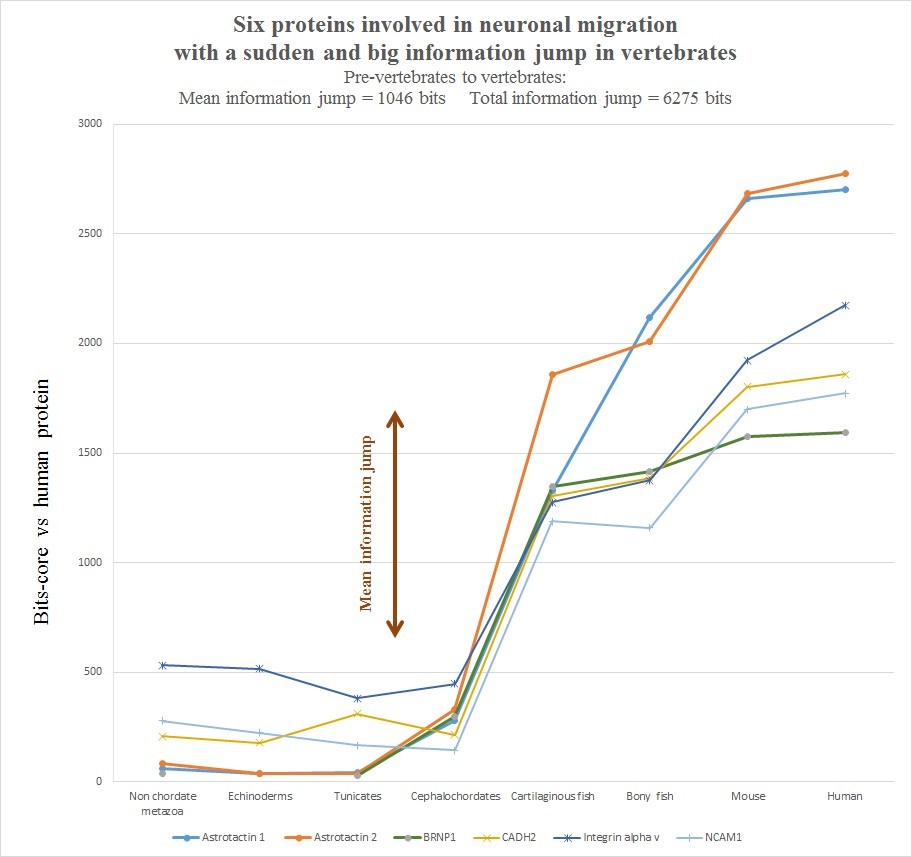
  • All those six proteins present a very big informarion jump between pre-vertebrate organisms and the first vertebrates

The evolutionary history of those six protein is summarized in the following graph, realized as usual by computing the best homology bit score with the human protein in different groups of organisms.
Neuron_migration

Very briefly, all the six human molecules have low homology with pre-vertebrates, while they already show a very high homology  in cartilaginous fishes. The most striking example is probably Astrotactin 2, which presents the biggest jump from cephalochordata (329 bits) to cartilaginous fishes (1860 bits), for a great total of 1531 bits of jump! The range of individual jumps in the group is 745 – 1531 bits, with a mean jump of 1046 bits per molecule and a total jump of 6275 bits for all six molecules. The jump has always been computed as the difference between the best bit score in cartilaginous fishes and the best bitscore in all pre-vertebrate metazoa. We can also observe that the first three proteins have really low homology with everything up to tunicates, but show a definite increase in Cephalochordata, which precedes the big jump in cartilaginous fishes, while the other three molecules have a rather constant behaviour in all pre-vertebrate metazoa, with a few hundred bits of homology, before “jumping” up in sharks. One could ask: is that a common behaviour of all proteins? The answer is no. Look at the following graph, which shows the same evolutionary history for two other proteins, both of them very big regulatory proteins, both of them implied in the same processes as the previous six.
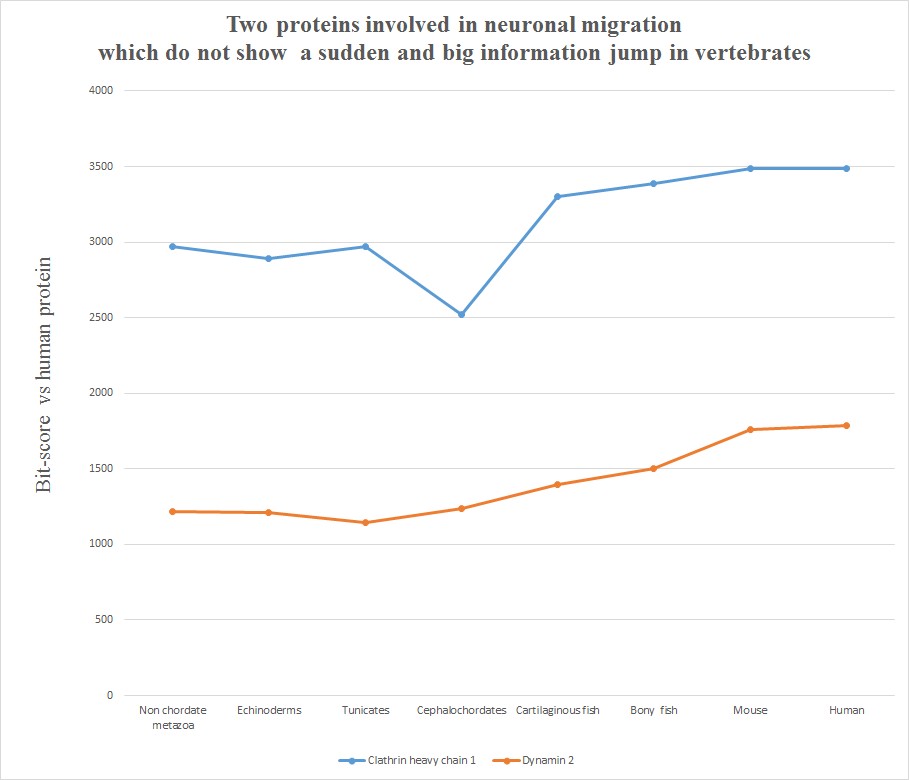
Neuron_migration2

Here, the behaviour is completely different. While there is a slight increase of homology in time, with a few smaller “jumps”, there is nothing comparable to the thousand bit jumps in the first six molecules. IOWs, these two molecules already show a very high level of homology to the human form in pre-vertebrates, and change only relatively little in vertebrates. We can say, therefore, that most of the functional information in these two proteins was already present before the transition to vertebrates.

So, to sum up:

  • a) The six proteins analyzed here all exhibit a huge informational jump between pre-vertebrates and vertebrates. The total functional informational novelty for just this small group of proteins is more than 6000 bits, with a mean of more than 1000 bits per protein.
  • b) These proteins are probably crucial agents in a much more complex regulation network implied in neuron adhesion, endocytosis, migration, and in the end in the vast developmental process which makes individual neurons migrate to their specific individual locations in the vertebrate body plan.
  • c) The above process is certainly much more complex than the six proteins we have considered, and implies other proteins and obviously many non coding elements. Our six proteins, therefore, can be considered as a tiny sample of the general complexity of the process, and of the informational novelty implied in the process itself.
  • d) Moreover, the process regulating neuron migration is certainly strictly integrated, with so many agents working in a coordinated way. Therefore, there is obviously a strong element of irreducible complexity implied in the whole informational novelty of the vertebrate process, an element that we can only barely envisage, because we still understand too little.
  • e) The neuron regulation process, of course, is only a part of the informational novelty implied in vertebrates, a small sample of a much more complex reality. For example, there is a lot of similar novelty implied in the workings of the immune system, of the cytokine signaling system, and so on.
  • f) The jump described here is really a jump: there is no trace of intermediate forms which can explain that jump in all existing pre-vertebrates. Of course, neo darwinists can always dream of lost intermediates in extinct species. This is a free world.
  • g) Are these 6000+ bits of functional information really functional? Yes, they are. Why? because they have been conserved for more than 400 million years. Remember, the transition we have considered happens between the first chordates and cartilaginous fish, and it can be traced to that range of time. And those 6000+ bits are bits of homology between cartilaginous fish and humans.
  • h) How much is 6000 bits of functional information? It is really a lot! Remember, Dembski’s Universal Probability Bound, taking in consideration the whole reasonable probabilistic resource of our whole universe from the Big Bang to now, is just 500 bits. 6000 bits correspond to a search space of 2^6000, IOWs about 10^2000, a number so big that we cannot even begin to visualize it. It’s good to remind ourselves, from time to time, that we are dealing with exponential values.
  • i) How great is the probability that 6000 bits of functional information can be generated in a window time of less than 100 million years, by some unguided process of RV + NS in six objects connected in an irreducibly complex system, even if RV were really helped by some NS in intermediates of which there is no trace? The answer is simple: practically non existent.
  • j) Therefore, the tiny sample of six proteins that we have considered here, which is only a small part of a much bigger scenario, points with extreme strength to a definite design inference:

The transition to vertebrates was a highly engineered process. The necessary functional information was added by design.

Comments
Alan Miller (at TSZ):
"Because there are mechanisms by which novel genes can arise, or appear to arise, and there are reasons why homology can be difficult to detect." I respectfully disagree with this point. I don’t think we have a clue how novel genes arrive.
I obviously agree with you, and I commend you for your intellectual honesty. :)gpuccio
July 28, 2016
July
07
Jul
28
28
2016
12:39 AM
12
12
39
AM
PST
gpuccio FYI - here's an invitation to a known scientist to comment on your OP and follow-up thread: https://uncommondescent.com/intelligent-design/methodological-naturalism-31-great-scientists-who-made-scientific-arguments-for-the-supernatural/#comment-613945Dionisio
July 27, 2016
July
07
Jul
27
27
2016
09:30 PM
9
09
30
PM
PST
Origenes @164
It must be a vexing task to make any sense of the meaningless drivel espoused by OMagain and her/his companions. I could not have done it.
I would not have even tried. :)Dionisio
July 27, 2016
July
07
Jul
27
27
2016
11:51 AM
11
11
51
AM
PST
gpuccio @163
We have debated these issues in great detail here. The same does not seem to be true of TSZ.
Have your 'politely-dissenting' interlocutors ever seriously discussed any important biology-related issue in great detail in their blog? At UD there are over 2,500 biology-related research papers referenced in the last couple of years. How many have they referenced at TSZ?Dionisio
July 27, 2016
July
07
Jul
27
27
2016
11:37 AM
11
11
37
AM
PST
gpuccio @163
You must be kidding. Or, simply, you are not familiar with protein homologies.
What is it that makes me think that in this case it's the latter? :)Dionisio
July 27, 2016
July
07
Jul
27
27
2016
11:24 AM
11
11
24
AM
PST
gpuccio @162
So, again, what do you mean? I have explicitly stated in my OP what you say in your comment. What is the problem with you?
Maybe they simply don't want to understand your explanations? Maybe some people think that understanding someone else's point of view is the same as agreeing with it? Or maybe they think they've understood your point, but really they haven't?Dionisio
July 27, 2016
July
07
Jul
27
27
2016
11:12 AM
11
11
12
AM
PST
Gpuccio
IOWs, let’s assume for a moment that an RNA world existed (I don’t believe it at all, and it remains pure conjecture). The big, big problem is: why should a system based on RNA, and not proteins, and on direct copying of an information which is about RNA enzymes, evolve at all to a system based on symbolic information for protein sequences?
Exactobill cole
July 27, 2016
July
07
Jul
27
27
2016
08:58 AM
8
08
58
AM
PST
gpuccio: You ask:
[...] why should a system based on RNA, and not proteins, and on direct copying of an information which is about RNA enzymes, evolve at all to a system based on symbolic information for protein sequences?
Your politely-dissenting interlocutors at the opposite blog may know the answer to that important question. However, maybe they don't want to share that information with you? :) What your interlocutors have written so far seems to lack substance. It definitely reminds me of Mina's song "parole, parole, parole". :)Dionisio
July 27, 2016
July
07
Jul
27
27
2016
05:53 AM
5
05
53
AM
PST
Dionisio: Thank you for linking those papers about the RNA world,a point that has been raised in this discussion. I think that this question from one of the papers: "5) How can the way information is stored and metabolic complexity coevolve to pave to road leading out of the RNA world to the present protein-DNA world?" well expresses the main point I have made here. IOWs, let's assume for a moment that an RNA world existed (I don't believe it at all, and it remains pure conjecture). The big, big problem is: why should a system based on RNA, and not proteins, and on direct copying of an information which is about RNA enzymes, evolve at all to a system based on symbolic information for protein sequences?gpuccio
July 27, 2016
July
07
Jul
27
27
2016
05:22 AM
5
05
22
AM
PST
John Harshman: "And why is similarity to humans an index of increased information content?" No. Its's not that similarity to humans is an index of increased information content. You are definitely misunderstanding my reasoning. There is nothing special in humans. Here I have considered sequences which, for a great part, appear in cartilaginous fish and bony fish (so, before the split), and are conserved up to humans. IOWs, sequences which are specific to vertebrates and conserved in the whole subphylum. That's the only role of human proteins in my reasoning. As the human line is derived from bony fish, I have used cartilaginous fish for the evaluation of the "jump", because that guarantees 400+ million years of conservation, which is exactly what I need to infer high functional restraint. If you look at my thread about Hymenoptera, you will see that I have inferred functional conservation for the specific sequence of protein Prickle 1 in Hymenoptera comparing wasps, bees and ants, without making any use of human proteins in the reasoning. Here is the thread: https://uncommondescent.com/intelligent-design/information-jumps-again-some-more-facts-and-thoughts-about-prickle-1-and-taxonomically-restricted-genes/gpuccio
July 27, 2016
July
07
Jul
27
27
2016
05:00 AM
5
05
00
AM
PST
Adapa: "ID offers no mechanisms, no timeline, not the slightest bit of detail on anything" (emphasis mine) I think that we have been debating exactly timelines here. In a thread at UD about an OP at UD based completely on ID theory. What's the problem with you?gpuccio
July 27, 2016
July
07
Jul
27
27
2016
04:51 AM
4
04
51
AM
PST
Origenes: Yes, it's a little exacting. However, I am grateful to them because they give me a chance to clarify better my points. I try to choose those comments which are good for that purpose, and to ignore the rest. :)gpuccio
July 27, 2016
July
07
Jul
27
27
2016
04:46 AM
4
04
46
AM
PST
John Harshman:
It doesn’t make sense to me for quite different reasons. I would consider 73% after 300 million years to be quite conserved.
Good. At least you seem to understand that basic fact.
But why should “conservation” refer to matching humans? Why not sharks? Why not fruit flies?
Have you read my post #141 here, in response to dazz? If not, I paste it here for your convenience:
dazz: "I’ve been reading Gpuccios article and he seems to compute “functional information” in terms of bit-score BLAST comparisons with human proteins: the higher the match to the human protein, the higher “functional information” is. Clearly he’s assuming the plan has been fulfilled and it’s us" No. You have understood the methodology, but not the reason for it. My fault, certainly. I have used this methodology in previous posts, so I have gone into details here. The idea is: I use the human form of the proteins because what I am looking for is conservation form the early vertebrates (especially cartilaginous fish) and humans. That gives ne a good foundation to consider the bitscore as a measure of functional information, because, as I have said many times, 400+ million years of conservation of a complex sequence is guarantee of high functional restraint. If you look at my previous posts, especially this one: https://uncommondescent.com.....ted-genes/ you will see that I have used exactly the same methodology to identify functional information in Hymenoptera. So, as you can see, I am in no way partial to a plan aimed at humans. I hope that clarifies the point.
My point was to look at jumps in vertebrates vs non vertebrates. So I use the shark human comparison because, as you certainly understand, that allows me to define a rather precise window pre (something less than 100 million years) and post (400+million years). That's clearly said in the OP, and further clarified in the comments in the thread. You add:
And what does that have to do with information?
It has all to do with information. You guys seem really to be unfamiliar with ID. The functional information is the information linked to the specific defined function. It is computed as the ratio between the target space (the number of sequences that exhibit the function) and the search space (the total number of possible sequences). So, the target space is the "island" of function, however big it is. Measuring the target space directly is very difficult for proteins (and, in general, with complex objects, including language). So. we must proceed with indirect approximations. The best way available, as far as I can say, is to measure the conservation across a long period of evolutionary time. So, that's, in a nutshell, what conservation has to do with information.gpuccio
July 27, 2016
July
07
Jul
27
27
2016
04:44 AM
4
04
44
AM
PST
GPuccio, thank you for your comments on TSZ. It must be a vexing task to make any sense of the meaningless drivel espoused by OMagain and her/his companions. I could not have done it.Origenes
July 27, 2016
July
07
Jul
27
27
2016
04:20 AM
4
04
20
AM
PST
dazz:
This doesn’t make any sense to me because the match for ASTN2 for example, between humans and sharks is 73%. That doesn’t look so conserved to me. It’s also hard to reconcile the idea that a single fold can diverge more than 25% and still perform the same basic function if “islands of function” was true. And that’s just one pair comparison
You must be kidding. Or, simply, you are not familiar with protein homologies. Believe me, 73% conservation between shark and human is an extremely high conservation. It's almost 900 identical aminoacids, a bitscore near to 2000 bits, and an expect of 0.0! You seem to forget the role of neutral variation. In 400 million years, neutral variation will practically erase any homology in any non functional sequence or position in a sequence. You can see that clearly when you evaluate the Ks values, the rate of mutation for synonimous sites, which are a good measure of neutral variation. At that chronological distance, Ks values tend to reach saturation, that is the point where you cannot any more detect any homology. So, this is an extreme conservation, and an extreme functional restraint. If you don't understand well these issues, just document yourself. You also add: "In fact, even if it was an entirely different function in my book that would also falsify the “islands of function” hypothesis" This is nonsense. Again, you don't know what you are saying. "more than 25%" is the minimum variation you can expect in 400 million years because of neutral variation, if the function remains exactly the same. That's why I call them "islands of function", and not "points of function". We have debated these issues in great detail here. The same does not seem to be true of TSZ. Look, myoglobin, which is a much shorter molecule (154 AAs) whose function is well known and rather stable, presents only 62 identities (42%, for a total of 123 bits and an expect of 9e-37) in the comparison between shark and humans. Some proteins are more flexible to neutral variation, others much less. That's exactly what functional information measures: the degree of functional restraint. AST2 shows a very high degree of functional restraint in a very long protein: that's why its functional information is so high.gpuccio
July 27, 2016
July
07
Jul
27
27
2016
04:00 AM
4
04
00
AM
PST
John Harshman:
And that big jump he makes a big deal out of is just the big slice of time separating the human-shark common ancestor from the human-cephalochordate common ancestor.
What do you mean? Have you read my OP? I quote from it:
For the following analysis, I will consider vertebrates versus everything which preceded them (all metazoa, including “pre-chordates” (Hemichordates and Echinoderms) and “early chordates” (Tunicata and Cephalochordata). So, everything which is new in vertebrates had to appear in the window between early chordates and the first vertebrates: cartilaginous fish and bony fish (I will not refer to lampreys, because the data are rather scarce). So, let’s try to define the temporal window, for what it is possible: Chordates are already present at the Cambrian explosion, 540 my ago. Jawless fish appeared slightly later (about 530 my ago), but they are mostly extinct. The split of jawless fish into cartilaginous fish and bony fish can be traced about at 450 my ago Therefore, with all the caution that is required, we can say that the information which can be found in both cartilaginous fish and bony fish, but not in non vertebrates (including early chordates), must have been generated in a window of less that 100 my, say between 540 my ago and 450 my ago. Now, my point is very simple: we can safely state that in that window of less than 100 million years a lot of new complex functional information was generated. Really a lot.
So, again, what do you mean? I have explicitly stated in my OP what you say in your comment. What is the problem with you?gpuccio
July 27, 2016
July
07
Jul
27
27
2016
03:37 AM
3
03
37
AM
PST
dazz: "I’m missing: Non chordate metazoa Echinoderms Tunicates Cartilaginous fish The ASTN1 ones would do" Here they are(the accessions are from NCBI, because I derive them from the blast results): Best nonchordate (non echinoderm): Lingula anatina XP_002123195 58.9 bits Echinoderms: Strongylocentrus purpuratus XP_790940.3 36.6 bits Tunicates: Ciona intestinalis XP_002123195 43.5 bits Cartilaginous fish: Callorhincus milii XP_007893873.1 1328 bitsgpuccio
July 27, 2016
July
07
Jul
27
27
2016
03:31 AM
3
03
31
AM
PST
Alan Fox (at TSZ): You raise many different arguments, many of which I have already discussed many times, even with you, I think. I cannot restate everything here in brief, of course. For the moment, this will suffice:
Well, all that goes out of the window, if you consider RNA world a plausible precursor to DNA and proteins. I used to be skeptical of RNA world, mainly due to the influence of the late Professor Robert Shapiro but I’ve come around due to persuasive arguments by fellow members here (notably Allan Miller) and also as it answers Upright Bipeds “semiotic” argument, RNA being able to double up on both information storage and catalytic function.
Well, I had not your fortune, and I am still extremely skeptical of RNA world. Will you accept me at TSZ? :) Moreover, I don't agree that "it answers Upright Bipeds “semiotic” argument". Not at all. Luckily, I have discussed this point recently on another thread, so I will just paste here a few reflections. This is the thread: https://uncommondescent.com/intelligent-design/thats-gotta-hurt/#comments Post #3: Me to Matspirit:
And, always just to know, how would a “direct copy organism”, whatever it may be, “evolve” a whole representation and translation system, with highly symbolic connections between nucleotides and aminoacids, implemented by some 20 highly complex proteins plus some “small” machinery like the ribosome and a lot of other assets? IOWs, I suppose that the “direct copy” system was copying RNA to RNA (am I correct, or you mean something else?). So, in the mythical RNA world, the sequence of nucleotides was important for the information about the final RNA effectors (rybozimes, and so on). IOWs, the information was about RNA as a biological effector, and had nothing to do with proteins, aminoacids, and so on. So, what happens? One day the DCO (direct copy organism) decides that it is rather old fashioned to store information for the reason it is used (RNA structures which have something to do), and it would be exciting to store completely new symbolic information for some unclear future purpose, having to do with some new molecules (proteins)? And what about proteins? Were they present in the DCO? Did they copy themselves? How? Or did they appear suddenly? It is fascinating how people who seem otherwise normally intelligent can accept this kind of conjectures as though they were reasonable scientific theories. Maybe my imagination has severe limitations…"
Post #16: Me to MatSpirit:
Thank you for trying. No name calling, obviously, but I really want to comment on what you say. “I was referring to a ten molecule polymer I mentioned in message 128” OK, but a ten molecule polymer is not an organism. So, my point remains: Direct copy organisms? Examples, please? “This would be direct reproduction where the molecule copies itself directly without any DNA or other representations, signs or symbols.” I have no problems with simple molecules directly copying themselves in the right context (usually designed ad hoc). That still has nothing to do with living organisms. “You can see where this idea upsets the semiotics people, but it seems to be what most of the OOL researchers seem to think happened. It goes under names like “RNA world” or “chemical evolution”.” I am certainly part of the semiotic people, but strangely I don’t feel upset at all. And I am well aware that “most of the OOL researchers” believe that kind of things. Look, there is just one argument that you should not use with me: the argument of conformistic thought. I always say that I am a minority guy. I am proud of that. You see, I don’t care how many authoritative people believe one thing: for me, the only importnat thing is if I can be convinced that it is true. I am very firmly convinced that a very strong cognitive bias is operating in biological ideology. I understand its origins, which are maybe partly justified (the need to free science from old dogmatisms mainly connected to religion). I can understand that, but the only result of dogmatic anti-dogmatism is a new form of dogmatism. So, I beg your pardon, but the simple fact that many believe something is not, for me, a reason to believe. I like to choose the things I believe in. That said, let’s go to the other points. “I don’t think the original DCO was “about” anything. It didn’t make proteins or anything else, just copies of itself. I think it was probably a polymer because just about everything alive today is made from them and because the polymer structure is perfect for evolution.” Again, a replicating molecule, even if it were really spontaneously possible, is not an organism: life is made first of all of metabolism, separation of environments, far from equilibrium states, and many other things. However, let’s say that your “organism” is an RNA organisms. So, we are entering the myth of RNA world. OK, let’s go on. “As for how such Direct Copy Organism (thanks for that name, I’ll keep using it)” No problem, I like it too! “would evolve the complex system we see today, I would guess that DNA backup for fragile RNA came first.” I have no problems with that. RNA and DNA are similar molecules, and complementary ones. OK, the scenario has many difficulties, but I don’t want to emphasize them here. Let’s go on. “Three of the four codon in DNA are identical to the ones in RNA and the fourth is a close chemical cousin. The backbones of both molecules are also chemical cousins.” OK. The origin of nucleotides is not exactly a solved problem, but let’s go on, again. “As far as proteins go, amino acids form spontaneously, botherwise on eart and in space. (Miller-Urey found five of them in their famous experiment. Modern researchers have examined vials saved from their experiment with modern instruments and brought the total up to 21.) Proteinoids (short proteins of up to 5 amino acids) form spontaneously. So I would guess that proteins of some kind were present.” OK. Having a few aminoacids and maybe some proteinoid is not really the problem. Now, let’s understand where the real, big problem is: 1) Proteins do not copy themselves directly. They can only be reproduced by the information in DNA genes, which uses the symbolic translation system. OK with that? 2) So, even if we have a proteinoid, and even if it does something useful (very doubtful, but OK, this is the game), my simple question is: how is the information for that simple proteinoid conserved and passed from DCO to DCO? Or are new instances of the same proteinoid created each time by sheer luck? Excuse me, but I don’t understand. And how can the information in the original proteinoid “evolve”, if the information is not copied and translated from some physical storage system? 3) And the most important point: how is it that some sequence of nucleotides at some point starts representing a sequence of aminoacids, according to some symbolic code? Remember, the sequence of nucleotides in our RNA DCO has only one function: to preserve and pass on the information for RNA enzymes. Now, the biochemical rules which govern RNA molecules are completely different from the biochemical rules which govern proteins. And, above all, there is no spontaneous symbolic connection between the two sets of rules. So, please, answer this very important point: why should a functional sequence which has a very definite function according to some set of rules, and is conserved and propagated exactly for that reason, become a sequence which has no more relationships with its initial function, but strangely starts to represent another completely different set of rules, according to a purely symbolic code, which can only work if a complex translation apparatus, including 20 aaRNA synthases, the ribosome, and many other components, is already working? This is really beyond my frail imagination. “Look at it this way. Life as we see it today, in all its towering complexity, is so well understood that it has become intellectually irresponsible to deny that that it’s material. There is no elan vital. That idea is dead.” To say that life is so well understood is really the statement of the millennium! Are you really convinced of what you are saying? I am afraid that there is no hope. However, while I would be happy to defend a little the “elan vital” here, I will simply emphasize that nothing in ID theory is denying that the biological information necessary for life is material, or at least implemented in material forms: our only point is that it is designed. A watch, a computer, are material objects, but the information which makes them what they are is designed. So, this is a false argument. We will discuss “elan vital” another time, for the moment let’s just discuss the origin of biological information, as we have always done. “So if the extravagantly complex life we see today is material and is known to have come from material causes (other life), why not believe those material causes extend all the way back until life was so simple that non living material causes could produce it?” Because it is simply wrong: complex functional information, even if materially implemented, has its origin in conscious intelligent representations. Always. That’s exactly the point of ID theory. Non conscious systems simply cannot generate that kind of physical organization, never have, never will. “It is a fact that a lot of very intelligent people who are also very well educated and who have studied the OOL field for decades DO think that conjectures like these are reasonable.” The conformistic thought argument again? They may think whatever they like. I don’t. “I think that if you understood the field better, you might think they were reasonable too.” Here I strongly disagree with you. I think that I understand the field well enough to have very strong and motivated convictions. Maybe I understand it better than you do, but just for fairness, let’s say that we understand the field equally well, and still we have opposite ideas. There is nothing strange in that. It’s called freedom of scientifc thought, and IMO it is the main cognitive manifestation of free will. But that’s another story. “I am confident that when you do disagree you will give cogent reason for your disagreement, as above, and not childish name calling and I thank you for it.” I have tried to satisfy your expectations. :)
Now, this other point. You say:
But this argument is only convincing if functional proteins are rare in sequence space. Evolutionary search only needs to stumble on a solution, not the solution. There is plenty of new research since Keefe and Szostak showed ATP binding is common in a random sequence library.
I would say that Keefe and Szostak was a very bad starting point. I have criticized that paper, and the conclusions which are usually derived from it, many times. can do it again any time you like. However, you refer to "plenty of new research". References, please, so that we can discuss. I am absolutely convinced that functional proteins are rare in sequence space. But there are many ways to define functional proteins. I must remind you that, in the context of your theory (neo darwinism) only one definition counts: proteins which can confer a reproductive advantage, and therefore can be visible to NS. You say: "Evolutionary search only needs to stumble on a solution, not the solution." OK. but the solution must be a naturally selectable solution. No other function counts. I am not aware of any naturally selectable result in Keefe and Szostak's paper, for example, in spite of all the Intelligent Selection they performed. You could be interested, perhaps, in this OP of mine about the differences between NS and artificial selection, a topic which is usually strangely ignored by neo darwinists: https://uncommondescent.com/intelligent-design/natural-selection-vs-artificial-selection/gpuccio
July 26, 2016
July
07
Jul
26
26
2016
01:36 PM
1
01
36
PM
PST
Joe Felsenstein (at TSZ): "Surely someone needs to mention that LUCA is the oldest species that had two or more living descendant species. It is not the organism at the origin of life, which could be much earlier" GlenDavidson (at TSZ): "LUCA, not FUCA." Well, LUCA is the oldest species for which we can reasonably infer anything. For what we know, it could have been the first living thing on earth. IOWs, as far as we know from observed facts, LUCA could well be FUCA. As far as we don't find any new facts, I start reasoning with LUCA. Anything else is not supported by facts. I am well available to discuss any FUCA which existed before LUCA, provided that someone shows me some evidence that such an organism ever existed, and that we have objective data which show what it was.gpuccio
July 26, 2016
July
07
Jul
26
26
2016
01:13 PM
1
01
13
PM
PST
dazz (at TSZ): "Can someone please ask gpuccio if he can share the FASTA files he used?" Here are the accession numbers (from UNIPROT) of the 6 human proteins I blasted: Astrotactin 1 O14525 Astrotactin 2 O75129 BRNP1 O60477 CADH2 P19022 Integrin alpha-V P06756 NCAM1 P13591 If you look at them on uniprot, you can easily download the sequence as a FASTA file. You can blast each of those proteins in BLAST, just using the accession number. To get the best non vertebrate homology, I blasted vs Metazoa, excluding Vertebrates. Do you need other details?gpuccio
July 26, 2016
July
07
Jul
26
26
2016
01:08 PM
1
01
08
PM
PST
I am busy now, I will go on answering what should be answered in TSZ's comments in a while.gpuccio
July 26, 2016
July
07
Jul
26
26
2016
11:03 AM
11
11
03
AM
PST
dazz (at TSZ): "I wonder if he also accepts that mutations happen, and that mutations alter the DNA sequence and in turn, protein sequence too. Because comparing protein sequences and rejecting the roll of mutation seems self-refuting. Maybe his “quantum interface” is responsible for those mutations instead of being truly random?" dazz, of course I accept that mutations happen. And that they alter the DNA sequence and protein sequence. Do you think I am a fool? Moreover, I am convinced that many mutations are completely random. I also believe that those random mutations are most times neutral or quasi neutral, and that they are subject to random drift, so that they can be fixed. I don't believe that random beneficial mutations have any important role in the generation of complex functional information. I think that their role is strictly limited to small "microevolutonary" events. I think that the variation which generates complex functional information is guided, and not random. And it acts through guided common descent. I hope this clarifies some of my views.gpuccio
July 26, 2016
July
07
Jul
26
26
2016
11:01 AM
11
11
01
AM
PST
CharlieM: You are welcome. I will wait for you.gpuccio
July 26, 2016
July
07
Jul
26
26
2016
10:53 AM
10
10
53
AM
PST
Hi gpuccio @140 I'm very short of time at the moment and I wouldn't describe myself as an adept. But I would be interested in your project. I'll be posting further when I get more time. regards CharlieCharlieM
July 26, 2016
July
07
Jul
26
26
2016
08:41 AM
8
08
41
AM
PST
Zachriel (at TSZ): Hi! Glad to see you again. Well, "handwaving" is how OMagain sees it. But I have never denied that I believe in a quantum interface between consciousness and matter. That's my strong view, and I absolutely stick to it. And I am not alone. Eccles. Beck. Penrose (in a different way). And others. Is that just handwaving? Is it so difficult to accept that others may have different views from yours, in highly controversial topics like the nature of consciousness, without feeling obliged to deride them?gpuccio
July 26, 2016
July
07
Jul
26
26
2016
06:42 AM
6
06
42
AM
PST
Alan Fox (at TSZ): Greetings to you! "the hardest nut to crack regarding life on earth is its origin" OK, I agree on that. Apart from the impressive impossibilities of getting from an inanimate system to any living system, apart from the problems of metabolism, genetic code, far from equilibrium systems, what came first, and so on, my simple point is that the information jump from any inanimate system to LUCA is beyond any imagination, if it is true that almost half of known protein superfamilies were already present in LUCA, as far as we may infer. You may know that I consider protein superfamilies as super-isolated islands of function, beyond any attempt of explanation by the neo darwinian mechanism. Almost 1000 of them appearing in, at most, a few hundred million years is the biggest information jump we can imagine. "Then the biochemical evolution of prokaryotes that continued for two billion years prior to the emergence of anything more complex* can only be considered with circumstantial evidence." OK. that's probably the least problematic aspect, at present. So, let's avoid it for the moment. "Though that the biochemistry is common across all Earth life is the killer argument for me that we all share a common ancestor." I agree. You may know that I believe that we (probably) share a common ancestor, and I have also defended that point of view many times here. "Once you have eukaryotes, for which there is a very satisfying explanation in symbiogenesis, it gets much easier. " I have to disagree: 1) Symbiogenesis has almost certainly a part in eukaryogenesis, but it certainly does not explain it. I think there is a lot of evidence that eukaryogenesis requires an information jump almost as big as OOL. 2) Even after eukaryotes, nothing is easy. The transition to metazoa is another huge jump: a lot of complex proteins and regulatory systems practically appear, or are drastically remodeled in multicellular organisms. And the emergence of the phyla is not "easy" at all, as you probably could acknowledge if you stop a moment to think of it. And my OP here was exactly about that: even the emergence of a subphylum, like vertebrates, implies tons of new complex information which is beyond any capabilities of the current neo darwinian theory. Of course you will disagree, but I wanted to make clear my position. "Evolve sex, multicellularity, cell specialisation… you’re home free." Free??? The nervous system, all epigenetic mechanisms, the whole transcription factors network, hundreds of different cell types, the immune system, and so on, and so on... Free??? If that is your idea of free... :)gpuccio
July 26, 2016
July
07
Jul
26
26
2016
06:29 AM
6
06
29
AM
PST
Acartia (at TSZ): "But I do do commend your attempt and your civil approach to the issue." Thank you! I commend you for your commending. Indeed, it does not happen often. :) I think that we could all benefit from keeping the discussion on a scientific plane. I like intellectual confrontation, and I also like it to be strong, even aggressive if necessary, but there is no reason not to have respect for one another. I agree that discussing "across two threads" can be tiresome. However, if you have any specific question or comment about my position, you are welcome to express it.gpuccio
July 26, 2016
July
07
Jul
26
26
2016
12:57 AM
12
12
57
AM
PST
gpuccio Ok, so what's their 'bottom line' answer? How did the functionality could get added to the proteins discussed in your OP? BTW, how many biology papers have they referenced in their blog the last couple of years?Dionisio
July 25, 2016
July
07
Jul
25
25
2016
07:46 PM
7
07
46
PM
PST
Acartia (at TSZ): "If Gpuccio is not willing to comment here, maybe he would be willing to ask Barry to grant another amnesty" I would like very much to have many of you here. However, Barry is obviously free to decide for himself. But are you really all banned? Just to know... However, if you want, we can go on with the inter-blogging debate, at least for some while. As I have said, I have already done it in the past.gpuccio
July 25, 2016
July
07
Jul
25
25
2016
07:42 PM
7
07
42
PM
PST
Dionisio: Ah! Some fun at last. :) In the past I had an interesting inter-blogging debate with TSZ which lasted for some time. In the end, it is rather tiresome, but once in while it can be fun. But I would advice our friends at TSZ to be cautious. Maybe Tom English has it right, after all: never respond to a crypto-creationist! :)gpuccio
July 25, 2016
July
07
Jul
25
25
2016
07:37 PM
7
07
37
PM
PST
1 3 4 5 6 7 10

Leave a Reply