Uncommon Descent Serving The Intelligent Design Community

Good thing someone eventually asked: What part of science does the Darwin lobby actually participate in?

Bio_Symposium_033.jpg
O'Leary/Bencze

I commend Thomas Cudworth’s post today to all, for raising a very good question: Do Darwin’s best known hacks and flacks do much science research. Given their other activies, like interfering with academic employment decisions and journal publications, writing hit pieces on scholars, and demanding wacky decisions from school authorities, one wonders where they would find the time.

One curious fact is that these activists are, generally speaking, Americans talking to Americans – and their fellow Americans have displayed a low level of confidence in Darwinism for decades.

So one of three possibilities, surely: Read More ›

180px-Wuerfel5
Various dice

Is chance “real”? Can it “cause” anything? Can we investigate it “scientifically”?

From the days of Plato in The Laws, Bk X on, design thinkers have usually been inclined to think in terms of necessity, chance and choice when they analyse causal factors.  In recent days, though, the reality of chance and its proper definition have been challenged, and not just here at UD.

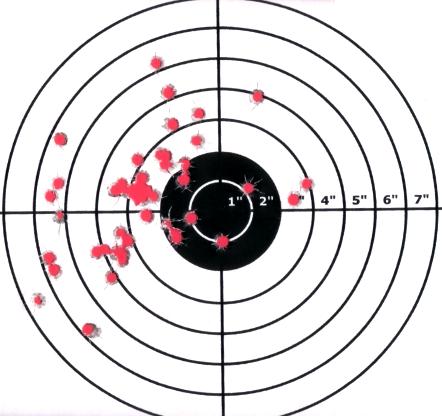
A glance at the target to the left will definitely show the typical kind of scatter that is in effect uncontrollable, even after careful and skilled efforts to get accuracy and precision. Here, the shooter- gun- range combination is definitely hitting to the left and slightly high [NW quadrant], with a significant amount of scatter. We see here both want of accuracy and want of precision in the result, and could–  if we wanted to, analyse the result statistically to generate a model based on random variables. Such is routinely done in scientific contexts, i.e. chance appears to be real, it appears in the guise of a causal factor leading to observable effects distinguishable from bias and from proximity to an intended target. Moreover, plainly, it can be studied using commonly used scientific methods.

But, some would argue, once the gun, shooter, target and range are set, and the trigger is pulled, the result is a foreordained conclusion.

See, no need for chance.

Especially, chance conceived as “Events and outcomes entirely unforeseen, undirected and unintended by any mind.

However, this is not the only view of chance that is reasonable, especially in a scientific context.

Read More ›

Zookeeper: Evolutionary psychology meets Hollywood

Reviewer Charlie Jane Anders tells us “Zookeeper is a horror movie about evolutionary biology” (IO9, July 8, 2011), but she means “evolutionary psychology.” Briefly, the zookeeper wants this girl, and the animals (who can talk, of course) advise him to use their mating strategies:

Griffin is encouraged to become an Alpha Male, to pee in public to mark his territory. (There is a lot of urination.) The Adam Sandler-voiced monkey tells him to fling poop. At various times, his mating seminar starts to seem like an episode of the Pick-Up Artist, as a lion tells him to throw some negs. He’s encouraged to pick fights with competing males, to separate his desired mate from the pack, and to make his nerdy-but-gorgeous best friend pretend to be his girlfriend to make Stephanie jealous. There is much slapstick involving Griffin attempting to do a frog confrontation stance and making his pants split open.Eventually, though, it starts to work — Griffin, implausibly, becomes an Alpha Male and everybody admires him. He becomes a kind of super-yuppie and God among ordinary shlubs.

The usual keenness of evolutionary psychology’s insight into human nature is on display here; the screenwriter captures the quintessential truth that humans have evolved to consider this kind of behaviour sexy – just as animals evolved to have equivalent-to-human minds. From Anders:

Read More ›

Why Were So Many Darwin Defenders No-Shows at the World’s Premier Evolutionary Conference?

I have often wondered whether the loudness and aggressiveness of many culture-war defenders of neo-Darwinian evolution bears any relationship at all to the actual scientific contributions of those defenders to the field of evolutionary biology.  As it happens, we have at hand some evidence, albeit of a rough and ready kind, relevant to that question.

Read More ›

Of Gaps, Fine-Tuning and Newton’s Solar System

New research is providing a fascinating new perspective on fine-tuning and a three hundred year old debate. First for the context. When Isaac Newton figured out how the solar system worked he also detected a stability problem. Could the smooth-running machine go unstable, with planets smashing into each other? This is what the math indicated. But on the other hand, we’re still here. How could that be?  Read more

600 Genes Involved in Fundamental Cell Division

The regulation of cellular processes occurs at many levels. Gene expression, where the DNA is transcribed into an RNA molecule, is exquisitely controlled but so are the many downstream actions as well. For instance, the new RNA molecule can be inactivated by an incredible process referred to as RNA interference. This sophisticated process targets specific genes, and as usual nature’s own tools provide researchers with excellent means to investigate and harness biology. For instance, researchers have used RNA interference to turn off one gene at a time in the human cell to determine its function.  Read more

Your daily dose of Darwin: Men with wide faces lie, cheat more

Now that News of the World has been shuttered in a scandal, what would we do without New Scientist for our  dose? In “Are wide-faced men rascals?” (07 July 2011), Andy Coghlan manages a straight face, reporting, Can it be true that men with extra-wide faces are more likely to be liars and cheats? That’s what a study published this week claims, but some researchers specialising in the evolution of trustworthiness have questioned the results.The study’s authors claim to have shown that men are most likely to cheat and lie if they have wider faces as measured by the facial width-to-height ratio, or WHR. Sceptics argue that the evidence supporting such a huge claim is weak, especially given that the Read More ›

Paul Nelson asks: Why are young American scientists too afraid to appear in this video?

Claire Berlinski comments at Ricochet: “Seriously, if you could have seen how everyone scrambled to get out of the camera when I said we just want to talk about the interesting things we were talking about yesterday. And people are afraid. It would be the end of their careers.” Caption quote: “People who want to explore these ideas are as afraid of reprisal as anyone I’ve ever met in Turkey. (Excessively so, I’d say: It’s not as if anyone is going to lock them up. But obviously, something is keeping them from speaking freely. And that cannot be good for any of us.) ” The fact that the “land of the free” is governed by an unrepresentative elite is incisively Read More ›

He said it: “Pure chance, absolutely free but blind, at the very root of the stupendous edifice of evolution”

Jacques Monod
Jacques Monod (1910-1976)

“We call these events [mutations] accidental; we say they are random occurrences. And since they constitute the only possible source of modification in the genetic text, itself the sole repository of the organism’s hereditary structures, it necessarily follows that chance alone is at the source of every innovation, of all creation in the biosphere. Pure chance, absolutely free but blind, at the very root of the stupendous edifice of evolution: this central concept of modern biology is no longer one among other possible or even conceivable hypotheses. Read More ›

What would Louis Pasteur have said about today’s origin of life dead end?

In “The Role of Creation in Science: The Real Story, a Breath of Fresh Air” (Evolution News & Views, July 2, 2011), science historian Michael Flannery remarks on Jonathan Bartlett’s “The Doctrine of Creation and the Making of Modern Biology,”

In a recent article at the Classical Conversations web site, Jonathan Bartlett authored an interesting commentary on creation as a concept for and catalyst to scientific inquiry and advance with “The Doctrine of Creation and the Making of Modern Biology.” Given the persistent claim by so-called “defenders” of quality science education such as Eugenie Scott, Paul Hanle, and others that only natural processes functioning via unbroken natural laws in nonpurposeful ways counts as science and that anything else is a “science stopper,” everyone–especially those least likely to do so–would do well to take page from Bartlett’s page of history. Read More ›

Confessions of a Design Heretic

Those of you who’ve followed my posts and comments will have picked up that my view of Intelligent Design is pretty complicated. On the one hand, I defend design inferences, even strong design inferences. I’m entirely comfortable with questioning Darwinism (if that view still has enough content to identify it as a clear position, anyway), and have a downright dismissive view of both naturalism (if that view… etc) and atheism. I regularly see the ID position butchered, mangled and misrepresented by its detractors, most of whom should and probably do know better.

On the flipside, I don’t think ID (or for that matter, no-ID) is science, even if I reason that if no-ID is science then so is ID. My personal leaning has always been towards theistic evolution, and I see evolution as yet another instance of design rather than something which runs in opposition to it – a view which I know some ID proponents share, but certainly not all. I think non-scientific arguments for and inferences to design have considerable power, and see little reason to elevate particular arguments simply because some insist they’re “scientific”.

Here’s another part of that flipside, and the subject of today’s post. One of the more prominent ID arguments hinges on the trichotomy of Chance, Necessity, and Design. The problem for me is that I question the very existence of Chance, and I see Necessity as subsumable under Design.

Read More ›

Ivory tower economics explains part of why evidence is irrelevant to Darwinism

In “Climate of Fear: Big Science, Big Government” (Forbes, July 8, 2011), Patrick Michaels, lobbyist for the American Association for the Advancement of Science, admits, In his 1961 Farewell Address, Dwight Eisenhower famously predicted the rise of a “military-industrial complex,” in which he said, “The potential for the disastrous rise of misplaced power exists and will persist”. He then went on to speculate as to what Vannevar Bush had wrought.Few remember the next paragraphs, in which he said that at universities, because of the enormous cost of scientific research, “a government contract becomes virtually a substitute for intellectual curiosity,” and that “we must also be alert” to the “danger that public policy itself could become the captive of a scientific-technological Read More ›

Materialism, Science, and Righteous Anger

When I was seven years old I figured it all out. It was a simple, logically inescapable conclusion. I believed that I was the product of a purely materialistic, random process that did not have me in mind. When I die and my chemistry shuts down I will cease to exist, enter eternal oblivion, and nothing I ever achieve or do will have any ultimate purpose or meaning. Furthermore, there is no ultimate justice. Hitler and the millions he tortured and murdered will have the same ultimate fate: pointless, meaningless oblivion. I lived my life in a complete state of depression, anger and despair for 43 years as a result of this notion, although I accomplished much during that time Read More ›

Darwin’s beneficial mutations do not benefit each other.

Here. Epistasis between Beneficial Mutations and the Phenotype-to-Fitness Map for a ssDNA VirusDarin R. Rokyta1*, Paul Joyce2, S. Brian Caudle1, Craig Miller3, Craig J. Beisel2, Holly A. Wichman3 Epistatic interactions between genes and individual mutations are major determinants of the evolutionary properties of genetic systems and have therefore been well documented, but few quantitative data exist on epistatic interactions between beneficial mutations, presumably because such mutations are so much rarer than deleterious ones . We explored epistasis for beneficial mutations by constructing genotypes with pairs of mutations that had been previously identified as beneficial to the ssDNA bacteriophage ID11 and by measuring the effects of these mutations alone and in combination. We constructed 18 of the 36 possible double mutants Read More ›