Uncommon Descent Serving The Intelligent Design Community

Overwhelming Evidence that Software Evolves

By comparing successive versions of Granville Sewell’s finite element program PDE2D (video here ), NCSE scientists have uncovered overwhelming evidence (from homology, etc.) that current versions evolved from a common ancester. The evidence is so overwhelming, in fact, that the competing theory of intelligent design has been abandoned by all serious scientists. “That Sewell’s software is the product of 35 years of evolution is now beyond debate,” said an NCSE spokesperson. “Only minor issues such as the mechanism of evolution are still being debated.” (For a modest proposal on how the two competing theories might be reconciled, see this or this, or the video here.)

Biophysics: Long DNA terminal repeats have wrapping function, researcher finds

In “Kinky genes: Biophysics of DNA affects how it works” (New Scientist, 08 July 2011), MacGregor Campbell reports DNA is typically a long double-helical strand that can expose its sequences of base pairs. These are translated by RNA and particles called ribosomes into proteins, which do the cell’s work. When not in use, DNA wraps around structural proteins called histones to form compact chromosomes. This wrapping is poorly understood, but one thing we do know is that it plays a key role in gene expression. Histones have up to 1000 times greater attraction for some DNA subsequences than others, but why this should be was a mystery.

Mind: Put “neuro” in front of an abstract discipline and poof! – it becomes nonsense

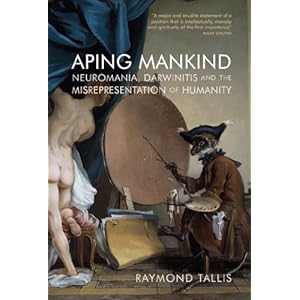
Aping Mankind: Neuromania, Darwinitis and the Misrepresentation of Humanity

In a recent review of Aping Mankind: Neuromania, Darwinitis and the Misrepresentation of Humanity, by MD neuroscientist Raymond Tallis, British journalist Robert McLuhan quotes Tallis on the current fad for identifying changes in brain function that are associated with thoughts and feelings as the explanation for those feelings.

There are repeated references to new disciplines with the prefix ‘neuro-‘ or ‘evolutionary’: neuro-jurisprudence, evolutionary economics, evolutionary aesthetics, neuro-theology, neuro-architecture, neuro-archeology and so on. Even philsophers – who should know better, being trained, one hopes, in scepticism – have entered the field with the discipline of ‘X-phi’, or experimental philosophy. Starry-eyed sages, for example, have invented ‘neuro-ethics’, in which ethical principles are examined by using brain scans to determine people’s intuitions when they are asked to deliberate on the classical dilemmas.

It is somewhat as if blushing was thought to be the cause of embarrassment. Yet … that is exactly what many such researchers believe: Read More ›

Darwinism: An Embarrassment for Legitimate Science

I write this post from a hotel room in Livermore, California, home of Lawrence Livermore National Laboratory, where my company has sent me for advanced training in computational fluid dynamics using LS-DYNA, arguably the most advanced finite element analysis program ever devised, originally at LLNL in the 1970s for the development and analysis of variable-yield nuclear weapons. I have a particular interest in LLNL because my father worked on the Manhattan A-bomb Project during WWII, and was the founder and director of an experimental nuclear reactor at Washington State University, which has been named in his honor. Here is some info from the LLNL website: For more than half a century, Lawrence Livermore National Laboratory has applied cutting-edge science and Read More ›

Proteins Did Not Evolve Even According to the Evolutionist’s Own Calculations but so What, Evolution is a Fact

Evolutionists say they just don’t know how to discern miracles. They might begin by looking at a protein. Proteins, according to science, are not likely to have evolved. And when I say “not likely,” I mean the chances are astronomically against such evolution. I may as well simply say: Proteins, according to science, did not evolve. To review, very briefly, here are some of the reasons:  Read more

NCSE stands firm: There is no evidence against (Darwinian) evolution

The source who reported on U.S. Darwin lobbyist Eugenie Scott’s recent talk in Scottsdale, Arizona, on why you can’t teach evidence against evolution, asked her for clarification.

Now, when she says “evolution,” we are pretty sure she means Darwinism. Why? Let investigative journalist Suzan Mazur explain. Her story is consistent with  another episode in the life of the Darwin lobby. His note to her:

Genie,

You stated in your April 17 talk in Scottsdale, AZ:

There is no evidence against evolution. There is no evidence against the idea that livings things shared common ancestry. All of the evidence that we have from biogeography, from comparative anatomy, from genetics, from the fossil record, from any number of different sources, that all is very compatible and pointing very clearly to the inference that living things had common ancestors. Nothing out there is running a big neon light saying, ‘Whoa! Evolution fails here! We have to toss it out!’

If “there is no evidence against evolution”, or indeed could exist, how then can evolution be testable?

The answer he got back was Read More ›

Tom Bethell on the value of bad – but readable – books

The Politically Incorrect Guide to Science (Politically Incorrect Guides)

Tom Bethell, author of The Politically Incorrect Guide to Science, offers his reason for reading Jacques “Chance alone is at the source ofevery innovation” Monod:

Some of the most useful books are written by people we don’t agree with. Francis Crick is another. After the double helix and his Nobel Prize in 1962, his position was impregnable and he could say whatever he liked without fear of losing grants. Read More ›

Darwin lobbyist Eugenie Scott on why you can’t teach evidence against evolution

Here. According to a source, round the 45 minute mark, she says U.S. courts have ruled that teachers cannot teach creationism or intelligent design. Then she says:

46:29 Okay, what else can you not do? I have a little asterisk here. You cannot teach evidence against evolution. There have been some court decisions that have talked about this including Kitzmiller, but there has not been a really clean test of this idea of teaching evidence against evolution. …


Read More ›

Most life forms show S pattern in chromosome lengths, guess which one doesn’t?

From “Chromosomes’ Big Picture: Similarities Found in Genomes Across Multiple Species; Platypus Still out of Place” (ScienceDaily, July 11, 2011), we learn: “Basically what this all means is that if the chromosome number of a species can be given, the relative sizes of all the chromosomes can instantly be known,” Yu said. “Also, if you tell me the genome size in the chromosome base pair, I can tell you the base pair length of each chromosome.”According to Yu, the most surprising finding is the extremely consistent distribution pattern of the chromosomes, a result from comparing the full sets of chromosomes — called genomes — of the 68 random eukaryotes. The team found that nearly every genome perfectly formed an S-curve Read More ›

Defining life in a world without Darwin

At one time, life was simple, and defining it was easy. NASA defined life as: “a self-sustained chemical system capable of undergoing Darwinian evolution.” [1] In that case, what are they to make of recent findings that life’s simplest cells evolve mainly by swapping genes, and not through Darwinian competition? [2] Can they forbid teaching that in publicly funded schools – Texas Darwin lobby-style? But then …

Read More ›

Darwin vs. design in the ‘Toons

Here’s Doonesbury’s daily dose of political correctness, this time on Darwin in the classroom, and here’s an on the ground response. Favourite panel line: Teacher: “Sorry, the government has mandated that I continue to fill your heads with this crap.” Here’s a great one on the difference between science as understood by the legacy media columnist (panel 1) and science on the ground (panel 2).

A very revealing post on naturalism, or: Good and bad extrapolations in science

Over at Why Evolution Is True, Professor Jerry Coyne is currently engaged in a very gentlemanly debate with ex-Anglican priest Eric McDonald on the meaning and existence of free will. Eric McDonald has opened with a very thoughtful article entitled, Free Will: A First, Very Tentative Step. Today, I’d like to focus on the first part of Professor Coyne’s extended reply to Eric McDonald. This post is an especially interesting one, as it not only reveals scientists’ real reasons for accepting determinism, but their reasons for accepting naturalism as well. I shall attempt to show that in both cases, scientists who accept these “isms” are not thinking rationally: they are guilty of making an illict extrapolation which is not warranted by the available evidence. Additionally, I will argue the case for scientific naturalism is built on the romantic myth that for the past 2,500 years, science has been continually enlarging the range of phenomena known to be naturally explicable, leaving fewer and fewer phenomena unexplained. I shall then put forward an alternative metric of progress in science, in place of the one proposed by Professor Coyne. Finally, I will conclude my essay by drawing a contrast between Coyne’s illicit extrapolation to scientific naturalism and another famous extrapolation in the history of science which everyone accepts as legitimate: Newton’s theory of universal gravitation.

Let’s return to Professor Coyne’s debate with Eric McDonald on free will. In his opening article, Eric McDonald highlights a critical flaw in Coyne’s scientific case against free will: scientists haven’t put forward any arguments in defence of determinism. McDonald anticipates a response that Professor Coyne might make, and then explains why he regards this response as unsatisfactory:
Read More ›
Where mellow elides to shallow? Andy Crouch looks at Brooks’ “The Social Animal”

In “Common Grace and Amazing Grace: A Review of David Brooks’s ‘The Social Animal,’” Andy Crouch finds that “Brooks’s portrait of human flourishing lacks the essential elements of rescue and redemption” (Christianity Today, 7/11/2011): Then there is Erica’s brief fling with adultery, her only real moral failure. Erica’s indiscretion could have been a catalyst of self-discovery and transformation, but in Brooks’s story of upper-middle-class well-adjustment, it’s a mere speed bump on the road to a warm, if not passionate, “companionate marriage.” Certainly infidelity, like premarital sex, is not always a Category 5 emotional hurricane, especially for those with abundant social capital. Yet one senses no real indignation. What else would you expect from social animals, after all? Radical commitment just Read More ›

Extrapolation studies discover single gene that creates human brain

normal vs. microcephalic brain/Yale School of Medicine

In “Mutations in Single Gene May Have Shaped Human Cerebral Cortex” (ScienceDaily, Apr. 28, 2011), we encounter a surprising claim:

The size and shape of the human cerebral cortex, an evolutionary marvel responsible for everything from Shakespeare’s poetry to the atomic bomb, are largely influenced by mutations in a single gene, according to a team of researchers led by the Yale School of Medicine and three other universities. Read More ›

Debate on the Theory of Everything

I’m on vacation so I haven’t had time to watch this, but I thought it looked interesting enough to share. Apparently, this year there was a debate on whether or not a theory of everything is possible. See here: http://www.youtube.com/watch?v=lYeN66CSQhg