Uncommon Descent Serving The Intelligent Design Community
Month

June 2011

News from “Darwinworld” increasingly mocked?

Here, Dave Coppedge handily summarizes and comments on the news from DarwinWorld, everything from “how the skunk got its stripes” to why superstitions “actually make evolutionary sense.” Of course, superstitions make evolutionary sense – in Darwinworld, the distinction between fact and “useful” fantasy disappears. Interestngly, Coppedge notes, One encouraging sign is that more readers seem to be mocking the evolutionary just-so stories in the comments. They usually get shouted down by Darwin bigots (some with terrible spelling and no sense of history or philosophy) … Coppedge offers an anti-bigot kit at the foot of the post.

Two views about how Darwinism stays in place, with but one difference …

“It is now blasphemy to criticise Darwin.”

Some months ago an American philosopher explained to a highly sophisticated audience in Britain what, in his opinion, was wrong, indeed fatally wrong, with the standard neo-Darwinian theory of biological evolution. He made it crystal clear that his criticism was not inspired by creationism, intelligent design or any remotely religious motivation. A senior gentleman in the audience erupted, in indignation: “You should not say such things, you should not write such things! The creationists will treasure them and use them against science.” The lecturer politely asked: “Even if they are true?” To which the instant and vibrant retort was: “Especially if they are true!” with emphasis on the ‘especially’.- Massimo Piattelli-Palmarini, “It is now blasphemy to criticise Darwin,” Spiked Review of Books Online (26 March 2010)

and Read More ›

Warning: Before you “dismantle” fine-tuned universe, read directions

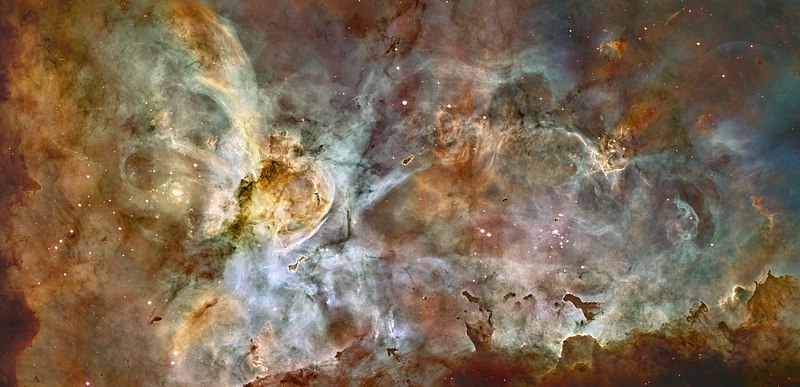
File:Eta Carinae Nebula 1.jpg
Nebulae are sometimes cited as fine tuning evidence. This is the Eta Carina Nebula from Hubble.

In “Why the universe wasn’t fine-tuned for life” (New Scientist, 08 June 2011), Marcus Chown tells us that Victor Stenger’s new The Fallacy of Fine-tuning “dismantles arguments that the laws of physics in our universe were ‘fine-tuned’ to foster life.”:

If the force of gravity were a few per cent weaker, it would not squeeze and heat the centre of the sun enough to ignite the nuclear reactions that generate the sunlight necessary for life on Earth. But if it were a few per cent stronger, the temperature of the solar core would have been boosted so much the sun would have burned out in less than a billion years – not enough time for the evolution of complex life like us.(You have to pay to read the article.)

Some, including some atheists, consider fine-tuning evidence for God (though not necessarily sufficient evidence). But not Stenger apparently. Determining whether you think he “dismantles” fine tuning, you might like to consider mathematician George Ellis’s “Toy Universe”comments on the question: Read More ›

Does science need fewer bad boys and more adults?

File:LeonardSusskindStanford2009.jpg
Leonard Susskind 2009/Jonathan Maltz

In Scientific American, Leonard Susskind is profiled as the “Bad Boy of Physics”: “Leonard Susskind rebelled as a teen and never stopped. Today he insists that reality may forever be beyond reach of our understanding (Peter Byrne, June 21, 2011),

Stanford University physicist Leonard Susskind revels in discovering ideas that transform the status quo in physics. Forty years ago he co-founded string theory, which was initially derided but eventually became the leading candidate for a unified theory of nature. For years he disputed Stephen Hawking’s conjecture that black holes do not merely swallow objects but grind them up beyond recovery, in violation of quantum mechanics. Hawking eventually conceded. And he helped to develop the modern conception of parallel universes, based on what he dubbed the “landscape” of string theory. It spoiled physicists’ dream to explain the universe as the unique outcome of basic principles.Physicists seeking to understand the deepest levels of reality now work within a framework largely of Susskind’s making. But a funny thing has happened along the way. Susskind now wonders whether physicists can understand reality.

Is this a pattern or what? Read More ›

He said it: Prof Lewontin’s strawman “justification” for imposing a priori materialist censorship on origins science

Yesterday, in the P Z Myers quote-mining and distortion thread, I happened to cite Lewontin’s infamous 1997 remark in his NYRB article, “Billions and Billions of Demons,” on a priori imposition of materialist censorship on origins science, which reads in the crucial part:

It is not that the methods and institutions of science somehow compel us to accept a material explanation of the phenomenal world, but, on the contrary, that we are forced by our a priori adherence to material causes to create an apparatus of investigation and a set of concepts that produce material explanations, no matter how counter-intuitive, no matter how mystifying to the uninitiated. Moreover, that materialism is absolute, for we cannot allow a Divine Foot in the door.

To my astonishment, I was promptly accused of quote-mining and even academic malpractice, because I omitted the following two sentences, which — strange as it may seem —  some evidently view as justifying the above censoring imposition:

The eminent Kant scholar Lewis Beck used to say that anyone who could believe in God could believe in anything. To appeal to an omnipotent deity is to allow that at any moment the regularities of nature may be ruptured, that miracles may happen.

To my mind, instead, these last two sentences are such a sad reflection of bias and ignorance, that their omission is an act of charity to a distinguished professor. Read More ›
Do you remember the psychology hoax before “evolutionary” psychology?

Before the Evolutionary Agony Aunt, Darwinian Brand Marketing, and thousands of dim frosh learning the “real” reasons people pray or why we don’t throw granny under the bus?

Think back. Think waaay back (if you can) to Wilhelm Reich, once the science darling of the Establishment, with a single, simple idea that governed everything:

The spiritual hysteria that Reich inspired in the America of the 1940s and early ’50s is as hard to explain now as the madness that 1920s crowds felt hearing Bix Beiderbecke play the cornet, especially when you consider that most Reichians were supposed to be educated skeptics and cultural critics. Even—or especially—intellectuals are not immune to America’s chronic and recurring religious revivals in their various forms.Saul Bellow, Norman Mailer, Dwight Macdonald, J.D. Salinger, Paul Goodman, William Burroughs and other bohemian culture heroes were among his followers: examples of what Lionel Trilling unsettlingly called “the moral urgency, the sense of crisis and the concern with personal salvation that mark the existence of American intellectuals.” Reich won a particular following among intellectuals, artists and cultural spokesmen who were looking for a new revo
ution after becoming disillusioned with communism.

– Henry Allen, “Thinking Inside the Box: Why some of America’s most prominent minds fell for the wildly eccentric ideas of Wilhelm Reich,”The Wall Street Journal, June 11, 2011

Reich was the prophet of the “apocalyptic orgasm.” No, really. And did any big brain get suspicious on account of his Read More ›

Is cell biologist James Shapiro a heretic? Or is this the year Darwinism collapsed?

Evolution: A View from the 21st CenturyLook what University of Chicago’s James Shapiro is saying,

New research has shown that a novel way of looking at evolution is needed. Cells are sensitive and communicative information processing entities. Novelty in evolution comes in part from genome changes that are the result of regulated cellular activity. The next step in the understanding of evolution is emerging since the Modern Synthesis of Darwinism and Mendelism and the discovery of the double helix structure of DNA in the middle of the last century. Vid also. Slides here.

He says the new way is informatics. And it’s okay for an establishment guy to just say this stuff?:

Disentangling basic issues in evolutionary debates

1. Origin of life & the first cells – still on the fringes of serious scientific discussion Read More ›

What won’t we pay to find out the origin of life?

In 2000, a man gathered two lbs of rock from a meteorite that crashed into the ice on Tagish Lake, in northern British Columbia, Canada. He kept them frozen until, in 2008, a Canadian research consortium bought them. In “Meteorite hints at life’s origins: As debate continues to swirl around arsenic-loving bacteria, a space rock yields new astrobiological clues,” Tia Ghose (The Scientist , June 9, 2011) tells us, Organic compounds from a meteorite may hold clues to the origin of life on Earth, according to a study published today (June 9) in Science. Water on the asteroid reacted with the rock to form organic compounds—including many scientists believe are the crucial ingredients that sparked life in Earth’s primordial oceans Read More ›

Bird tool use study provides answers – and questions

This is the parrot Kea using a ball shaped tool at the Multi Access Box. (Credit: Alice Auersperg)

In “Clever Tool Use in Parrots and Crows”, (ScienceDaily, June 13, 2011) , we learn:

Parrots and Corvids frequently astonish researchers investigating animal intelligence, in particular when it comes to solving technical problems. The New Caledonian crow (Corvus monduloides), for example, manufactures and uses elongated objects such as sticks or pieces of Pandanus leaves as tools to probe for grubs in tree bark and dead wood. The kea (Nestor notabilis), a mountain parrot which is unknown to employ tools in the wild, can accomplish the use of compact objects tools to knock a food reward out of place. Read More ›

My Controversial Tautology

Greetings from beautiful Tucuman, Argentina! The main point of my withdrawn paper was the tautology: If an increase in order is extremely improbable when a system is isolated, it is still extremely improbable when the system is open, unless something is entering (or leaving) which makes it NOT extremely improbable. When is a tautology controversial? When it contradicts the consensus view of science, which is that anything can happen in an open system as long as something (anything) is happening outside which, if reversed, would be even more improbable! (See my video, starting at about minute 4, if you don’t believe that is what the consensus view is all about.) I looked at the very equations on which this “compensation” Read More ›

800 million year old shelled fossil found in Yukon, Canada

In “Yukon fossils reveal oldest armoured organism” (CBC News, Jun 13, 2011), we learn, … 800 million-year-old fossilized evidence that organisms were trying to protect themselves by forming their own shield-like plates.It is the oldest evidence ever of biomineralization, the use of minerals by a living thing to form a hard shell, similar to the way clams or lobsters form their own protection. The tiny fossils date back between 717 and 812 million years. [ … ] Until now the oldest evidence from similar organisms biomineralizing was found in Africa and dates back to about 550 million years ago, Cohen said. The fossils are microscopic, of course. Do they raise questions one doesn’t ask nowadays? See also “Spider in amber Read More ›

The real difference between humans and apes – well, one of them, anyway

not a good reason
Natalie Dee

At New Scientist, Michael Marshall reports, “It is human nature to cooperate with strangers” (13 June 2011):

It seems humans really are the cooperative ape. A nomadic society in east Africa that lacks a centralised government can still regularly muster armies of several hundred warriors, most of whom are strangers to each other.

These would be Turkana men, raising a crowd to risk their lives rustling cattle. Marshall observes,

We are the only species prepared to cooperate in large numbers with unrelated individuals. The feeling was that such behaviour was a recent development, requiring a centralised political authority. Now it seems possible that such cooperation could have predated these organisational structures and may have featured in numerous large prehistoric societies hundreds of thousands of years ago.

In that case, we are allowed to believe that such co-operation exists.

Interesting that researchers Mathew and Boyd – instead of theorizing from baboons and vervet monkeys and then making an announcement that lies in the face of everyday observation – observed humans in real life (the Turkana here standing in for Cave Man).

I have noted the same quality in a starkly non-violent situation: A Toronto subway shutdown at rush hour. If humans have an “innate tendency” to interpersonal violence or lack of co-operativeness, the shutdown should demonstrate it – thousands of people from all over the globe suddenly stranded together at a major urban intersection. What happened? Why? Read More ›

A study of reviewers who read or didn’t read Meyer’s Signature in the Cell, before trashing it …

😆 Wrapping up the recent contest on why some educated people trash books unread and what to call those who do, thanks to commenter TomG at 9 who links us to a study at Thinking Christian of “noviewers” of Steve Meyer’s Signature in the Cell: So then, who read the book? Of those who rated the book favorably (5 stars), 94 percent likely read the book, and 2 percent communicated they had not read it, and 4 percent were in the middle grouping. Of those who gave the book a 1-star rating, only 26 percent likely read the book. About 43 percent of very negative ratings came from people who read the book only in part (or whose reading of Read More ›

Uncommon Descent Contest: Why do people refuse to read books they are attacking? First award – judged

The contest is here.

The question was, for a free copy of The Nature of Nature , why would a scientist or scholar actually volunteer to trash books unread?

It seems to happen frequently to books arguing for design in nature. And the winner is CannuckianYankee at 20 for

To inform the public on what I haven’t read,

To inform the public on what I don’t like,

To inform myself on why I’m such an ignoramus – but that usually doesn’t work.  :lol:

It’s simple enough to write on the blackboard or put on a sign on an office door – if you are a teacher who takes the formation of students’ minds seriously. Or in any setting where an ignoramus is volubly demonstrating his talent, unobstructed.

CannuckianYankee needs to be in touch with me at denyseoleary@gmail.com, to make arrangements for shipping.

He offers some hints for detecting these noviews at 18, for example: Read More ›

Reb Moshe asks whether paleontologist Niles Eldredge believes in Darwinian evolution …

Dr. Niles Eldredge
Niles Eldredge

Here (The Allgemeiner,, June 12, 2011). A good question, say many. Long gone are the days when Eldredge and Steve Gould hung out together, scoffing at Darwin dogma. It all got kind of dangerous later so …, but we digress.

Reb Moshe’s big thing is logic:

Please focus on this crucial distinction. Logic is not science. Logic is a commodity which cannot be hoarded or monopolized by any particular occupation or profession. Logic is an intellectual tool available equally to both scientist and non-scientist. If the issue at hand is not a question of scientific data or knowledge itself, but a logical comparison, deduction, or conclusion involving scientific data or knowledge, scientific credentials are for the most part irrelevant.

Commenting on Eldredge’s position, he homes in on the critical question: Is Eldredge in fact an utterly convinced Darwin believer? Is there truly a great long beard growing around his heart? Well, the Reb certainly doesn’t put it quite like that; he observes: Read More ›