Uncommon Descent Serving The Intelligent Design Community

Self-aware mindedness and the problem of trying to get North by going West . . .

Categories
Intelligent Design
Mind
mind and brain
rhetoric
worldview
Share
Facebook
Twitter/X
LinkedIn
Flipboard
Print
Email

It seems that self-aware mindedness is now on the table for discussion.

In that context, I see that Reciprocating Bill is arguing:

Given the fact that you entertain the notion that brains aren’t necessary for dreaming, why can’t that which dreams without a brain be a rock?

This is a carry over from a discussion where I have pointed out:
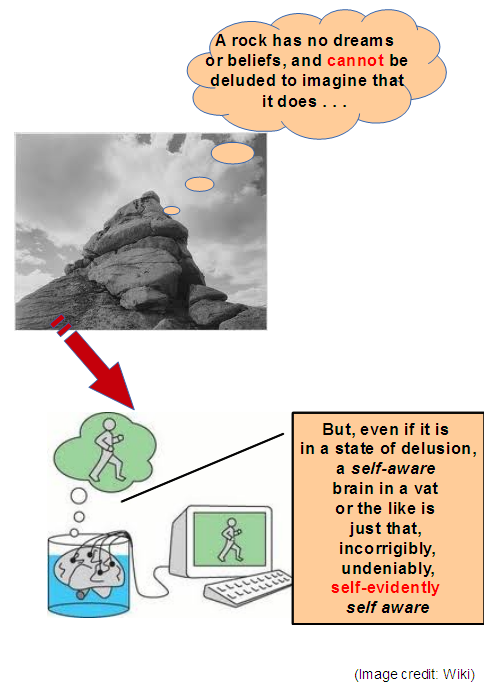
self_aware_or_not

And also how a neural network is an example of how refined rock organised into a GIGO-limited computational unit still has not broken through from mechanical cause effect computation — which a raw rock obviously cannot do — to self-aware insightful reasoning contemplation:
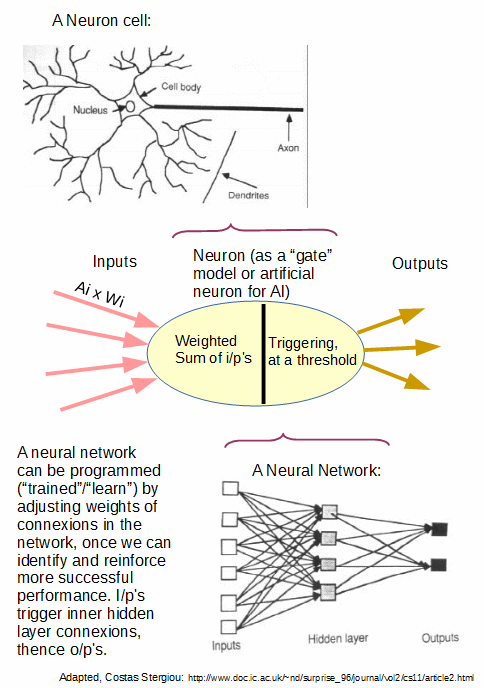
A neural network is essentially a weighted sum interconnected gate array, it is not an exception to the GIGO principle

. . . in the brain:

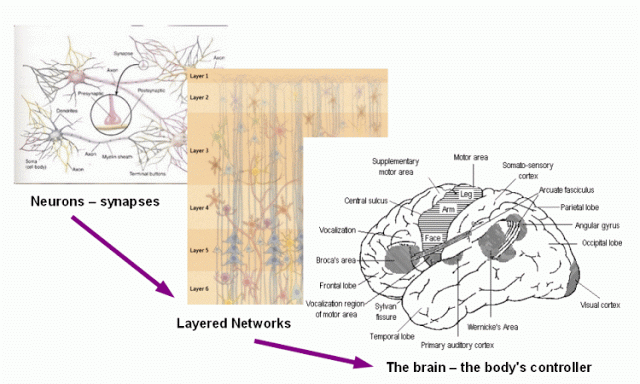
neurobrain750


That is, just as for a Thomson Mechanical Integrator:
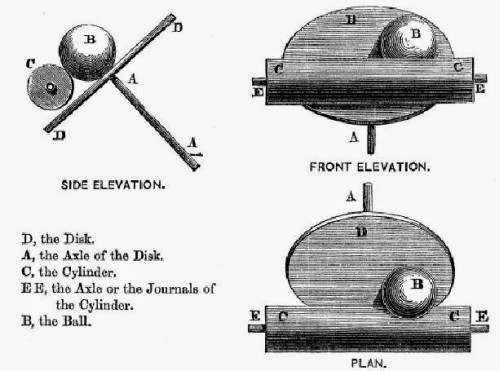
thomson_integrator

. . . or [U/d, Dec 11 ’14, HT UoIL]  the op amp based electronic equivalent:
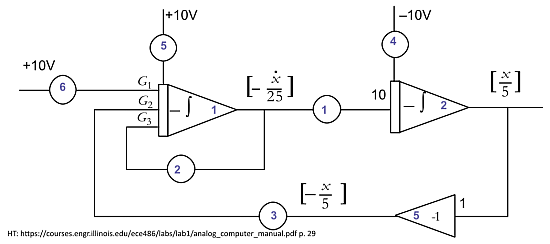
op_amp_integrator

. . . or a more conventional digital computer microprocessor central processing unit:
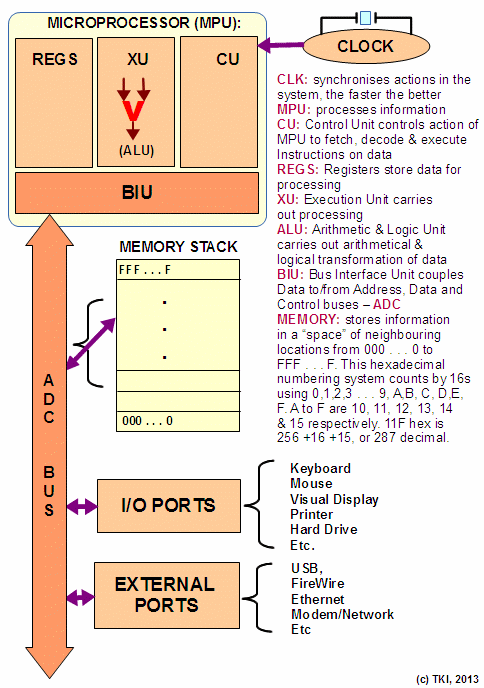
mpu_model

. . .  a neural network based computational processor is blindly computing in accord with cause-effect chains imposed by its organisation, more or less as Leibniz long ago pointed out by using his famous analogy of the Mill in Monadology 17:

[P]erception, and that which depends upon it, are inexplicable by mechanical causes, that is to say, by figures and motions. Supposing that there were a machine whose structure produced thought, sensation, and perception, we could conceive of it as increased in size with the same proportions until one was able to enter into its interior, as he would into a mill. Now, on going into it he would find only pieces working upon one another, but never would he find anything to explain perception.

Accordingly, I responded to R-B on the problem of trying to get North by going West:

___________________

>> It is quite evidently a fact that raw, in-nature rocks are passive in the face of forces of chance and mechanical necessity.

That raw rocks have no dreams SHOULD be obvious as a matter of basic fact . . . save to those with a talking point agenda. Failure to acknowledge evident fact as a start point for all else, is not a healthy sign.

Second, I looked at processed, refined rocks that are made into devices that process information. Lo, behold, just as Leibniz pointed out, they too are passive, blindly interacting in cause-effect chains. That is, the functional organisation that effects computation has not changed the basic pattern, that is why GIGO rules in Thomson mechanical integrators, digital computers and neural networks alike.

Maybe, you are old enough to recall how the first Pentiums, after being triumphantly announced, had to undergo a major recall because an error was discovered in the floating point math coprocessor embedded in the devices. That is illustrative on how blind cause-effect chains fail to attain to actual reasoning in which inference is a process of insight based meaningful inference. As Reppert summarised (cited at 29 above):

. . . let us suppose that brain state A, which is token identical to the thought that all men are mortal, and brain state B, which is token identical to the thought that Socrates is a man, together cause the belief that Socrates is mortal. It isn’t enough for rational inference that these events be those beliefs, it is also necessary that the causal transaction be in virtue of the content of those thoughts . . . [But] if naturalism is true, then the propositional content is irrelevant to the causal transaction that produces the conclusion, and [so] we do not have a case of rational inference. In rational inference, as [C S] Lewis puts it, one thought causes another thought not by being, but by being seen to be, the ground for it. But causal transactions in the brain occur in virtue of the brain’s being in a particular type of state that is relevant to physical causal transactions.

This means that, even with computational functional organisation, we have not been able to make rocks dream . . . nor can we.

Computational processing in various architectures — INCLUDING neural networks, artificial or natural (= brains) — is patently qualitatively, categorically distinct from the self aware, insightful, rational and creative contemplation we experience and observe in one another.

Where also, the notion that such dreams may emerge beyond a magical threshold is tantamount to trying to draw out something from nothing — from non-being. Until you identify and demonstrate a sufficient causal pattern or an observed fact, we can set this notion to one side as science fiction fantasy.

There is a fundamental distinction between blind, signal processing based computation and insightful, self aware rational reasoning.

So, the fact that self-aware mindedness exists is pointing to something that an a priori materialism influenced age has great difficulty acknowledging. Namely, that it is at least possible that the material world we experience as self aware conscious persons may not be the only world we experience.

In a world dominated by evolutionary materialism dressed up in a lab coat, that may be very hard to recognise or allow in the door.

But, surely, at minimum we should keep an open mind on the subject, given that we can see that computation and contemplation are fundamentally distinct phenomena.

By now, it should be plain that blind, mechanical, programmed cause effect chain computation is simply not a process of rational insight. Which carries with it the point that we should be willing to recognise that neural network or digital computer or mechanical integrator based signal processing is not even on the right path to be self-aware, conscious reasoning and meaningful contemplation.

So, rocks not only have no dreams in the raw states as a matter of observed fact, but we can show why refined and organised rocks that form computational entities, by virtuet of the radical difference between cause-effect links and ground-consequent inferences, are not even on the right road to dreaming.

Which is not just the musings of one of those suspect “IDiots” and “Creationists in cheap tuxedos” — yes, we are very aware of the prejudices and contempt-laced accusatory attitudes that are ever so common — out on a silly blog that objectors to design theory come to to try to see if they can convince the unwashed heathen to give up their backward ways.

Nope, it is a direct implication of the so-called hard problem of consciousness, as stated by Chalmers, e.g. in his original paper as just linked:

The really hard problem of consciousness is the problem of experience. When we think and perceive, there is a whir of information-processing, but there is also a subjective aspect. As Nagel (1974) has put it, there is something it is like to be a conscious organism. This subjective aspect is experience. When we see, for example, we experience visual sensations: the felt quality of redness, the experience of dark and light, the quality of depth in a visual field. Other experiences go along with perception in different modalities: the sound of a clarinet, the smell of mothballs. Then there are bodily sensations, from pains to orgasms; mental images that are conjured up internally; the felt quality of emotion, and the experience of a stream of conscious thought. What unites all of these states is that there is something it is like to be in them. All of them are states of experience.

It is undeniable that some organisms are subjects of experience. But the question of how it is that these systems are subjects of experience is perplexing. Why is it that when our cognitive systems engage in visual and auditory information-processing, we have visual or auditory experience: the quality of deep blue, the sensation of middle C? How can we explain why there is something it is like to entertain a mental image, or to experience an emotion? It is widely agreed that experience arises from a physical basis, but we have no good explanation of why and how it so arises. Why should physical processing give rise to a rich inner life at all? It seems objectively unreasonable that it should, and yet it does.

Notice, Chalmers’ confession: “It seems objectively unreasonable . . . ” and his contrasting creedal confession that follows, that somehow it has to be that the conscious emerges from the inherently non-conscious; per, the a priori materialism thesis that prevails as a dominant school of thought in our time, and which do often demands our genuflection.

But, sometimes, when you have come to what you regard as a puzzling paradox to be resolved by pushing forward ever more diligently, what you have actually arrived at is a reduction to absurdity that your paradigm makes it all but impossible to acknowledge.

You are not ever going to go North by going due West, in effect. (On a round planet such as ours, you can go West to get East . . . as Columbus proposed, but you will not ever get North by going West; as, the two directions are orthogonal.)

Let us call this, for onward reference, The get North by going West fallacy.

A manifestation of sheer wrong-headedness. Which, if insisted upon in the teeth of correction, becomes absurdity.

No wonder, Searle’s Chinese Room thought exercise then has so much bite, as it exposes the orthogonal difference between blind mechanical processing and genuine self-aware, language using understanding . . . a pivotal component of general — as opposed to limited — intelligence and rational mindedness:

Imagine that a person—me, for example—knows no Chinese and is locked in a room with boxes full of Chinese symbols and an instruction book written in English for manipulating the symbols. Unknown to me, the boxes are called “the database” and the instruction book is called “the program.” I am called “the computer.”

People outside the room pass in bunches of Chinese symbols that, unknown to me, are questions. I look up in the instruction book what I am supposed to do and I give back answers in Chinese symbols.

Suppose I get so good at shuffling the symbols and passing out the answers that my answers are indistinguishable from a native Chinese speaker’s. I give every indication of understanding the language despite the fact that I actually don’t understand a word of Chinese.

And if I do not, neither does any digital computer, because no computer, qua computer, has anything I do not have. It has stocks of symbols, rules for manipulating symbols, a system that allows it to rapidly transition from zeros to ones, and the ability to process inputs and outputs. That is it. There is nothing else. [Cf. Jay Richards here.]

The problem for evolutionary materialism is even deeper than that, as J B S Haldane long ago highlighted, in a profoundly linked observation:

“It seems to me immensely unlikely that mind is a mere by-product of matter. For if my mental processes are determined wholly by the motions of atoms in my brain I have no reason to suppose that my beliefs are true. They may be sound chemically, but that does not make them sound logically. And hence I have no reason for supposing my brain to be composed of atoms. In order to escape from this necessity of sawing away the branch on which I am sitting, so to speak, I am compelled to believe that mind is not wholly conditioned by matter.” [“When I am dead,” in Possible Worlds: And Other Essays [1927], Chatto and Windus: London, 1932, reprint, p.209.]

Reppert caps off:

It isn’t enough for rational inference that these events be those beliefs, it is also necessary that the causal transaction be in virtue of the content of those thoughts . . . [But] if naturalism is true, then the propositional content is irrelevant to the causal transaction that produces the conclusion, and [so] we do not have a case of rational inference. In rational inference, as [C S] Lewis puts it, one thought causes another thought not by being, but by being seen to be, the ground for it.

In short, you patently cannot get north by going west.

Just so, to demand why couldn’t a rock — raw or refined — be a basis for contemplation, is to try to go North by going West instead.

It is also to profoundly misunderstand the point that has been made, which has taken in not only raw rocks that are simply passive in the face of forces, but also rocks that have been processed to form signal processing computational entities.

As Searle has decisively shown, you inherently are not going in the right direction when you try to reduce insight to blind algorithmic or similar signal processing.

As Haldane has shown, blind processing — even in a neural network — is not even linked to self-aware rational insight.

And as Reppert has highlighted from Lewis [with Leibniz lurking in the background], until you acknowledge that the ground-consequent relationship is not equal to or transmutable into the cause-effect one you can get nowhere.

It is high time to see that one cannot ever get North by insisting on Going West, no mind how determined one is.  >>

___________________

So, it seems that until we become willing to acknowledge that one cannot get North by going West, there can be no mutually agreed progress on this subject.

But, of course, Planck long ago pointed out that too often old paradigms die hard, one funeral at a time as the old generation passes off the scene stuck in its old ways. In an age of pervasive computation, sooner or later, it is going to get through to a critical mass that wait a minute, rocks have no dreams and computation is not equal to contemplation — so let’s stop trying to get North by going West.

And, it is the job of a blog such as this, to stand up early and point that out — even when it is decidedly unfashionable to do so in the face of the strong riptide of the age. END

PS: As it keeps cropping up, here is the Smith Model in summary outline:
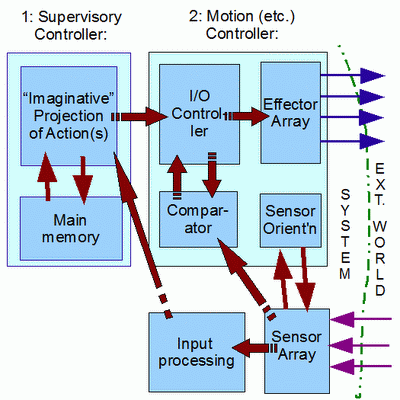
smith_model_agent

 PPS: U/D Jun 29 — as it seems that the issue of inference that mind may not necessarily be based on computational material substrates is coming up in the comments, and as in a follow-on thread on FSCO/I and its significance, here, I add the following from that post, on the inference from evident fine tuning of the observed cosmos we inhabit, to design of the cosmos:

>> . . . there is in fact only one actually observed cause of FSCO/I beyond that 500 – 1,000 bit threshold, design. Design by an intelligence. Which dovetails neatly with the implications of the needle in haystack blind search challenge. And, it meets the requisites of the vera causa test for causally explaining what we do not observe directly in light of causes uniquely known to be capable of causing the like effect.

So, perhaps, we need to listen again to the distinguished, Nobel-equivalent prize holding astrophysicist and lifelong agnostic — so much for “Creationists in cheap tuxedos” — Sir Fred Hoyle:

From 1953 onward, Willy Fowler and I have always been intrigued by the remarkable relation of the 7.65 MeV energy level in the nucleus of 12 C to the 7.12 MeV level in 16 O. If you wanted to produce carbon and oxygen in roughly equal quantities by stellar nucleosynthesis, these are the two levels you would have to fix, and your fixing would have to be just where these levels are actually found to be. Another put-up job? . . . I am inclined to think so. A common sense interpretation of the facts suggests that a super intellect has “monkeyed” with the physics as well as the chemistry and biology, and there are no blind forces worth speaking about in nature. [F. Hoyle, Annual Review of Astronomy and Astrophysics, 20 (1982): 16.]

And again, in his famous Caltech talk:

The big problem in biology, as I see it, is to understand the origin of the information carried by the explicit structures of biomolecules. The issue isn’t so much the rather crude fact that a protein consists of a chain of amino acids linked together in a certain way, but that the explicit ordering of the amino acids endows the chain with remarkable properties, which other orderings wouldn’t give. The case of the enzymes is well known . . . If amino acids were linked at random, there would be a vast number of arrange-ments that would be useless in serving the pur-poses of a living cell. When you consider that a typical enzyme has a chain of perhaps 200 links and that there are 20 possibilities for each link,it’s easy to see that the number of useless arrangements is enormous, more than the number of atoms in all the galaxies visible in the largest telescopes. [–> ~ 10^80] This is for one enzyme, and there are upwards of 2000 of them, mainly serving very different purposes. So how did the situation get to where we find it to be? This is, as I see it, the biological problem – the information problem . . . .

I was constantly plagued by the thought that the number of ways in which even a single enzyme could be wrongly constructed was greater than the number of all the atoms in the universe. So try as I would, I couldn’t convince myself that even the whole universe would be sufficient to find life by random processes – by what are called the blind forces of nature . . . . By far the simplest way to arrive at the correct sequences of amino acids in the enzymes would be by thought, not by random processes . . . .

Now imagine yourself as a superintellect [–> this shows a clear and widely understood concept of intelligence] working through possibilities in polymer chemistry. Would you not be astonished that polymers based on the carbon atom turned out in your calculations to have the remarkable properties of the enzymes and other biomolecules? Would you not be bowled over in surprise to find that a living cell was a feasible construct? Would you not say to yourself, in whatever language supercalculating intellects use: Some supercalculating intellect must have designed the properties of the carbon atom, otherwise the chance of my finding such an atom through the blind forces of nature would be utterly minuscule. Of course you would, and if you were a sensible superintellect you would conclude that the carbon atom is a fix.

Noting also:

I do not believe that any physicist who examined the evidence could fail to draw the inference that the laws of nuclear physics have been deliberately designed with regard to the consequences they produce within stars. [“The Universe: Past and Present Reflections.” Engineering and Science, November, 1981. pp. 8–12]

No wonder, in that same period, the same distinguished scientist went on record on January 12th, 1982, in the Omni Lecture at the Royal Institution, London, entitled “Evolution from Space”:

The difference between an intelligent ordering, whether of words, fruit boxes, amino acids, or the Rubik cube, and merely random shufflings can be fantastically large, even as large as a number that would fill the whole volume of Shakespeare’s plays with its zeros. So if one proceeds directly and straightforwardly in this matter, without being deflected by a fear of incurring the wrath of scientific opinion, one arrives at the conclusion that biomaterials with their amazing measure or order must be the outcome of intelligent design. No other possibility I have been able to think of in pondering this issue over quite a long time seems to me to have anything like as high a possibility of being true. [This appeared in a book of the same title, pp. 27-28. Emphases added.]>>

Comments
PS: Nowhere in the op do I say what you wish to characterise me as saying, nor in comment 8 where I first respond to you:
R-B: You talk as though you have never dealt with rocks, or with scientific observations. That’s a dead giveaway — we all know we walk around on a rock body of mass ~ 6 * 10^24 kg. There is a vast body of such observations, consequently and they fully warrant the conclusion that raw rocks are passive, mechanically moved inert entities. And for science, brain in vat scenarios are off the books absent positive indicators. But all of that is on rabbit trails. The real focal point is that when rocks are refined and organised into computing elements, they STILL remain blind, interacting by cause-effect chains without any reference to meaning. That’s why if things go out of whack, GIGO kicks in. KF
In short, I remain as speaking to computational substrates including brains. The first time the expression:
From your OP, and from your first response to me, we learned that neither rocks nor human beings have the right physical, functional or computational organization for reflective consciousness. In this respect rocks and human beings are similar.
. . . appears in the thread -- per search (and thereafter every other time save when I cited you to object) it comes from you R-Bill, in 149, preparing a summary you purport to represent what I have said. But by substituting the word "human being" for neural network computational substrate, you create a strawman. A human BRAIN is objectively a computational substrate that will have blind cause-effect chains [regardless of how many there are, that is HOW it works, cf. OP and illustration], it simply does not answer to an adequate ground for the self-aware insightful rational contemplation we carry out. I have corrected your misrepresentation of intent and on searching can find nowhere above that I use such phrasing as representing my thoughts. And indeed that sort of phrasing is alien to my thought and argument which has focussed on computational substrates and would lead to BRAINS not "human beings." The human brain does not equal the human being. This looks like yet another strawman caricature, taken up to a further level of irresponsibility. My definitive answer to any serious concerns you have had was at 75 - 77 supra, and again at 88 and elaborations. These are my answer to the concerns you raised and until I am satisfied that you take back the false accusation that I have not answered to those claims, I find little or no use in running all over the world of ideas to try to answer someone who seems only interested in misrepresentation and manipulation. If I used a phrase that can be misunderstood as you portray, I have explicitly repudiated such an interpretation. And as at now it looks like you are reporting a strawman caricature summary as though it accurately reports. That is irresponsible at best. The basic approach of civil discussion would lead in a very different direction than you have taken. Game over. KFkairosfocus
July 5, 2014
July
07
Jul
5
05
2014
01:37 PM
1
01
37
PM
PDT
R-Bill: I have consistently discussed a problem of rocks refined and organised into computational substrates, which substrates are capable only of blind computation on cause-effect bonds. Whether or not I used "human beings" in some remark you have snipped out of context, I have been clear from the outset as to what I speak of, and have clarified. If you wish to continue pretzel-twisting strawman caricature games, just remember this underscores just how much of a poster boy you are making yourself of the moral and intellectual irresponsibility and unseriousness of evolutionary materialism. KFkairosfocus
July 5, 2014
July
07
Jul
5
05
2014
01:13 PM
1
01
13
PM
PDT
KF:
Why do you insist on strawman caricatures so: Neither rocks nor human beings have the right physical, functional or computational organization for reflective consciousness.
I said:
Why are we so confident that rocks have no dreams (beliefs, desires, subjective experiences)? Because rocks don’t have the right physical organization to sustain/instantiate such states.
You said:
And neither do we.
I'm unsure why you bold "beings," in the above, but I would think the "we" in your statement designates human beings, as I am a human being and I assume you are a human being as well. If you are not a human being and take offense, just let me know.
So, instead, I point in another direction given one of your complaints.
I'm not sure what this means, but you are certainly motivated to bypass the question at hand, and go another direction.
Namely, you seem to be working on the premise, might and manipulation make ‘truth’ and ‘right.’ (As in playing right out of the Alinskyite nihilist tactics primer.)
It's unclear what "might" I have in this context. You, however, invoke the loudspeaker in the ceiling to insert remarks into my comments (against stated UD policy, as I recall), have in other threads deleted portions of others' comments and inserted your own, can ban commenters from your threads at any time you wish, etc. Those are the only forms of "might" available in an internet discussion, and it is all in your hands. I disagree that I have "manipulated" anything. Rather, I have posed the same simple argument and question for two weeks. You've evaded answering it for two weeks. All three people still following this thread can see that.Reciprocating Bill
July 5, 2014
July
07
Jul
5
05
2014
09:15 AM
9
09
15
AM
PDT
R-Bill: Why do you insist on strawman caricatures so:
Neither rocks nor human beings have the right physical, functional or computational organization for reflective consciousness.
I have consistently spoken to how raw rocks are passive under blind cause-effect chains. Then, on experience, I have pointed out how rocks refined and organised into computational substrates -- e.g. Thomson integrators, digital processors and neural networks alike -- are STILL carrying out blind, GIGO limited cause effect chains. The point being that computation is not even headed in the right direction to be self-aware, insightful, understanding and meaning based rational contemplation. And, you will kindly observe neural networks, specifically including brains. Brains are not simply to be equated to human beings without begging big questions, given what has been repeatedly put on the table but dismissed, ignored or twisted into strawman caricatures. Let me cite Reppert yet again for instance:
. . . let us suppose that brain state A, which is token identical to the thought that all men are mortal, and brain state B, which is token identical to the thought that Socrates is a man, together cause the belief that Socrates is mortal. It isn’t enough for rational inference that these events be those beliefs, it is also necessary that the causal transaction be in virtue of the content of those thoughts . . . [But] if naturalism is true, then the propositional content is irrelevant to the causal transaction that produces the conclusion, and [so] we do not have a case of rational inference. In rational inference, as [C S] Lewis puts it, one thought causes another thought not by being, but by being seen to be, the ground for it. But causal transactions in the brain occur in virtue of the brain’s being in a particular type of state that is relevant to physical causal transactions.
At this point, it is already utterly clear that you have no intent to accurately portray or fairly respond to what I have said. So, instead, I point in another direction given one of your complaints. Do you not see how you are making yourself into yet another poster-boy for the moral irresponsibility of evolutionary materialist ideology at work on the ground? Namely, you seem to be working on the premise, might and manipulation make 'truth' and 'right.' (As in playing right out of the Alinskyite nihilist tactics primer.) Please, think again. KFkairosfocus
July 5, 2014
July
07
Jul
5
05
2014
08:44 AM
8
08
44
AM
PDT
1) Neither rocks nor human beings have the right physical, functional or computational organization for reflective consciousness. RB:
Why are we so confident that rocks have no dreams (beliefs, desires, subjective experiences)? Because rocks don’t have the right physical organization to sustain/instantiate such states.
KF:
And neither do we. You failed to see that rocks lead to GIGO-constrained blind mechanical computation, minds contemplate. Including the one you are using to imagine that you are a glorified rock. (Never mind that the involved FSCO/I points to design of even that much, whether a Thomson integrator analogue comp cascade, or a collection of gates and software in silicio, or neural networks using electrochemistry.) There is a categorical difference that has to be faced and the sci-fi equivalent of poof magic, emergence or its substantial equivalent, has to be seen for what it is. KF
2) Disembodied consciousness is possible.
I am not even convinced that a brain is necessary for dreaming.
And
The fine tuning of our cosmos is a case where we find evidence that puts the possibility — I am not here arguing plausibility — of design of the physics and materials of the observed cosmos on the table. Consequently I find it necessary to be open-minded about minds that are not embodied; mind, ontologically prior to matter.
Given the above, do you deny that it follows that some additional, non-physical ingredient is necessary and sufficient for consciousness? If not, why can’t rocks possess that ingredient? An answer would start something like, “Rocks can’t possess that additional non-physical ingredient because…” Helpful hints: The ellipsis designates the place where you put your actual answer. Cutting and pasting massive quantities of stale text that does not contain an answer doesn’t provide an answer.Reciprocating Bill
July 5, 2014
July
07
Jul
5
05
2014
08:22 AM
8
08
22
AM
PDT
R-Bill: You know full well that by snipping things out of context and refusing to engage the substantial basis of conclusions they can be twisted into a strawman caricature. That is what you have done and that is what I have answered to step by step since 88, now going to the extent of laying out point by point the specific part of your remarks that I am responding to. It remains astonishing that you refuse to entertain the reason why I hold (with the likes of a Sir Fred Hoyle) that cosmological evidence of fine tuning and onwards of design points to the possibility -- not at this stage the conclusion, just the possibility, thus the grounds to sit at the table as of right not sufferance -- that mind is a serious candidate explanation for our material observed cosmos. Thus, there is a reasonable view that we should be open tot he possibility that mind is potentially independent of matter. Instead, you have tried to push me into a strawmannish straightjacketed lumpen platonist who reacts to brains, "ick." Sorry, at this stage your insistence on caricatures becomes revelatory of willful distortion to play rhetorical games without regard to duties of care to truth or fairness. KF PS: And even this, evidently plays off a caricature that design thinkers are guilty of general strawman caricatures so turnabout is probably perceived as fair play by virtue of being tit for perceived tat.kairosfocus
July 5, 2014
July
07
Jul
5
05
2014
07:54 AM
7
07
54
AM
PDT
P^5S: At this point let me again remind of the Haldane test that points to the self-referential incoherence of evolutionary materialism:
"It seems to me immensely unlikely that mind is a mere by-product of matter. For if my mental processes are determined wholly by the motions of atoms in my brain I have no reason to suppose that my beliefs are true. They may be sound chemically, but that does not make them sound logically. And hence I have no reason for supposing my brain to be composed of atoms. In order to escape from this necessity of sawing away the branch on which I am sitting, so to speak, I am compelled to believe that mind is not wholly conditioned by matter.” [["When I am dead," in Possible Worlds: And Other Essays [1927], Chatto and Windus: London, 1932, reprint, p.209.]
kairosfocus
July 5, 2014
July
07
Jul
5
05
2014
07:44 AM
7
07
44
AM
PDT
KF: Do you deny that the following accurately characterizes your views? 1) Neither rocks nor human beings have the right physical, functional or computational organization for reflective consciousness. 2) Disembodied consciousness is possible. Do you deny that it follows from these claims that some additional, non-physical ingredient is necessary and sufficient for consciousness? If not, why can't rocks possess that ingredient? An answer would start something like, “Rocks can’t possess that additional non-physical ingredient because…” Helpful hints: The ellipsis designates the place where you put your actual answer. Cutting and pasting massive quantities of stale text that does not contain an answer doesn't provide an answer.Reciprocating Bill
July 5, 2014
July
07
Jul
5
05
2014
07:42 AM
7
07
42
AM
PDT
PPPS: Since you, R-Bill, by implication seem to object to my summary of critiques of evo mat beliefs since Plato in The Laws Bk X, let me clip Plato on the subject, noting that Alcibiades and co are probably his exhibit A: _________________ >> [The avant garde philosophers, teachers and artists c. 400 BC] say . . . that fire and water, and earth and air [[i.e the classical "material" elements of the cosmos], all exist by nature and chance, and none of them by art, and that as to the bodies which come next in order-earth, and sun, and moon, and stars-they have been created by means of these absolutely inanimate existences. The elements are severally moved by chance and some inherent force according to certain affinities among them-of hot with cold, or of dry with moist, or of soft with hard, and according to all the other accidental admixtures of opposites which have been formed by necessity. After this fashion and in this manner the whole heaven has been created, and all that is in the heaven, as well as animals and all plants, and all the seasons come from these elements, not by the action of mind, as they say, or of any God, or from art, but as I was saying, by nature and chance only . . . . [[T]hese people would say that the Gods exist not by nature, but by art, and by the laws of states, which are different in different places, according to the agreement of those who make them; and that the honourable is one thing by nature and another thing by law, and that the principles of justice have no existence at all in nature, but that mankind are always disputing about them and altering them; and that the alterations which are made by art and by law have no basis in nature, but are of authority for the moment and at the time at which they are made.- [[Relativism, too, is not new; complete with its radical amorality rooted in a worldview that has no foundational IS that can ground OUGHT. ] These, my friends, are the sayings of wise men, poets and prose writers, which find a way into the minds of youth. They are told by them that the highest right is might [[ Evolutionary materialism leads to the promotion of amorality], and in this way the young fall into impieties, under the idea that the Gods are not such as the law bids them imagine; and hence arise factions [Evolutionary materialism-motivated amorality "naturally" leads to continual contentions and power struggles], these philosophers inviting them to lead a true life according to nature, that is, to live in real dominion over others [such amoral factions, if they gain power, "naturally" tend towards ruthless tyranny; here, too, Plato hints at the career of Alcibiades], and not in legal subjection to them . . . >> ________________ If you think this classic 2350 year old rebuke by one of the top ten minds of our civilisation is harsh, outdated and unwarranted, then please ponder this by Michael Ruse & E. O. Wilson in their 1991 essay, “The Evolution of Ethics”:
The time has come to take seriously the fact [--> This is a gross error at the outset, as macro-evolution is a theory (an explanation) about the unobserved past of origins and so cannot be a fact on the level of the observed roundness of the earth or the orbiting of planets around the sun etc.] that we humans are modified monkeys, not the favored Creation of a Benevolent God on the Sixth Day . . . We must think again especially about our so-called ‘ethical principles.’ The question is not whether biology—specifically, our evolution—is connected with ethics, but how. As evolutionists, we see that no justification of the traditional kind is possible. Morality, or more strictly our belief in morality, is merely an adaptation put in place to further our reproductive ends. Hence the basis of ethics does not lie in God’s will … In an important sense, ethics as we understand it is an illusion fobbed off on us by our genes to get us to cooperate. It is without external grounding … Ethics is illusory inasmuch as it persuades us that it has an objective reference. This is the crux of the biological position. Once it is grasped, everything falls into place . . .
Thus also, Provine at the 1998 U Tenn Darwin Day remark went on record:
Naturalistic evolution has clear consequences that Charles Darwin understood perfectly. 1) No gods worth having exist; 2) no life after death exists; 3) no ultimate foundation for ethics exists; 4) no ultimate meaning in life exists; and 5) human free will is nonexistent . . . . The first 4 implications are so obvious to modern naturalistic evolutionists that I will spend little time defending them. Human free will, however, is another matter. Even evolutionists have trouble swallowing that implication. I will argue that humans are locally determined systems that make choices. They have, however, no free will . . .
I hardly need to say that if we do not have genuine responsible freedom, ethics is dead, which does in fact open the door to nihilism, and is inescapably amoral, having no foundational IS that can ground OUGHT. Dawkins also comes up in concurrence:
Nature is not cruel, only pitilessly indifferent. This lesson is one of the hardest for humans to learn. We cannot accept that things might be neither good nor evil, neither cruel nor kind, but simply callous: indifferent to all suffering, lacking all purpose . . . . In a universe of electrons and selfish genes, blind physical forces and genetic replication, some people are going to get hurt, other people are going to get lucky, and you won’t find any rhyme or reason in it, nor any justice. The universe that we observe has precisely the properties we should expect if there is, at bottom, no design, no purpose, no evil and no good, nothing but pitiless indifference . . . . DNA neither cares nor knows. DNA just is. And we dance to its music. [[ “God’s Utility Function,” Sci. Am. Aug 1995, pp. 80 - 85.]
Maybe, you do not like the fact that I am adducing on evidence that evolutionary materialism is an inherently amoral worldview that has no sound defense against nihilism, i.e. opens the gates of the city to it. There is abundant evidence of such, coming from critics over the past 2350 years, corroboraed by statements in our time from leading evolutionary materialism advocates. All I will say to such is that a system that cannot recognise that it is self evidently true that one ought not to kidnap, torture, rape and murder a little child and in the end boils down to might and manipulation make 'right', is morally bankrupt. I did not choose the worldview premises or where they lead by force of the logic and what has happened by dint of actual history especially in the past 100 years as the ghosts of 100 million plus victims moan out. So, please, do not shoot the messenger simply because you cannot face the consequences of your scheme of thought. Maybe, you should give it up instead as morally bankrupt? P^4S: I cannot make out why you imagine that listing the crimes of the Russian state over the past few months in taking over the Crimea through subterfuge and force and now going on to foment troubles in the rest of Ukraine, constitute reason to dismiss me. I do not endorse the Ukrainians as sinless innocents, no more than I think the Poles were utterly innocent of all wrongs in 1938 - 39 or thereabouts. For that matter the Western Allies were not without sins either, a point Hitler used as the pivot of a speech in reply to Roosevelt's question that pivoted on twisting about -- the very same tactic that it seems has stirred your ire (and doubtless that of the usual suspect sites) because I have pointed it out in what you have done -- and accusing them of their sins, even while his planners on his instructions were putting the finishing touches to aggressive war plans. Six years later and 60 millions dead with a devastated continent and more, the world knew the difference.kairosfocus
July 5, 2014
July
07
Jul
5
05
2014
07:41 AM
7
07
41
AM
PDT
PPS: In 167 of course, R-B tries a turnspeech twistabout projection in order to duck his responsibility for such a destructive tactic. And his trick there is how dare you point out that (1) such was used by KS and other objectors to ID, and (2) how dare you point out who were the notorious mid C20 champions of that nasty tactic. The turnabout projective accusation of course, is meant to confuse the onlooker by blaming "he hit back first" or worse. R-B needs to know that for me to recognise, identify and point out antecedents to such common anti ID tactics, is to simply lay out some facts that are all too relevant to uncivil behaviour by too many objectors to design theory. The real answer is simple. Avoid such twistabout accusations R-B et al at ATBC, Anti-Evo, and other sites all too notorious for incivility and abuse.kairosfocus
July 5, 2014
July
07
Jul
5
05
2014
07:07 AM
7
07
07
AM
PDT
PS: Yet again, the answer that R-Bill pretends is not an answer and plays strawman caricature, drumbeat- repetition- of- irresponsible - (known or should be known) falsehoods- to- create- a- misleading- impression- of- truth dismissal agitprop tactic rhetorical games; to avoid addressing on the merits. This time I will insert his remarks again in clips step by step to show the specific responsiveness of what I said from 88 on. In particular note how by displacing the discussion on possibility of mind antecedent to matter from its actual context in what I said and what Sir Fred Hoyle said, he smuggles in a lumpen Platonist ghost in machine or disembodied ghost caricature meant to be a basis for cruel and dismissive mockery of the imagined IDiot -- in effect, "Ick," i.e, he resents the messily biological nature of brains: >>> For record, I will again reproduce the answer to your repeated question that appears at 88, now adding not only NB commentaries but clips in sequence that highlight just which parts of the main clip given numbered points respond to. To disagree with it would be one thing, but to pretend it does not exist and/or is not cogent is for you to speak with disregard to duties of care to truth and fairness. Which, itself points to classic problems and gaps of the evolutionary materialist view in regards to duty to truth and to others, never mind its lab coat. Such concerns are rooted in its lack of a sound foundational IS that can properly ground OUGHT, and the deleterious influence this view has exerted among the educated and influential classes in recent years. For the record from 88 and 96 (and with the suspicion that it is all too likely that a twisted version of this latest tactic will be presented elsewhere as though it were unquestionable proof that I have had no reasonable answer): ______________________ >> kairosfocusJune 28, 2014 at 5:59 am (Edit) R-Bill: It’s easy to accuse of question-begging when one reverses a course of argument, turning it into a strawman caricature. Which is what the following clipped does:
[R-B:} Human beings, in your framework, are conscious and self-aware not because of the organization of their brains, bodies and nervous systems (which on your view are neither necessary nor sufficient for consciousness), but because they possess an additional, non-physical ingredient, one that may even make possible completely disembodied consciousness. No need for mucilaginous brains and nervous systems. Ick.
RB, clip 1: >Human beings, in your framework, are conscious and self-aware not because of the organization of their brains, bodies and nervous systems (which on your view are neither necessary nor sufficient for consciousness) but because they possess an additional, non-physical ingredient . . . .> [KF:} 1 –> Human beings, in my framework, are immediately conscious of being self-aware, contemplative beings.
[NB 1: Onlookers seeking truth: the framework of say a building lays out guidelines for its foundation, etc. That is, the matter starts with the foundational, so I have every right to focus my reply on fact no 1, our self-aware contemplative inner lives through which we access all other facts]
2 –> Indeed, it is our prime fact, the fact through which we become aware of all other facts. 3 –> And in fact, if you will scroll back up to the OP, you will see that the first graphic ponders a hypothetical case of a self-aware brain in vat, dreaming of being a runner under stimulus of feed-in probes. 4 –> The point made is that while the entity may be confused as to circumstances, it cannot be so on its status of being self-aware.
[NB 2: I point back to the roots of the discussion and to the significance of a pivotal self-evident fact. Namely, being self-aware is immediate and undeniable, even if one otherwise labours under a delusion.]
RB, clip 2: > not because of the organization of their brains, bodies and nervous systems (which on your view are neither necessary nor sufficient for consciousness), > 5 –> By contrast, a rock (which we observe to be entirely passive) has neither dreams nor beliefs and cannot be deluded to imagine such.
[NB 3: Here, I point out a generally conceded fact; one that highlights the rhetorical artificiality and distractive nature of the gambit being used. With raw in-nature rocks, there is no empirical data whatsoever that they are self-aware, self-moved entities. And, every bit of data one may desire that they are passive, mechanically moved entities fully explained as mixtures of minerals fully explained empirically on being passively moved by forces of physics and chemistry etc. In short, absent a material body of evidence of self awareness, there is no good reason to suggest that any party to a discussion has a problem if he simply accepts the premise that discussions on scientific matters must be empirically grounded -- must be factually adequate. But then, as I had to highlight at 75 above as a start-point, RB has a problem with inductive reasoning by abductive inference to best explanation on factual adequacy, coherence and explanatory balance and power.]
6 –> I then went on to point out, based on physics of computational substrates, that such entities do not in the end rise above the level of cogs grinding against one another in blind, GIGO-limited cause effect chains. 7 –> That is, even refined rocks organised into computational substrates are still only passively, blindly interacting.
[NB 4: I have pointed out, from the outset, that when raw in-nature rocks are converted into computational substrates -- in our actual observation, invariably by design, and involving FSCO/I which is a strong empirical sign of design -- these substrates are composed of components that blindly interact through physcical and/or chemical forces. That is, they are blindly, mechanically working in cause-effect physical-chemical chains, not based on actual insight. If they are built with bugs, or go out of whack, they will just as blindly produce errors. Indeed, they are limited by GIGO. And, specifically this involves neural networks such as may be found in brains and nervous systems. That is, we have got not one inch Northwards to self-aware, insight based rational contemplation, by concentrating on going west on blind mechanical GIGO-limited cause-effect chains.]
8 –> I took time to point out how neural networks, a computational architecture, fall into this category. 9 –> So, I concluded that brains are processor networks, they are not in themselves the seat and source or credible cause of self-aware, contemplative, insight- and understanding, meaning based rational inquiry.
[NB 5: as just pointed out.]
10 –> Which, again, we directly experience and observe.
[NB 6: Notice the reference to Fact no 1. Explanations answer to facts, and good ones will draw together the material facts in coherent unified ways, neither being simplistic nor an ad hoc patchwork. Going ever faster West hoping to get North is a major factual gap and breakdown of coherence. Indeed, as I have repeatedly pointed out it simply fails to account for self-aware insightful rational contemplation, by implicitly implying poof-magic emergence. Demonstrate such emergence empirically, then we have something to talk about. Otherwise this becomes a grand case of a non sequitur.]
11 –> So, you have set up and knocked over a strawman caricature, driven by perceptions of how I “must” be reasoning. R-B, clip 3: > but because they possess an additional, non-physical ingredient, one that may even make possible completely disembodied consciousness > 12 –> You then set up a second strawman caricature on mind vs matter.
[NB 7: Notice, I am progressing through the paragraph put up by R-Bill in stages, now turning to: " . . . because they possess an additional, non-physical ingredient, one that may even make possible completely disembodied consciousness." Here, R-Bill has skipped over the context of empirical evidence and reasoning in which -- following points made by lifelong agnostic and Nobel equivalent prize holding Astrophysicist Sir Fred Hoyle -- I highlighted how the evident fine tuning of our observed cosmos puts an inference to design of the cosmos by an intelligence beyond the observed material cosmos, on the table. That is, unlike the hinted at a priori supernaturalism that peeks out from between R-Bill's lines, I am pointing to a significant body of empirical evidence. One that makes Mind ontologically prior to matter a reasonable view (cf. here and onwards for a bit more on that topic). Where, as a long time critic of UD, R-Bill has a particular duty of being aware that in the ID Foundations series, years ago now, I emphasised the importance of the cosmological design inference and so helped to give it a much higher profile at UD. Indeed, I have long been on repeated record here at UD that the FSCO/I in observed cell based life could be sufficiently explained on a molecular nanotech lab some generations beyond Venter et al.; but it is at the issue of fine tuning that we see a need to have designing mind beyond cosmos sitting at the table as of right not sufferance. Which echoes and builds on the thinking in the very first technical design theory work, by Thaxton et al in TMLO, 1984. So in that context, R-Bill has a lot of explaining to do about the strawman he set up and knocked over.] [NB 7a: observe how, where I highlighted why I point to evidence of cosmological fine tuning that leaves the POSSIBILITY of mind antecedent to and causal of the observed material cosmos on the table, R-B tried to deride and dismiss without addressing the merits, in 167 above: >> I can’t really follow the panicky paragraph that is your note at “NB 7.” >> Translated, I am not bothering to actually address what you -- and actually more importantly Sir Fred Hoyle -- actually said when I can get away with a barbed emotionally loaded dismissal. ]
13 –> Notice, how you have consistently failed to cogently engage the point on our observed, fine tuned cosmos, as has been pioneered by lifelong agnostic and Nobel equivalent prize-holding Astrophysicist, Sir Fred Hoyle.
[NB 8: I point to the actual context for my point, as opposed to the strawman caricature.]
14 –> I have pointed out that this argument as developed puts to the table the possibility to be taken seriously, that mind is ontologically prior to the observed material cosmos. And, a serious candidate to be its cause, per inductive inference to best explanation . . . which form of reasoning underlies science and which you plainly struggle with when it may point where you have a problem going. 15 –> Obviously, I cannot make you revise your thinking on inductive logic, but I can highlight the selective hyperskepticism and its self-refuting consequences. 16 –> Where also, inductive inference to best explanation across serious candidates obviously is not question-begging. R-B, clip 4: > because they possess an additional, non-physical ingredient, one that may even make possible completely disembodied consciousness. No need for mucilaginous brains and nervous systems. Ick. > 17 –> So, no, I am no lumpen Platonist, I leave that to the New Agers playing with Gnosticism. 18 –> Likewise, I do not despise computational substrates, whether metallic or Silicon or wetware -- as in "mucilaginous brains and nervous systems . . . " -- electrochemical. 19 –> I am just insistent on being clear-eyed about their limitations: GIGO, blind cause-effect. And no basis for self aware consciousness in sight save the materialistic magic of “emergence,” which looks suspiciously like something from nothing. 20 –> where, again, I suggest you ponder Fact No 1: self-aware consciousness. 21 –> And again, Reppert’s point speaks:
. . . let us suppose that brain state A, which is token identical to the thought that all men are mortal, and brain state B, which is token identical to the thought that Socrates is a man, together cause the belief that Socrates is mortal. It isn’t enough for rational inference that these events be those beliefs, it is also necessary that the causal transaction be in virtue of the content of those thoughts . . . [But] if naturalism is true, then the propositional content is irrelevant to the causal transaction that produces the conclusion, and [so] we do not have a case of rational inference. In rational inference, as [C S] Lewis puts it, one thought causes another thought not by being, but by being seen to be, the ground for it. But causal transactions in the brain occur in virtue of the brain’s being in a particular type of state that is relevant to physical causal transactions.
___________________ You cannot get North by heading West. >> ______________________ For the record. >>>kairosfocus
July 5, 2014
July
07
Jul
5
05
2014
06:17 AM
6
06
17
AM
PDT
R-Bill: The easily observed repeatedly documented fact is, I have answered your question, taking pains to do so. You may not like how I answered it, disentangling strawman caricatures, identifying blinding a prioris and impositions, alerting the reader to the first fact through which we access other facts -- self-aware insightful rational contemplation, cutting apart complex loaded barbed questions, and linking to fundamental issues but you cannot truthfully or responsibly state that I have failed to answer the questions and points you raised. Actually, I anticipated many of them from my original posts and especially in key citations. It is at the point where you have chosen to derail a discussion of a serious issue by making false accusations that we part company. I note, further, that objectors have had little or nothing to say on the actual substantial matters and have resorted to agendas of tired talking points in defense of a worldview that on fair and grounded comment is patently and inescapably self referentially incoherent and so irretrievably irrational, evolutionary materialism. This pattern is also far more widespread, the anti-design movement clustering on NCSE et al seems to base its case on ideology and toxic misrepresentation to the point of speaking with disregard to truth banking on what they say being widely perceived as truth. That is a saddening, sobering, sorry picture. So, I suggest to you and your ilk, that you take stock of what you have done, day in, day out, for many years now. And, I suggest to you that when raw in-nature rocks show serious signs of self-aware contemplative rational behaviour, there will be something to explain. Until then, not. And, I point out that the evidence, from Thomson integrators to digital processors to neural networks also uniformly underscores that Leibnitz had a serious point in Monadology 17, which I have highlighted:
perception, and that which depends upon it, are inexplicable by mechanical causes, that is to say, by figures and motions. Supposing that there were a machine whose structure produced thought, sensation, and perception, we could conceive of it as increased in size with the same proportions until one was able to enter into its interior, as he would into a mill. Now, on going into it he would find only pieces working upon one another, but never would he find anything to explain perception.
In the series of blog discussions that includes the above post, I have examined this in light of my experience with processing. The conclusion is simple and well substantiated. Computation, by analogue or digital or neural network systems, is inherently a blind cogs on cogs cause-effect chain so designed by an external entity as to effect relevant signal processing. It is GIGO limited, and will just as blindly output rubbish as correct results. The cogs and the processor neither know nor care. Blind cause-effect chain GIGO limited computation is not self-aware, value-motivated, insightful, understanding and meaning based rational contemplation. And to imagine that the reason why a raw rock does not contemplate is that it fails of computational organisation is therefore to commit a categorical confusion. One cannot get North by going West. And, this is meant to draw attention to the blinding effect of a paradigm. In this case, a priori evolutionary materialism dressed up in a lab coat. Which cannot pass the Haldane test:
"It seems to me immensely unlikely that mind is a mere by-product of matter. For if my mental processes are determined wholly by the motions of atoms in my brain I have no reason to suppose that my beliefs are true. They may be sound chemically, but that does not make them sound logically. And hence I have no reason for supposing my brain to be composed of atoms. In order to escape from this necessity of sawing away the branch on which I am sitting, so to speak, I am compelled to believe that mind is not wholly conditioned by matter.” ["When I am dead," in Possible Worlds: And Other Essays [1927], Chatto and Windus: London, 1932, reprint, p.209.]
Again, you cannot get North by going West. KFkairosfocus
July 5, 2014
July
07
Jul
5
05
2014
06:11 AM
6
06
11
AM
PDT
The fact is from 75 on and from 88 on, substantial answers were given to R-Bill’s points
But not an answer to the question I have posed from the outset of this discussion.Reciprocating Bill
July 4, 2014
July
07
Jul
4
04
2014
01:14 PM
1
01
14
PM
PDT
PPS: Did you know that in 1933 the commies set thr Reichstag on fire, in 1918 the Jews stabbed Germany in the back, in 1938 the Czecks were oppressing the Sudeten Germans, in 1939, the Poles attacked German Radio Stations -- there were bodies in Polish uniforms to prove it, and last of all in 1941, Stalin was about to attack Germany! In short, twistabout accusations in the teeth of evident facts has a long pedigree. The fact is from 75 on and from 88 on, substantial answers were given to R-Bill's points, but he has chosen to twist facts into pretzels to distract from the sorry record that rocks, whether raw or refined have no dreams, and that refining and functionally organising rocks into computational substrates has no evident ability to surmount the problem of blind cause effect chains limited by GIGO. While, we experience self aware insightful, rational contemplation. After the side tracks and tangents we are still at: computation is not contemplation, no more than you get North by going West.kairosfocus
July 4, 2014
July
07
Jul
4
04
2014
12:31 PM
12
12
31
PM
PDT
FTR: It is now quite obvious that defenders of the notion that meat changed itself into mind by blind chance and mechanical necessity . . . meat being a form of refined, organised rock . . . have nothing more than "it must have been so" backed up by implicit a priori evolutionary materialism. And in particular refining and organising rocks into computational substrates leaves the same fundamental dynamic at work: blind, cause effect chains. Such are at utter cross-purposes to insightful, self aware, meaning based rational contemplation that understands, sees grounds and consequences and draws conclusions rationally. This is, on the face of it, strong substantiation for the point long since made by Haldane:
“It seems to me immensely unlikely that mind is a mere by-product of matter. For if my mental processes are determined wholly by the motions of atoms in my brain I have no reason to suppose that my beliefs are true. They may be sound chemically, but that does not make them sound logically. And hence I have no reason for supposing my brain to be composed of atoms. In order to escape from this necessity of sawing away the branch on which I am sitting, so to speak, I am compelled to believe that mind is not wholly conditioned by matter.” ["When I am dead," in Possible Worlds: And Other Essays [1927], Chatto and Windus: London, 1932, reprint, p.209.]
So, the sound effects tell the sorry tale:
zip, zip, zip, zip, zip . . . CRAAACK . . !
After all the distractive, side tracking, issue clouding rhetoric has been said and done by the materialism champions, they in the end have no answer to that. One cannot get North by going West. Let us take due note. KF PS: When R-Bill and co show us a raw in nature rock that shows evidence of self-aware intelligence, or a refined rock rearranged into a computational substrate that does the same, e.g. something analogous to the Glasgow coma scale test, or perhaps the Ada Lovelace test, then there will be something to explain. In the meanwhile, what we have on abundant empirical evidence is the well founded induction -- notice repeated the sly side slips into demanding a deductive proof on an empirical matter [i.e. selective hyperskepticism] -- that raw or refined rocks organised into computational substrates alike prove to be passively driven by blind cause effect patterns and forces. This R-Bill et al know or should know, but seem to be insistent on refusing to acknowledge. Likewise, such know or should know that it is abundantly shown that refining and organising rocks into computational substrates is relevant to blind GIGO limited cause effect bond chains, not to insightful reasoning on understanding.kairosfocus
July 4, 2014
July
07
Jul
4
04
2014
12:03 PM
12
12
03
PM
PDT
KF:
Self aware contemplativeness is our first fact and the pivotal matter to be addressed.
But not relevant to the question I have posed, as I acknowledged and agreed with your 1, acknowledged that it is your view that physical substrates are neither necessary or sufficient to 1, and drew from that the consequence that a non-physical ingredient must therefore be necessary. The question at hand is, given all that, why can't rocks possess that non-physical ingredient? A question that remains (and obviously will perpetually remain) unanswered. Then there is this: 1) On your view, neither rocks nor human beings have the right physical, functional or computational organization for reflective consciousness. 2) It is your view that disembodied consciousness is possible. 3) It follows that that an additional non-physical ingredient is both necessary and sufficient for contemplative consciousness. Do you dispute that 1) and 2) are views that you hold? Do you dispute that 3) follows from 1) and 2)? KF:
PS: Your dismissal of note 7, which highlights that I have gone through your remark step by step in points, is revealing, sadly revealing.
Sadly revealing of my error while selecting text to copy, Einstein.
7 –> That is, even refined rocks organised into computational substrates are still only passively, blindly interacting.
Why would I deliberately omit that? That (and NB-4) make no difference whatsoever to my reply: "Yes, of course you’ve said this. That affirms my observation that you assert that neither rocks nor human beings have the right physical, functional or computational organization for reflective consciousness, and that something more, a non-physical ingredient, is therefore required. Which leads to my question: “On what basis do you claim that rocks, passive entities interacting in blind cause-effect chains, don’t also have that non-physical ingredient?” A question that remains unanswered. Maybe it would help if I make clear what I mean by "answer." An answer would start something like, "Rocks can't possess that additional non-physical ingredient because..." The ellipsis designates the place where you put your actual answer. Please don't put 88 there, because it's not an answer, and is way to long.Reciprocating Bill
July 4, 2014
July
07
Jul
4
04
2014
11:56 AM
11
11
56
AM
PDT
PPS: R-Bill, it seems you have at least understood what is at stake when you insistently speak with disregard to the truth, hoping to profit from what you have said being taken as true. One hopes, therefore that in future you will take duties of care to truth and fairness seriously.kairosfocus
July 4, 2014
July
07
Jul
4
04
2014
11:52 AM
11
11
52
AM
PDT
R-Bill: The first dismissal is pivotal to seeing your problem. Self aware contemplativeness is our first fact and the pivotal matter to be addressed. The contrast of rocks in raw and refined organised states simply shows why a blind cause-effect process is not adequate to address such. And, as has been repeatedly pointed out, there is good evidence that rocks are merely passive entities so there is nothing there to be explained. But the thing that is offered up as a materialistic explanation, refining and organising rocks also turned out to be on teh wrong orientation completely: blind, GIGO-limited cause effect chains are relevant to computation under external direction and control, but not to the thing to be explained, the fact of self aware, insightful rational contemplation. Of course this has been repeatedly pointed out but the game of sideslips, tangents, strawmen arguments and outright denials of evident truth in hopes of the denial being perceived as true continues. Sad. KF PS: Your dismissal of note 7, which highlights that I have gone through your remark step by step in points, is revealing, sadly revealing.kairosfocus
July 4, 2014
July
07
Jul
4
04
2014
11:13 AM
11
11
13
AM
PDT
@RB (163)
I would say that this is beneath you, but the fact is that similar statements are characteristic of you, KF.
The record shows otherwise. Goebbels and kf are a the same level: here, here, here, here, here, here, here Even evomats like Allen MacNeil and Richard Dawkins use the Goebbels-reference: here, here, here This shows that RB has no regard for truth! By denying and dismissing reality you think you can make it go away. There's a critical gap truth-wise! I trust you will do better next time!JWTruthInLove
July 4, 2014
July
07
Jul
4
04
2014
10:42 AM
10
10
42
AM
PDT
KF:
For record, I will again reproduce the answer to your repeated question that appears at 88.
Good. Let’s see which point or points raised in your 88 address my question:
1 –> Human beings, in my framework, are immediately conscious of being self-aware, contemplative beings.
I don’t disagree. But irrelevant to my question.
2 –> Indeed, it is our prime fact, the fact through which we become aware of all other facts. 3 –> And in fact, if you will scroll back up to the OP, you will see that the first graphic ponders a hypothetical case of a self-aware brain in vat, dreaming of being a runner under stimulus of feed-in probes. 4 –> The point made is that while the entity may be confused as to circumstances, it cannot be so on its status of being self-aware.
Also not relevant to my question. (But possibly false as a matter of empirical fact, as seen in Cotard delusion, in which the afflicted person holds the delusion that he or she is dead.)
5 –> By contrast, a rock (which we observe to be entirely passive) has neither dreams nor beliefs and cannot be deluded to imagine such.
I also agree. On my view, as simple aggregates, rocks have the wrong physical and functional organization for dreams and beliefs. However, on your view, a non-physical ingredient is both necessary and sufficient for consciousness, and you’ve never told us why a rock can’t be in possession of that ingredient.
6 –> I then went on to point out, based on physics of computational substrates, that such entities do not in the end rise above the level of cogs grinding against one another in blind, GIGO-limited cause effect chains. 8 –> I took time to point out how neural networks, a computational architecture, fall into this category. 9 –> So, I concluded that brains are processor networks, they are not in themselves the seat and source or credible cause of self-aware, contemplative, insight- and understanding, meaning based rational inquiry.
Yes, of course you've said this. That affirms my observation that you assert that neither rocks nor human beings have the right physical, functional or computational organization for reflective consciousness, and that something more, a non-physical ingredient, is therefore required. Which leads to my question: “On what basis do you claim that rocks, passive entities interacting in blind cause-effect chains, don’t also have that non-physical ingredient?”
10 –> Which, again, we directly experience and observe.
We are capable of self-aware, contemplative, insight- and understanding, meaning based rational inquiry. I’ve never disputed this. Nor does it have any bearing upon the question I have posed.
11 –> So, you have set up and knocked over a strawman caricature, driven by perceptions of how I “must” be reasoning.
No, I asked a question that you claim to have answered in your post at 88. We’re half-way through that post; no sign of an answer yet. Let’s continue.
12 –> You then set up a second strawman caricature on mind vs matter.
I can’t really follow the panicky paragraph that is your note at “NB 7.” However, 1) On your view, neither rocks nor human beings have the right physical, functional or computational organization for reflective consciousness. 2) It is your view that disembodied consciousness is possible. 3) It follows that that an additional non-physical ingredient is both necessary and sufficient for contemplative consciousness. Do you dispute that 1) and 2) are views that you hold? Do you dispute that 3) follows from 1) and 2)?
13 –> Notice, how you have consistently failed to cogently engage the point on our observed, fine tuned cosmos, as has been pioneered by lifelong agnostic and Nobel equivalent prize-holding Astrophysicist, Sir Fred Hoyle.
Because it has no bearing upon the question I have posed to you.
14 –> I have pointed out that this argument as developed puts to the table the possibility to be taken seriously, that mind is ontologically prior to the observed material cosmos. And, a serious candidate to be its cause, per inductive inference to best explanation . . . which form of reasoning underlies science and which you plainly struggle with when it may point where you have a problem going.
Yes, I acknowledge that your argument puts on the table the idea that mind is ontologically prior to the observed material cosmos. My question builds upon that acknowledgement. If the physical and computational organization of human beings is not sufficient, or even necessary, for consciousness, and if consciousness may be disembodied - both notions that flow from the idea that mind is ontologically prior to matter - then clearly a non-physical ingredient is required for consciousness, including human consciousness. My question, heretofore unanswered, is: On what basis do you claim that rocks, passive entities interacting in blind cauise-effect chains, don’t also have that non-physical ingredient?
5 –> Obviously, I cannot make you revise your thinking on inductive logic, but I can highlight the selective hyperskepticism and its self-refuting consequences. 16 –> Where also, inductive inference to best explanation across serious candidates obviously is not question-begging. 17 –> So, no, I am no lumpen Platonist, I leave that to the New Agers playing with Gnosticism. 19 –> I am just insistent on being clear-eyed about their limitations: GIGO, blind cause-effect. And no basis for self aware consciousness in sight save the materialistic magic of “emergence,” which looks suspiciously like something from nothing.
None of which have any bearing upon my question. ("Inference to the best explanation" is abductive, not inductive, however.)
18 –> Likewise, I do not despise computational substrates, whether metallic or Silicon or wetware electrochemical.
You must own a Mac.
20 –> where, again, I suggest you ponder Fact No 1: self-aware consciousness.
OK, I did. Cool. Given that is is your view that the self-aware consciousness I just contemplated flows from a non-physical source that is both necessary and sufficient for same, why can’t a rock also possess that ingredient, and therefore also be self-aware?
21 –> And again, Reppert’s point speaks:
Reppert’s passage speaks to perceived limitations of a view other than your own, and has no bearing on my question, which concerns the entailments of your claims. ----- So, like neutrinos through naboulsi, we've passed through your entire post 88 without striking anything resembling a response to my question.
FYI, R-Bill, to speak with disregard to the truth as you have again and again done, in hopes of profiting by what is said being perceived as the truth is something that has a name, a short three letter word beginning with l.
I see. Stating that someone is a liar without actually spelling the word is "within the pale." Which I think makes you - well, you guess the letter.Reciprocating Bill
July 4, 2014
July
07
Jul
4
04
2014
10:37 AM
10
10
37
AM
PDT
F/N: As R-Bill is liable to distort comenteary in service to an agenda I note for record on his clip:
The famous mind-body problem, the source of so much controversy over the past two millennia, has a simple solution. The solution has been available to any educated person since serious work began on the brain nearly a century ago, and, in a sense, we all know it to be true. Here it is: Mental phenomena are caused by neurophysiological processes in the brain and are themselves features of the brain. To distinguish this view from the many others in the field, I call it “biological naturalism.” Mental events and processes are as much part of our biological natural history as digestion, mitosis, meiosis, or enzyme secretion.
All this says is that per evolutionary materialist a prioris, mind is to be reduced to or emerges from or is an epiphenomenon of computation in the brain which is blind and cause-effect. However, it is to be noted that -- quite obviously given his known stance -- I cited Searle as testifying against known interest and revealing a key contrast between blind processing and rational contemplation and response. Which the Chinese room thought exercise amply documents. This can easily be seen from how I have cited his work. That is then to be set in the context of another remark I have repeatedly clipped from noted evolutionist J B S Haldane, who makes the point succinctly and well:
"It seems to me immensely unlikely that mind is a mere by-product of matter. For if my mental processes are determined wholly by the motions of atoms in my brain I have no reason to suppose that my beliefs are true. They may be sound chemically, but that does not make them sound logically. And hence I have no reason for supposing my brain to be composed of atoms. In order to escape from this necessity of sawing away the branch on which I am sitting, so to speak, I am compelled to believe that mind is not wholly conditioned by matter.” ["When I am dead," in Possible Worlds: And Other Essays [1927], Chatto and Windus: London, 1932, reprint, p.209.]
In that light, ponder this from Reppert (as repeatedly pointed out and repeatedly ignored):
. . . let us suppose that brain state A, which is token identical to the thought that all men are mortal, and brain state B, which is token identical to the thought that Socrates is a man, together cause the belief that Socrates is mortal. It isn’t enough for rational inference that these events be those beliefs, it is also necessary that the causal transaction be in virtue of the content of those thoughts . . . [But] if naturalism is true, then the propositional content is irrelevant to the causal transaction that produces the conclusion, and [so] we do not have a case of rational inference. In rational inference, as Lewis puts it, one thought causes another thought not by being, but by being seen to be, the ground for it. But causal transactions in the brain occur in virtue of the brain’s being in a particular type of state that is relevant to physical causal transactions.
It should be plain that rocks, whether raw or refined and organised into computational substrates, simply do no more than cause-effect sequences of action blindly. This is in itself capital reason to infer on evidence, massive evidence that rocks show no sign of self-aware self-moved behaviour. So it is idle rhetoric to acknowledge that in one breath then pretend to cast in the teeth of myself why does that happen. Again, blind computation which is what organisation of materials effects, is simply not in the same category as contemplative reasoned thought. The insistence on confusing the two is ideological, not reasonable. And we see highlighted a critical gap in evolutionary materialist thought, never mind the lab coat. KFkairosfocus
July 4, 2014
July
07
Jul
4
04
2014
09:01 AM
9
09
01
AM
PDT
R-Bill, I am now completely convinced that you believe that by blandly denying and dismissing a reality you can make it go away, at least so far as the audience you are interested in is concerned. Just for record, for I don't remember how many times since 88: >>> Kindly, observe the note at 100 above. For record, I will again reproduce the answer to your repeated question that appears at 88. To disagree with it would be one thing, but to pretend it does not exist and/or is not cogent is for you to speak with disregard to duties of care to truth and fairness. Which, itself points to classic problems and gaps of the evolutionary materialist view in regards to duty to truth and to others, never mind its lab coat. Such concerns are rooted in its lack of a sound foundational IS that can properly ground OUGHT, and the deleterious influence this view has exerted among the educated and influential classes in recent years. For the record from 88 and 96 (and with the suspicion that it is all too likely that a twisted version of this latest tactic will be presented elsewhere as though it were unquestionable proof that I have had no reasonable answer): ______________________ >> kairosfocusJune 28, 2014 at 5:59 am (Edit) R-Bill: It’s easy to accuse of question-begging when one reverses a course of argument, turning it into a strawman caricature. Which is what the following clipped does:
[R-B:} Human beings, in your framework, are conscious and self-aware not because of the organization of their brains, bodies and nervous systems (which on your view are neither necessary nor sufficient for consciousness), but because they possess an additional, non-physical ingredient, one that may even make possible completely disembodied consciousness. No need for mucilaginous brains and nervous systems. Ick.
[KF:} 1 –> Human beings, in my framework, are immediately conscious of being self-aware, contemplative beings.
[NB 1: Onlookers seeking truth: the framework of say a building lays out guidelines for its foundation, etc. That is, the matter starts with the foundational, so I have every right to focus my reply on fact no 1, our self-aware contemplative inner lives through which we access all other facts]
2 –> Indeed, it is our prime fact, the fact through which we become aware of all other facts. 3 –> And in fact, if you will scroll back up to the OP, you will see that the first graphic ponders a hypothetical case of a self-aware brain in vat, dreaming of being a runner under stimulus of feed-in probes. 4 –> The point made is that while the entity may be confused as to circumstances, it cannot be so on its status of being self-aware.
[NB 2: I point back to the roots of the discussion and to the significance of a pivotal self-evident fact. Namely, being self-aware is immediate and undeniable, even if one otherwise labours under a delusion.]
5 –> By contrast, a rock (which we observe to be entirely passive) has neither dreams nor beliefs and cannot be deluded to imagine such.
[NB 3: Here, I point out a generally conceded fact; one that highlights the rhetorical artificiality and distractive nature of the gambit being used. With raw in-nature rocks, there is no empirical data whatsoever that they are self-aware, self-moved entities. And, every bit of data one may desire that they are passive, mechanically moved entities fully explained as mixtures of minerals fully explained empirically on being passively moved by forces of physics and chemistry etc. In short, absent a material body of evidence of self awareness, there is no good reason to suggest that any party to a discussion has a problem if he simply accepts the premise that discussions on scientific matters must be empirically grounded -- must be factually adequate. But then, as I had to highlight at 75 above as a start-point, RB has a problem with inductive reasoning by abductive inference to best explanation on factual adequacy, coherence and explanatory balance and power.]
6 –> I then went on to point out, based on physics of computational substrates, that such entities do not in the end rise above the level of cogs grinding against one another in blind, GIGO-limited cause effect chains. 7 –> That is, even refined rocks organised into computational substrates are still only passively, blindly interacting.
[NB 4: I have pointed out, from the outset, that when raw in-nature rocks are converted into computational substrates -- in our actual observation, invariably by design, and involving FSCO/I which is a strong empirical sign of design -- these substrates are composed of components that blindly interact through physcical and/or chemical forces. That is, they are blindly, mechanically working in cause-effect physical-chemical chains, not based on actual insight. If they are built with bugs, or go out of whack, they will just as blindly produce errors. Indeed, they are limited by GIGO. And, specifically this involves neural networks such as may be found in brains and nervous systems. That is, we have got not one inch Northwards to self-aware, insight based rational contemplation, by concentrating on going west on blind mechanical GIGO-limited cause-effect chains.]
8 –> I took time to point out how neural networks, a computational architecture, fall into this category. 9 –> So, I concluded that brains are processor networks, they are not in themselves the seat and source or credible cause of self-aware, contemplative, insight- and understanding, meaning based rational inquiry.
[NB 5: as just pointed out.]
10 –> Which, again, we directly experience and observe.
[NB 6: Notice the reference to Fact no 1. Explanations answer to facts, and good ones will draw together the material facts in coherent unified ways, neither being simplistic nor an ad hoc patchwork. Going ever faster West hoping to get North is a major factual gap and breakdown of coherence. Indeed, as I have repeatedly pointed out it simply fails to account for self-aware insightful rational contemplation, by implicitly implying poof-magic emergence. Demonstrate such emergence empirically, then we have something to talk about. Otherwise this becomes a grand case of a non sequitur.]
11 –> So, you have set up and knocked over a strawman caricature, driven by perceptions of how I “must” be reasoning. 12 –> You then set up a second strawman caricature on mind vs matter.
[NB 7: Notice, I am progressing through the paragraph put up by R-Bill in stages, now turning to: " . . . because they possess an additional, non-physical ingredient, one that may even make possible completely disembodied consciousness." Here, R-Bill has skipped over the context of empirical evidence and reasoning in which -- following points made by lifelong agnostic and Nobel equivalent prize holding Astrophysicist Sir Fred Hoyle -- I highlighted how the evident fine tuning of our observed cosmos puts an inference to design of the cosmos by an intelligence beyond the observed material cosmos, on the table. That is, unlike the hinted at a priori supernaturalism that peeks out from between R-Bill's lines, I am pointing to a significant body of empirical evidence. One that makes Mind ontologically prior to matter a reasonable view (cf. here and onwards for a bit more on that topic). Where, as a long time critic of UD, R-Bill has a particular duty of being aware that in the ID Foundations series, years ago now, I emphasised the importance of the cosmological design inference and so helped to give it a much higher profile at UD. Indeed, I have long been on repeated record here at UD that the FSCO/I in observed cell based life could be sufficiently explained on a molecular nanotech lab some generations beyond Venter et al.; but it is at the issue of fine tuning that we see a need to have designing mind beyond cosmos sitting at the table as of right not sufferance. Which echoes and builds on the thinking in the very first technical design theory work, by Thaxton et al in TMLO, 1984. So in that context, R-Bill has a lot of explaining to do about the strawman he set up and knocked over.]
13 –> Notice, how you have consistently failed to cogently engage the point on our observed, fine tuned cosmos, as has been pioneered by lifelong agnostic and Nobel equivalent prize-holding Astrophysicist, Sir Fred Hoyle.
[NB 8: I point to the actual context for my point, as opposed to the strawman caricature.]
14 –> I have pointed out that this argument as developed puts to the table the possibility to be taken seriously, that mind is ontologically prior to the observed material cosmos. And, a serious candidate to be its cause, per inductive inference to best explanation . . . which form of reasoning underlies science and which you plainly struggle with when it may point where you have a problem going. 15 –> Obviously, I cannot make you revise your thinking on inductive logic, but I can highlight the selective hyperskepticism and its self-refuting consequences. 16 –> Where also, inductive inference to best explanation across serious candidates obviously is not question-begging. 17 –> So, no, I am no lumpen Platonist, I leave that to the New Agers playing with Gnosticism. 18 –> Likewise, I do not despise computational substrates, whether metallic or Silicon or wetware electrochemical. 19 –> I am just insistent on being clear-eyed about their limitations: GIGO, blind cause-effect. And no basis for self aware consciousness in sight save the materialistic magic of “emergence,” which looks suspiciously like something from nothing. 20 –> where, again, I suggest you ponder Fact No 1: self-aware consciousness. 21 –> And again, Reppert’s point speaks:
. . . let us suppose that brain state A, which is token identical to the thought that all men are mortal, and brain state B, which is token identical to the thought that Socrates is a man, together cause the belief that Socrates is mortal. It isn’t enough for rational inference that these events be those beliefs, it is also necessary that the causal transaction be in virtue of the content of those thoughts . . . [But] if naturalism is true, then the propositional content is irrelevant to the causal transaction that produces the conclusion, and [so] we do not have a case of rational inference. In rational inference, as [C S] Lewis puts it, one thought causes another thought not by being, but by being seen to be, the ground for it. But causal transactions in the brain occur in virtue of the brain’s being in a particular type of state that is relevant to physical causal transactions.
___________________ You cannot get North by heading West. >> ______________________ For the record. >>> FYI, R-Bill, to speak with disregard to the truth as you have again and again done, in hopes of profiting by what is said being perceived as the truth is something that has a name, a short three letter word beginning with l. I trust you will do better next time. KFkairosfocus
July 4, 2014
July
07
Jul
4
04
2014
08:25 AM
8
08
25
AM
PDT
By the way, KF, since you are fond of quoting John Searle on his "Chinese Room" thought experiment, it is worth noting his view on the relationship between brain and mind, as indicated by the following opening paragraph of his 1992 book, "The Rediscovery of the Mind."
The famous mind-body problem, the source of so much controversy over the past two millennia, has a simple solution. The solution has been available to any educated person since serious work began on the brain nearly a century ago, and, in a sense, we all know it to be true. Here it is: Mental phenomena are caused by neurophysiological processes in the brain and are themselves features of the brain. To distinguish this view from the many others in the field, I call it “biological naturalism.” Mental events and processes are as much part of our biological natural history as digestion, mitosis, meiosis, or enzyme secretion.
Searle proposed the "Chinese Room" thought experiment as an argument against "Strong AI," not contra a biological account of mental processes.Reciprocating Bill
July 4, 2014
July
07
Jul
4
04
2014
07:22 AM
7
07
22
AM
PDT
KF:
R-Bill: Why are you pretending that I have not given you a very detailed answer more than once or twice or three times?
I am stating that you haven’t given an answer to my question because you haven’t.
Do you, instead only rhetorically wish to make a falsehood seem true by repeating it in a drumbeat like Dr Goebbels at work? That speaks volumes, none of it to your good.
I would say that this is beneath you, but the fact is that similar statements are characteristic of you, KF. By the way, wasn’t it you who stated that accusations of lying are “a step beyond the pale of civil discussion?” (In 117 above, five-six lines below an accusation that I am lying.)
You may want to suggest that somehow it emerges on blind computation at some threshold, but that is something you are far from demonstrating, so you have no right to pretend that that explanation or insistence is the only “scientific” approach.
I’ve made exactly zero statements claiming that the problem of consciousness is solved by crossing a computational threshold. The assertion would be irrelevant to my question in any event, as I my query goes to implications of your claims, not my beliefs about the matter. In fact, I granted the opposite arguendo, as carefully laid out in 149 above:
To be clear... Neither does it flow from the almost oceanic computational and information processing characteristics of the physical human brain. Something more than physical and computational organization is required for contemplative consciousness. Let us call this something more a “non-physical” ingredient (as neutral a term as possible).
KF:
In summary, for record again: rocks are inherently passive entities, interacting in blind cause-effect chains.
See 149 above, which lays out reasoning I have presented since the beginning of this discussion, upon which you have yet to comment. On your view, neither rocks nor human beings have the right physical, functional or computational organization for reflective consciousness. It is also your view that disembodied consciousness is possible. It follows that that an additional non-physical ingredient is both necessary and sufficient for contemplative consciousness. If degrees of physical, functional and computational organization don’t account for the presence of that ingredient, and therefore contemplative consciousness, then it cannot be the case that rocks lack that ingredient due to their simplicity, passivity, and participation in cause-effect chains - physical characteristics that exemplify their degree of physical and functional organization. On what basis do you claim that rocks, passive entities interacting in blind cauise-effect chains, don’t also have that non-physical ingredient?Reciprocating Bill
July 4, 2014
July
07
Jul
4
04
2014
06:13 AM
6
06
13
AM
PDT
F/N: Let me clip from a related exchange in another thread: language thread, 22 on: >> Intelligence is conceptual which may be spatial, linguistic, movie in the head and more but always it depends on insight. Understanding. That is the underlying force of Searle’s thought case. Absent insight and linked creative imagination, intelligence becomes a problem . . . . That a neural network can carry out a steepest descent or similar algorithm is not in dispute. Whee that comes from is not either. Computation is not contemplation and rocks only make it so far as the former, for fundamental reasons . . . As an illustration of the first problem, observe Wiki:
The [connection] weights in a neural network are adjusted according to some learning rule or algorithm. Thus, connectionists have created many sophisticated learning procedures for neural networks. Learning always involves modifying the connection weights. In general, these involve mathematical formulas to determine the change in weights when given sets of data consisting of activation vectors for some subset of the neural units. By formalizing learning in such a way, connectionists have many tools. A very common strategy in connectionist learning methods is to incorporate gradient descent over an error surface in a space defined by the weight matrix. All gradient descent learning in connectionist models involves changing each weight by the partial derivative of the error surface with respect to the weight.
First, we see anthropomorphising a heuristic procedure as “learning.” (Well do I recall behavourism’s operant conditioning games, where successful patterns in a search space were reinforced and learning was equated to acquired behaviour patterns.) Second, we see our old friends of evolutionary computing. Including in effect a fitness function and things like steep slope seeking goal directed algorithms. When we deal with relevant complex functionality, the islands isolated in the search space eat up the possibility of successful search, unless of course one is effectively starting within the shores of an island. This points to search for search challenges. Which, per evo mat influenced ideas, is driven by blind chance and mechanical necessity on the gamut of solar system or observed cosmos. Thus hitting the FSCO/I threshold challenge. Genuine creative insight is light years away from this sort of thing. However we do it, we perceive key relationships and possibilities, and can evaluate likeliness to succeed. Then, if we are good at it, we can plunk down close enough for debugging to carry us the rest of the way absent nasty black swans lurking . . . . machines simply are not learning save in a confusing metaphorical sense . . . . I should add that Descartes’ conundrum had to do with an excess of reliance on the power of doubt in western phil. He painted himself in a corner . . . to doubt is to dismiss save we have certain proof, in effect . . . and tried to get out through a perceived self evident truth, self-aware cognition. The subsequent ugly ditch between the inner world and the outer one runs into the difficulty highlighted by Bradley. Namely to claim to know we cannot know the external world is to claim to know something of the external world. Self referential incoherence. Instead, we will find it profitable to view any claim that points to general delusion as self-undermining. For the obvious reason. Intelligence is closely tied to understanding and that manifests itself in concepts, perceptions, awareness, intuitions etc etc. The notion that these are simply reducible to connexions of arrays of neurons or similar processor elements runs straight into the search space challenges at the heart of ID, and pivotally beg questions on representation of info and how we find ourselves on or close to islands of function esp when blind chance and mechanical necessity are deemed the only acceptable formative forces. Intelligence is linked to awareness of patterns, but suggesting that if such are not reduced to coded symbols then the cause-effect blind processing issue is irrelevant again begs questions. And I repeat, the heart of Searle’s point is not about language but the difference between acting blindly and with insight. I don’t know if your paradigm is a roadblock to seeing that but please note that language has never been my prime focus. Insight has . . . . >>kairosfocus
July 4, 2014
July
07
Jul
4
04
2014
04:25 AM
4
04
25
AM
PDT
R-Bill: Why are you pretending that I have not given you a very detailed answer more than once or twice or three times? For sure, you are not so unintelligent that you cannot understand that an answer was given. Do you, instead only rhetorically wish to make a falsehood seem true by repeating it in a drumbeat like Dr Goebbels at work? That speaks volumes, none of it to your good. In summary, for record again: rocks are inherently passive entities, interacting in blind cause-effect chains. When refined and reorganised into procesors that compute, whether analogue or digital or neural network -- the latest darling it seems -- they still retain that inherent blind character. Such processors compute, carrying out blind cause effect chains that neither know nor care that what they do is informational. Hence the caution GIGO. In short, rocks refined and organised are relevant to blind computation, they are not relevant to insightful, self-aware, rational contemplation that understands, creates, sees connexions that are ground and consequent and concludes based on insight. That latter pattern is what we exhibit routinely, and undeniably. You may want to suggest that somehow it emerges on blind computation at some threshold, but that is something you are far from demonstrating, so you have no right to pretend that that explanation or insistence is the only "scientific" approach, however you may wish to disdain anything that leaves a possible opening for the soul. KFkairosfocus
July 4, 2014
July
07
Jul
4
04
2014
04:01 AM
4
04
01
AM
PDT
Joe, we dream during sleep; which we seem to need primarily for bodily rest -- that is where we often feel the lack most strongly. There also seems to be a bit of housekeeping brain work going on in sleep, and which is a strong indication that the canard on how poof there goes consciousness is poof gone itself. Notice how that line went quiet? A mind without a body -- and the pivotal case is the one that may well have designed the cosmos, would be in a different case. Such a mind might day dream as we call it, contemplate, which is more what I have in mind, but that is another story yet again. KFkairosfocus
July 4, 2014
July
07
Jul
4
04
2014
03:51 AM
3
03
51
AM
PDT
Yes, matter and energy are different manifestations of the same thing but neither would exist without information.Joe
July 2, 2014
July
07
Jul
2
02
2014
01:39 PM
1
01
39
PM
PDT
Matter (mass) and energy are two forms of the same thing: particles. I am not at all sold on the idea that information is more fundamental than matter/energy. IMO, if something can change, it is matter.Mapou
July 2, 2014
July
07
Jul
2
02
2014
01:16 PM
1
01
16
PM
PDT
Umm matter couldn't exist without energy and information. And information is neither matter nor energy.Joe
July 2, 2014
July
07
Jul
2
02
2014
11:49 AM
11
11
49
AM
PDT
1 2 3 … 7