Uncommon Descent Serving The Intelligent Design Community

Failure of the “compensation argument” and implausibility of evolution

Categories
Biophysics
Intelligent Design
Share
Facebook
Twitter/X
LinkedIn
Flipboard
Print
Email

Granville Sewell and Daniel Styer have a thing in common: both wrote an article with the same title “Entropy and evolution”. But they reach opposite conclusions on a fundamental question: Styer says that the evolutionist “compensation argument” (henceforth “ECA”) is ok, Sewell says it isn’t. Here I briefly explain why I fully agree with Granville. The ECA is an argument that tries to resolve the problems the 2nd law of statistical mechanics (henceforth 2nd_law_SM) posits to unguided evolution. I adopt Styer’s article as ECA archetype because he also offers calculations, which make clearer its failure.

The 2nd_law_SM as problem for evolution.

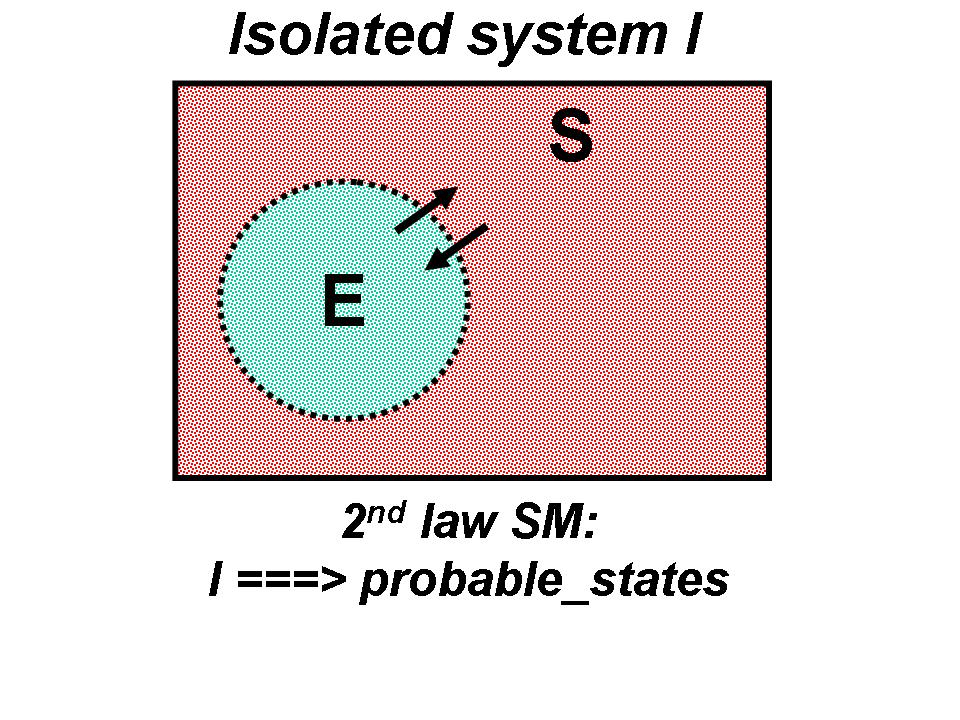
The 2nd_law_SM says that a isolated system goes toward its more probable macrostates. In this diagram the arrow represents the 2nd_law_SM rightward trend/direction:

organization … improbable_states … systems ====>>> probable_states

Sewell says:

“The second law is all about using probability at the microscopic level to predict macroscopic change. […] This statement of the second law, or at least of the fundamental principle behind the second law, is the one that should be applied to evolution.”

The physical evolution of a isolated system passes spontaneously through macrostates with increasing values of probability until arriving to equilibrium (the most probable macrostate). Since organization is highly improbable a corollary of the 2nd_law_SM is that isolated systems don’t self-organize. That is the opposite of what biological evolution pretends.

See the picture:
cs1

Styer’s ECA.

Since the 2nd_law_SM applies to isolated systems the ECA says: the Earth E is not a isolated system, then its entropy can decrease thanks to an entropy increase (compensation) in the surroundings S (wrt to the energy coming from the Sun). Unfortunately to consider open the systems is useless, because, as Sewell puts it:

“If an increase in order is extremely improbable when a system is closed, it is still extremely improbable when the system is open, unless something is entering which makes it not extremely improbable.”

Here is how Styer applies the ECA to show that “evolution is consistent with the 2nd law”.
Suppose that, due to evolution, each individual organism is 1000 times more improbable that the corresponding individual was 100 years ago (Emory Bunn says 1000 times is incorrect, it should be 10^25 times, but this is a detail). If Wi is the number of microstates consistent with the specification of an initial organism I 100 years ago, and Wf is the number of microstates consistent with the specification of today’s improved and less probable organism F, then

Wf = Wi / 1000

At this point he uses Boltzmann’s formula:

S = k * ln (W)

where S = entropy, W = number of microstates, k = 1.38 x 10^-23 joules/degrees, ln = logarithm.

Then he calculates the entropy change over 100 years, and finally the entropy decrease per second:

Sf – Si = -3.02 x 10^-30 joules/degrees

By considering all individuals of all species he gets the change in entropy of the biosphere each second: -302 joules/degrees. Since he knows that the Earth’s physical entropy throughput (due to energy from the Sun) each second is: 420 x 10^12 joules/degrees he concludes: “at a minimum the Earth is bathed in about one trillion times the amount of entropy flux required to support the rate of evolution assumed here”, then evolution is largely consistent with the 2nd law.

The problem in Styer’s argument (and in general in the ECA).

Although it could seem an innocent issue of measure units the introduction of the Boltzmann’s formula with k = 1.38 x 10^-23 joules/degrees in this context is a conceptual error. With such formula the ECA has transformed a difficult problem of probability (in connection with the arise of ultra-complex organized systems) into a simple issue of energy (“joule” is unit of energy, work, or amount of heat). This assumes a priori that energy is able to organize organisms from sparse atoms. But such assumption is totally gratuitous and unproved. That energy can do that is exactly what the ECA should prove in the first place. So Styer’s ECA begs the question.

Similarly Andy McIntosh (cited by Sewell) says:

Both Styer and Bunn calculate by slightly different routes a statistical upper bound on the total entropy reduction necessary to ‘achieve’ life on earth. This is then compared to the total entropy received by the Earth for a given period of time. However, all these authors are making the same assumption—viz. that all one needs is sufficient energy flow into a [non-isolated] system and this will be the means of increasing the probability of life developing in complexity and new machinery evolving. But as stated earlier this begs the question…

The Boltzmann’s formula in the ECA, with its introduction of joules of energy, establishes a bridge between probabilities and the joules coming from the Sun. Unfortunately this link is unsubstantiated here because no one has proved that joules cause biological organization. On the contrary, in my previous post “The illusion of organizing energy” I explained why any kind of energy per se cannot create organization in principle. To greater reason, thermal energy is unable to the task. In fact, heat is the more degraded and disordered kind of energy, the one with maximum entropy. So the ECA would contain also an internal contradiction: by importing entropy in E one decreases entropy in E!

The problem of Boltzmann’s formula, as used in the ECA, is then “to buy” probability bonus with energy “money”. Sewell expresses the same concept with different words:

The compensation argument is predicated on the idea […] that the universal currency for entropy is thermal entropy.

That conversion / compensation is not allowed if one hasn’t proved at the outset a direct causation role of energy in producing the effect, biological organization, which is in the opposite direction of the 2nd_law_SM rightward arrow (extreme left on the above diagram). In a sense the ECA conflates two different planes. This wrong conflation is like to say that a roulette placed inside a refrigerated room can easily output 1 million “black” in a row because its entropy is decreased compared to the outside.

Note that evolution doesn’t imply a single small deviation from the trend, quite differently it implies countless highly improbable processes happened continually in countless organisms during billion years. Who claims that evolution doesn’t violate the 2nd_law_SM, would doubt a violation if countless tornados always turned rubble into houses, cars and computers for billion years? Sewell asks (backward tornado is the metaphor he uses more). In conclusion Roger Caillois is right: “Clausius and Darwin cannot both be right.”

Implausibility of evolution.

Styer’s paper is also an opportunity to see the problem of evolution from a probabilistic viewpoint. You will note the huge difference of difficulty of the probabilistic scenario compared to the above enthusiastic thermal entropy scenario, with potentially 1,000,000,000,000 times evolution!
In Appendix #2 he proposes a problem for students: “How much improved and less probable would each organism be, relative to its (possibly single-celled) ancestor at the beginning of the Cambrian explosion? (Answer: 10 raised to the 1.8 x 10^22 times)”. Call this monster number “a”, Wi = the initial microstates, Wf = the final microstates, W = the total microstates. According to Styer’s answer (which is correct as calculation) we have:

Wf = Wi / a

The probability of the initial macrostate is Wi / W. The probability of the final macrostate is Wf / W. Suppose Wf = 1, then Wi is = a. W must be equal or greater a otherwise (Wi / W) would be greater than 1 (impossible). Therefore the probability to occur of the final macrostate is:

(Wf / W) equal or less (1 / a)

This is the probability of evolution of a single individual organism in the Cambrian:

1 on 10 raised to the 1.8 x 10^22

a number with more than 10^22 digits (10 trillion billion digits). This miraculous event had to occur 10^18 times, for each of other organisms.

Dembski’s “universal probability bound” is:

1 / 10^150

1 on a number with “only” 150 digits. Therefore evolution is far beyond the plausibility threshold. In conclusion: the ECA fails to prove that “evolution is consistent with the 2nd law”, and we have also a proof of the implausibility of evolution based on probability.

Some could object: “you cannot have both ways, if the ECA is wrong then Appendix #2 is wrong too, because it uses the same method, then the evolution probability is not correct”.
Answer: the method is biased toward evolution both in ECA and in Appendix #2. This means the evolution probability is even worse than that, and the implausibility of evolution holds to greater reason.

Comments
fifthmonarchyman: If an event is highly specified there is indeed only a very limited number of macrostates that will do. And a snowflake is highly specific compared to the amorphous water from which it forms. You can determine this by comparing the available microstates for both forms. fifthmonarchyman: By the very same token there is only one macrostate that deliminates the difference between an organism that is “alive” and one that is dead. There's are all sorts of living things that meet the specification "alive". They range from bacteria to bamboo to bambiraptors. fifthmonarchyman: Given materialism there are no organisms – there are just particles in motion. That would probably be a surprise to most materialists. The question is whether it is possible to coherently recognize macroscopic objects; table, star, aardvark. It is. fifthmonarchyman: These particles don’t form a whole, they are all doing their own thing, blissfully unaware of something bigger than them. The same with the water molecules in snowflakes. niwrad: I simply put that the 2nd_law_SM is a BIAS (symbolized by an arrow) toward probability, while organization is extreme improbability. And, given liquid water, a snowflake is improbable as a chance arrangement of microstates. It takes work to move water molecules into the configuration of a snowflake, just as it takes work to weave warp and weft into a tapestry.Zachriel
April 3, 2015
April
04
Apr
3
03
2015
05:44 AM
5
05
44
AM
PDT
Piotr #233, I'm truly sorry to hear that. Do tell, what is an organism - under materialism - other than particles in motion?
Piotr #215: I have no idea how you define “materialism”, but nobody I know denies the existence of patterns, structures, systems, etc. After all, molecules, atoms and particles are also structures to which some kind of identity can be ascribed.
What are these structures you speak of - under materialism - other than particles in motion? Or do you prefer the term "fermions and bosons"?
The basic things everything is made up of are fermions and bosons. That’s it. Perhaps you thought the basic stuff was electrons, protons, neutrons, and maybe quarks. Besides those particles, there are also leptons, neutrinos, muons, tauons, gluons, photons, and probably a lot more elementary particles that make up stuff. But all these elementary particles come in only one of two kinds. Some of them are fermions; the rest are bosons. There is no third kind of subatomic particle. And everything is made up of these two kinds of things. Roughly speaking, fermions are what matter is composed of, while bosons are what fields of force are made of. Fermions and bosons. All the processes in the universe, from atomic to bodily to mental, are purely physical processes involving fermions and bosons interacting with one another. Eventually, science will have to show the details of how the basic physical processes bring about us, our brain, and our behavior. But the broad outlines of how they do so are already well understood. [A.Rosenberg, The Atheist's Guide to Reality, Ch.2 The nature of reality.]
Box
April 3, 2015
April
04
Apr
3
03
2015
03:10 AM
3
03
10
AM
PDT
Piotr, It isn't nonsense as living organisms require immaterial information before they can live.Joe
April 3, 2015
April
04
Apr
3
03
2015
03:02 AM
3
03
02
AM
PDT
Given materialism there are no organisms – there are just particles in motion.
Freaking nonsense. Pardon my French, but I'm sick of your straw man tactics.Piotr
April 3, 2015
April
04
Apr
3
03
2015
02:49 AM
2
02
49
AM
PDT
fifthmonarchyman #220
What we need to do is show how organization and order are related and that specification has a place in discussions of entropy.
Simply there is no phylogenetic relation between order and organization. Organization cannot be obtained by increasing order, whatever be the increase. You cannot get the Space Shuttle by increasing the size of a regular matrix of points, or multiplying the faces and angles of a crystal. Similarly you cannot obtain algebra or calculus by counting 1,2,3....n for whatever n, or by drawing whatever shapes. Algebra and calculus involve many hierarchical levels of abstract formalisms transcending integers and shapes. Similarly, organization potentially involves a limitless series of hierarchical levels of abstract formalisms transcending order. This limitlessness means organization is not a "closed" concept. On the contrary, it is a concept "open" to infinity, so to speak. Specification, like complexity, information and many others, is an aspect of organization. This is one of the reasons I have never used the concept of order in the actual ID argument from the 2nd_law_SM. Entropy concept is useless too in such argument, and in fact I have never used it. See the initial diagram in the OP. I simply put that the 2nd_law_SM is a BIAS (symbolized by an arrow) toward probability, while organization is extreme improbability. The BIAS points to right, organization is at the extreme left. Then I asked, following Sewell, how one could ever reach the left by going to right.niwrad
April 3, 2015
April
04
Apr
3
03
2015
12:59 AM
12
12
59
AM
PDT
Box said, Given materialism there are no organisms – there are just particles in motion. And these particles in motion don’t give a hoot about some (non-existent) organism. These particles don’t form a whole, they are all doing their own thing, blissfully unaware of something bigger than them. And one cannot explain the coherence we see in organisms from blind uninterested parts. I say, Exactly!!!! The problem of the one and the many is the original sin of materialism and it is at the heart of the misunderstandings about specification expressed here. peacefifthmonarchyman
April 2, 2015
April
04
Apr
2
02
2015
05:42 PM
5
05
42
PM
PDT
All, Today has seen some great discussion. It appears that we might be close to actually dialog here please keep it up. My praise especially goes to the critics. Thank you so much for doing your best to understand what the other side is saying and not fall into the same old tired talking points. EugeneS says, I think that thermodynamics does not provide a sensible means to actually distinguish between bona fide organization and order. It simply ignores the specification because it is not meant to be able to do it. It is a different level of abstraction. I say, That is simply the single best critique of the second law argument that I have seen. I think that it behooves folks on our side to provide a convincing rebuttal. What we need to do is show how organization and order are related and that specification has a place in discussions of entropy. If we can do that the 2nd law argument is valid if not it is defeated before it gets off the ground. Piotr says, There is no “unique OK macrostate” I say I think you are missing the point of specification and falling into the Zac's old snow flake and storm trap. If an event is highly specified there is indeed only a very limited number of macrostates that will do. Think of the specification we call Pi. There is only one constant that meets the criteria of being the ratio of a circle's circumference to it's diameter. By the very same token there is only one macrostate that deliminates the difference between an organism that is "alive" and one that is dead. Piotr says, Did Bach “discover” it [the St Matthew Passion] as a unique solution in the space of compositions, waiting for someone to find it and write it down? I say, I believe the answer is yes. In a very real sense Bach did discover the compositions he wrote. Bach had freedom but it was a compatibilisitc freedom. The St Matthew Passion like all specified things existed objectively and uniquely out side the cave before it existed in the materiel universe . My question is Is there any way to determine scientifically to determine whether you or I am right on this one? peacefifthmonarchyman
April 2, 2015
April
04
Apr
2
02
2015
05:37 PM
5
05
37
PM
PDT
#216 CJYman, You may be intersted in KeithS's response to your question. Keith can't post here, but has asked me to direct you to what he says at TSZ: http://theskepticalzone.com/wp/?p=27154&cpage=4#comment-60276Piotr
April 2, 2015
April
04
Apr
2
02
2015
04:40 PM
4
04
40
PM
PDT
So, to be clear, you are saying that a state change from low multiplicity to high multiplicity of an energy macrostate (thermodynamic state, no?) is not an example of change in thermodynamic entropy unless the macrostate is measured in J/K?
NO! J/K is dimensionless! It only indicates the method used to count the energy microstates. 1 Joule/Kelvin = 1 / (1.381 x 10^-23) / ln (2) Shannon Bits = 1.045 x 10^23 Shannon Bits This is just a logarithmic measure of the number energy microstates. 500 fair coins also has 500 head/tails microstates or 500 bits. It would be wrong however to attempt the following sort of reverse conversion even if 500 bits is dimensionaless: 500 / (1.045 x 10^23 Shannon Bits) = 4.78 x10^-21 J/K = inappropriate and wrong conversion to J/K That's because heads/tails microstates aren't energy micrsotates of thermodynamics, thus conversion of dimesionless heads/tails bits to J/K is meaningless and wrong.scordova
April 2, 2015
April
04
Apr
2
02
2015
02:04 PM
2
02
04
PM
PDT
CJYman: Is there any reason, logical, mathematical, or otherwise other than personal preference why ‘S’ cannot in principle refer to multiplicity of energy flow macrostate (still thermodynamic entropy) as measured in non-J/K terms, presuming sufficiently rigorous definition and measurement of said macrostate? Can you give a very simple example of "multiplicity of energy flow macrostate (still thermodynamic entropy)"?Zachriel
April 2, 2015
April
04
Apr
2
02
2015
01:36 PM
1
01
36
PM
PDT
I stated: "... would we be within reason to state that we are dealing with a type of thermodynamic entropy?" scordova: "No, imho." So, to be clear, you are saying that a state change from low multiplicity to high multiplicity of an energy macrostate (thermodynamic state, no?) is not an example of change in thermodynamic entropy unless the macrostate is measured in J/K? Thank you for that record of your personal opinion. What follows from you does not explain your opinion in the slightest. I understood and agreed with the example of the copper pennies the first time you outlined it. I see no attempt from you to explain how it relates to any of my points. Remember, my question is simply about a 'hypothetical' macrostate that is most definitely thermodynamic -- dealing with energy flow -- yet not measured in J/K. Instead, you keep wanting to talk about the disconnect between J/K measurements and specific cases of non-thermodynamic configuration entropy, but I already agree with your assessment of that specific disconnect at the classical 'penny state' level, so shall we carry on with my question to you? Where is the non-arbitrary disconnect between two different thermodynamic macrostates that both follow the 2LOT as it relates to energy dispersal -- the only difference between the two macrostates being the measurement. One is measured in J/K, the other is not, yet I emphasize *is still a measure of energy flow*. scordova: "Additionally, thermodynamic entropy is a state function, meaning, the history of how it got to that level of entropy is not embedded into the entropy amount." ... as it relates to J/K measurement. Understood. However, there is more to energy flow and its change from low to high multiplicity than merely J/K measurements, and it just so happens that 2LOT is all about the history of a system's thermodynamic entropy as it relates to energy dispersal. 2LOT is not about the final state measurement, it is about the change in entropy. Again, you are attempting to change the discussion. I really hope I am just unfolding my position poorly, rather than you being disingenuous. I am not accusing you of anything, I just need clarification that you understand my argument up to this point. scordova: "More significantly, we can’t tell that something is heads or tails by the present KE number or thermodynamic entropy number, and that is a problem if one is trying to infer present mechanical configuration based on functions defined only by present energy such as total kinetic energy and thermodynamic entropy! By way of induction, delta-S values are also almost as meaningless unless one has the entire history of the system in some other records." If I am indeed following correctly, I agree but that is irrelevant to my argument. I am not talking about a measurement of macrostate in terms of kinetic energy or J/K, but I am still talking about a change in thermodynamic macrostate. I've already begun to explain it in terms of energy flow configuration and in the end it will require a rigorous definition of organization and thermodynamic 'tolerance.' However, first, we need to decide based on good reason, if all thermodynamic macrostates that relate to energy dispersal are indeed related to and do indeed follow 2LOT. That is where I am presently at in this discussion. Furthermore, it appears that my conclusion which is the same as Granville's still stands and I have shown my final syllogism which shows the relation to 2LOT. To this point you have disagreed with neither my conclusion nor my final syllogism. scordova: "The necessary physical information for inferring design is driven by the history or total boundary conditions involved. Unfortunately that information is erased or not present in state function variables." My argument is not yet dealing with design detection. That is much further down the road. scordova: "The bottom line is that although energy is influential in determining design, state functions that are merely functions of present kinetic energy (thermal entropy is a state function of the kinetic energy of the molecules, number of molecules, volume, pressure), do not give us sufficient information that is of interest to ID proponents." Yes J/K measurements are useless in design detection as well as being useless as a compensation argument for certain processes as pointed out by Granville. Again, please refer to my conclusion that re-states what I see as Granville's main point. scordova: "In that sense 2LOT entropy has insufficient information regarding evolution of design because it is a state function, not a historical record." That should be "In that sense J/K entropy ..." if what I am arguing is reasonable since there could be more than one measure of 2LOT entropy that deals with the direction of energy dispersal, which you haven't really responded to yet. Furthermore, 2LOT deals specifically with historical and future probabilities -- changes of entropy -- which is exactly what this argument is all about. scordova: "One can of course bypass the need of historical records in inferring design if one providentially deals with a situation where LLN can be applied such as 500 fair coins 100% heads, or provisionally “all amino acids left handed despite thermal disordering tendencies”, etc." Great, and that's only part of the ID argument. The other part of the argument that I am discussing deals with the thermodynamic configuration and how it changes and can be directed, and will end up bolstering the design argument since it deals precisely with which historical probabilities are rational given initial thermodynamic configurations. My argument would also deal with thermodynamic configurations required for the generation and operation of intelligent systems and the difference in flow of energy configuration with intelligence present or absent (ie: energy flow --> intelligence --> energy flow --> design vs. energy flow --> uneven heating/open system --> energy flow --> 'design'). Obviously the connection to non-thermodynamic configurations is that all configurations require energy flow to arrive at any relative state. The question becomes, must those arrows always follow 2LOT and what is the lowest probability and type of 'designs' in either case given the starting entropy in terms of both J/K entropy and 'energy configuration' entropy? Is there a qualitative and quantifiable difference? The end result could be examined via LLN, but the process, the real reason why we can see such drastic differences in the 'LLN style analysis,' is because of a certain law which governs the flow of energy. This could provide the necessary link from a measurement perspective between intelligence and its designs rather than relying on only inference. Inference is only a start but we can do much, much better especially when it comes to linking intelligence to its designs and in defining intelligence, but again, I digress. That is the end game and I have now spilled the beans beyond what I should have. I'm jumping way ahead. We are still at Granville's conclusions, my agreement with his conclusions and my final syllogism and the question that I keep asking because I have not received anything other than a flat out 'imho, no.' I need a reason, please, or I have no way to determine if your honest opinion could be correct or not. scordova: "In no way could I even attempt to reject the chance hypothesis using 2LOT. If this can’t be done for such trivial designs as coins using 2LOT, I don’t think it can be done for more complex designs. That’s why I would recommend to next generation IDists, rely on LLN not 2LOT." That would make sense if there is good reason that 2LOT only deals with J/K measurements. Simply put ... 2LOT: dS>0, unless 'compensated' S = thermodynamic entropy, measured in J/K Is there any reason, logical, mathematical, or otherwise other than personal preference why 'S' cannot in principle refer to multiplicity of energy flow macrostate (still thermodynamic entropy) as measured in non-J/K terms, presuming sufficiently rigorous definition and measurement of said macrostate? If the answer is no, there is no good reason why that can't be the case, then why would we not include that under 2LOT, presuming we are not making any changes to the definition of 2LOT as the direction of energy dissipation measured by change in thermodynamic entropy. Finally, this idea that I am putting forward is still somewhat separate from Granville's conclusion, my restatement (as a conclusion), and my final syllogism. It would definitely add to his conclusion, but I'm not sure that it is strictly required. I am also still interested to know if there is a logical flaw in my syllogism or if you disagree with Granville's conclusion, notwithstanding how he arrives at that conclusion.CJYman
April 2, 2015
April
04
Apr
2
02
2015
01:11 PM
1
01
11
PM
PDT
#214 Box, Straw man alert. I have no idea how you define "materialism", but nobody I know denies the existence of patterns, structures, systems, etc. After all, molecules, atoms and particles are also structures to which some kind of identity can be ascribed. It isn't an immaterial life-force or spiritual energy that makes an organism. To say that parts "serve" the whole and "care" about its well-being is an anthropomorohic metaphor, not an explanation of anything. Is your liver your dutiful servant? Really? So if you develop liver cancer, the liver becomes a rebel servant, a traitor? Anyway, I fail to see what this naive philosophy has to do with the operation of natural selection.Piotr
April 2, 2015
April
04
Apr
2
02
2015
12:46 PM
12
12
46
PM
PDT
Oh Piotr ... your position is far more incoherent than you think. Allow me to quickly address some points: First of all there is no organism! Given materialism there are no organisms - there are just particles in motion. And these particles in motion don't give a hoot about some (non-existent) organism. These particles don't form a whole, they are all doing their own thing, blissfully unaware of something bigger than them. And one cannot explain the coherence we see in organisms from blind uninterested parts. So your basis of reasoning is a cause - the particles in motion - that is insufficient to explain the effect - a coherent whole, the organism. And it's safe to say that, during its life, a single cell is never the same. So we are talking about a dynamic equilibrium - not one single 'ok macrostate' but a 'collection' of interconnected macrostates. We are talking about a delicate balancing act performed by an organism (which doesn't exist under materialism). And materialism cannot accommodate such a balancing act, because the parts have no reason whatsoever to do that. And when we look at each and every organism we see that the parts are functionally subjugated by the whole. Parts in service (and in functional coherence) of the whole organism - which (again) does not exist under materialism. "Details" such as these are often glossed over in discussions about evolution, but I hold that they show materialism to be utterly incoherent wrt life.Box
April 2, 2015
April
04
Apr
2
02
2015
11:40 AM
11
11
40
AM
PDT
Piotr:
Selection is the opposite of blind chance: it’s the bias imposed by the environment (which doesn’t mean that there is only one way or a unique “optimal way” in which an evolving population can respond to a selective pressure).
That just makes it non-random as in there is unequal probability of elimination. Whatever is good enough gets the chance to reproduce.Joe
April 2, 2015
April
04
Apr
2
02
2015
11:29 AM
11
11
29
AM
PDT
ES, you have mail. :)Upright BiPed
April 2, 2015
April
04
Apr
2
02
2015
11:11 AM
11
11
11
AM
PDT
#210 Box, Selection is the opposite of blind chance: it's the bias imposed by the environment (which doesn't mean that there is only one way or a unique "optimal way" in which an evolving population can respond to a selective pressure). Music (of a given style) has to follow certain conventions, but otherwise composers enjoy a lot of freedom. Is the St Matthew Passion the only possible musical composition? Is it the only Passion written by Bach? Did Bach "discover" it as a unique solution in the space of compositions, waiting for someone to find it and write it down? Was there no other way to compose it? Could someone else (not Bach) also find it? If you hand out the text of a poem to 100 skilled composers and ask each of them them to put it to music, will they all return the same song, or more probably 100 different songs?Piotr
April 2, 2015
April
04
Apr
2
02
2015
11:08 AM
11
11
08
AM
PDT
Niwrad #205, It's like attempting to play the St Matthew Passion by blindfolded throwing rocks at music instruments. :)Box
April 2, 2015
April
04
Apr
2
02
2015
10:26 AM
10
10
26
AM
PDT
Piotr:
If you have a genotype producing a viable phenotype, a small number of copying errors will usually lead to a slightly different but also viable phenotype (a neighbouring “OK macrostate”). If not, the phenotype dies and an unpromising line of search terminates.
Dr Sermonti calls that a wobbling stability:
Sexuality has brought joy to the world, to the world of the wild beasts, and to the world of flowers, but it has brought an end to evolution. In the lineages of living beings, whenever absent-minded Venus has taken the upper hand, forms have forgotten to make progress. It is only the husbandman that has improved strains, and he has done so by bullying, enslaving, and segregating. All these methods, of course, have made for sad, alienated animals, but they have not resulted in new species. Left to themselves, domesticated breeds would either die out or revert to the wild state—scarcely a commendable model for nature’s progress.
(snip a few paragraphs on peppered moths)
Natural Selection, which indeed occurs in nature (as Bishop Wilberforce, too, was perfectly aware), mainly has the effect of maintaining equilibrium and stability. It eliminates all those that dare depart from the type—the eccentrics and the adventurers and the marginal sort. It is ever adjusting populations, but it does so in each case by bringing them back to the norm. We read in the textbooks that, when environmental conditions change, the selection process may produce a shift in a population’s mean values, by a process known as adaptation. If the climate turns very cold, the cold-adapted beings are favored relative to others.; if it becomes windy, the wind blows away those that are most exposed; if an illness breaks out, those in questionable health will be lost. But all these artful guiles serve their purpose only until the clouds blow away. The species, in fact, is an organic entity, a typical form, which may deviate only to return to the furrow of its destiny; it may wander from the band only to find its proper place by returning to the gang. Everything that disassembles, upsets proportions or becomes distorted in any way is sooner or later brought back to the type. There has been a tendency to confuse fleeting adjustments with grand destinies, minor shrewdness with signs of the times. It is true that species may lose something on the way—the mole its eyes, say, and the succulent plant its leaves, never to recover them again. But here we are dealing with unhappy, mutilated species, at the margins of their area of distribution—the extreme and the specialized. These are species with no future; they are not pioneers, but prisoners in nature’s penitentiary.
Joe
April 2, 2015
April
04
Apr
2
02
2015
10:25 AM
10
10
25
AM
PDT
Page 131 of NFL:
As an aside, this information-theoretic entropy measure is mathematically identical to the Maxwell-Boltzmann-Gibbs entropy from statistical mechanics provided the alphabet a1...an is reiterated as a partition of phase space and the probabilities p1,...pn are reinterpreted as the probabilities of particles being in those corresponding partition elements.
He says that H is maximal (H being entropy) when all the pis are identical (i.e. each pi = 1/n)Joe
April 2, 2015
April
04
Apr
2
02
2015
10:22 AM
10
10
22
AM
PDT
There is no "unique OK macrostate", see #36. If you have a genotype producing a viable phenotype, a small number of copying errors will usually lead to a slightly different but also viable phenotype (a neighbouring "OK macrostate"). If not, the phenotype dies and an unpromising line of search terminates. There is no Everest to reach in the fitness landscape, no "best" organism, no Holy Grail of evolution.Piotr
April 2, 2015
April
04
Apr
2
02
2015
10:18 AM
10
10
18
AM
PDT
Piotr, Thank you for proving evolution is impotent. The process you described doesn't have a chance at producing life's diversity unless the diversity was already present when that process started.Joe
April 2, 2015
April
04
Apr
2
02
2015
10:11 AM
10
10
11
AM
PDT
Piotr "That’s what selection does." No, it cannot do that in principle, because survival as a goal has no navigator power to reach the ok macrostate in the state space. The "specificity" of selection for survival has no relation with the organizational specificity of the ok macrostate. They will never meet. This is a key-point. A "brownian motion" (I don't use "search" because evolution doesn't search) based on an extremely generic fitness function (as "survival") cannot reach the ultra-specific target of the unique ok macrostate. Metaphor, if your intention is only to vaguely "go to East", you will never reach the top of Everest, which needs exact path, correct knowledge, apt equipment and countless other abilities.niwrad
April 2, 2015
April
04
Apr
2
02
2015
09:12 AM
9
09
12
AM
PDT
Therefore you cannot say “evolution has no target” then whatever macrostate is ok. Organisms are not bags filled with potatoes. If they were potatoe bags, your could rearrange the potatoes in infinite ways without problems, and you reasoning would be sound. In organisms whatever you change you risk the failure.
That's what selection does. It removes the failures at once and sweeps away the (vast) sets of microstates corresponding to them, making the surviving organisms more and more specific (and therefore technically "improbable"). From generation to generation, the genome is not scrambled and randomly rearranged, but inherited with very few changes, so that the danger of producing a lethal combination is minimised and improvement becomes possible. Evolution has no target -- it only has a resticted numbers of paths leading to non-lethal macrostates from a given starting point. No-one knows in advance where the walk will lead.Piotr
April 2, 2015
April
04
Apr
2
02
2015
08:29 AM
8
08
29
AM
PDT
On page 131 of the pro-ID book No Free Lunch by Bill Dembski, the information amount specified complexity is related to Boltzman entropy. Ergo, for specified complexity to increase entropy must INCREASE! Entropy must exist for specified complexity to exist. If universal entropy is always increasing according to 2LOT, how then is this bad for designs since in many cases designs need entropy increase for designs to be achieved? This also highlights the absurdity of equating entropy with disorder or disorganization. i.e. the most complex designs are ones with the highest design entropy, and in many cases (like space shuttles) they have a lot of thermodynamic entropy to boot (relative to crumpled scraps of aluminum foil).scordova
April 2, 2015
April
04
Apr
2
02
2015
08:18 AM
8
08
18
AM
PDT
Piotr Congratulations also to you for you correct homework. At least on numbers we agree. Now let's examine the meanings. I explain in simple words why your reasoning based on the analogy between 1000 coin flip and bio-evolution is wrong. You say that any 1000 coin flip sequence is equivalent, then it doesn't matter if the probability of a specific single sequence is 1.0715086071863 x 10^-301. Analogously, any bio-macrostate is equivalent, then it doesn't matter if the probability of a specific macrostate is 10^-(1.62 x 10^22), because evolution has no target, you say. Unfortunately, while it is true that any 1000 flip sequence is equivalent, because these sequences have no functionanility to perform, it is NOT true that any macrostate is equivalent, because only an ok bio-macrostate DOES perform functionanility. In other words, most the other (1.62 x 10^22)-1 macrostates are NOT functioning organisms at all. This is due to the extreme specificity of any functional organization. Example, if in a car-engine (or whatever complex system) you apply a random 1% change you don't get another engine, rather simply non functioning stuff. Go figure when you change 2%, 4%, 10%, 20%... Therefore you cannot say "evolution has no target" then whatever macrostate is ok. Organisms are not bags filled with potatoes. If they were potatoe bags, your could rearrange the potatoes in infinite ways without problems, and you reasoning would be sound. In organisms whatever you change you risk the failure. To sum up, the infinitesimal probability of an evoluted functioning bio-macrostate DOES matter. To match such probability in a oceanic state space is a big problem. Worse, this eventual match is only necessary but NOT sufficient condition. There is also the problem of specification and information. But on this my CSI ID collegues have just insisted a lot countless times.niwrad
April 2, 2015
April
04
Apr
2
02
2015
07:40 AM
7
07
40
AM
PDT
#196 Piotr, I am with you as regards the interpretation of the results. Just a low probability won't do. To get a clear answer here, we need to have a map of all possibilities as well as a statistic on what gets realized. At some point, given a genome it will be possible to construct such a map. However, I disagree with you on the general capabilities of unguided evolution. It is too broad a characterization on your part, I am afraid. When you start getting into detail, you will see that it is not actually capable of producing organized systems in practice. It is only capable of producing small scale adaptations as the environment changes. Anything is possible, but far not anything is statistically plausible. I am using the work 'organized' here to mean a pragmatically functional whole composed of multiple parts each contributing to the single function. Function is about concept, not physicality. That is why I think that thermodynamics does not provide a sensible means to actually distinguish between bona fide organization and order. It simply ignores the specification because it is not meant to be able to do it. It is a different level of abstraction. From the point of molecular interactions, it does not matter whether something is truly organized (like a meaningful string of symbols) to prescribe function or is a random sequence without any meaning. Semantics & concept/purpose are an altogether different cattle of fish. To thermodynamics it makes no difference what kind of machine it is to do work as long as it does work. However, in practice e.g. linguistic machines require intelligence to produce. That there needs to be energy enough to build and sustain organized systems is a different matter. An important one but different. Prescription and logic come first as far as organized systems are concerned. And only then comes physical implementation that is subject to the second law. Thermodynamics gives us a syntactic physical outline. It does not give us an insight into the semantics of organized systems.EugeneS
April 2, 2015
April
04
Apr
2
02
2015
07:33 AM
7
07
33
AM
PDT
So is a weather storm based on the assumption that it is a chance arrangements of microstates.
No.Joe
April 2, 2015
April
04
Apr
2
02
2015
06:24 AM
6
06
24
AM
PDT
Box: If an organism is comparable to e.g. 1000H or 1000T than that outcome constitutes a macrostate that is highly improbable. Sure. So is a weather storm based on the assumption that it is a chance arrangements of microstates.Zachriel
April 2, 2015
April
04
Apr
2
02
2015
06:13 AM
6
06
13
AM
PDT
Piotr: Let’s compare that again with flipping a fair coin 1000 times. The probability of any specific outcome is 10^(-301), far exceeding Dembski’s limit, thought it takes, say, an hour to perform the experiment (not the age of the Universe multiplied by an enormous factor). But some outcome is inevitable, it just can’t be predicted accurately.
500 heads & 500 tails is a macrostate which contains the most microstates (in other words: it is the most likely macrostate/outcome), next macrostate in line wrt to microstates is 501H & 499T and 499H & 501T - and so forth. If an organism is comparable to e.g. 1000H or 1000T than that outcome constitutes a macrostate that is highly improbable ( each contains just 1 microstate).Box
April 2, 2015
April
04
Apr
2
02
2015
06:02 AM
6
06
02
AM
PDT
Piotr, The issue is your position doesn't have any evidence. It doesn't have any methodology. It doesn't have any entailments. That is why people bring up probabilities, LLN and 2LoT. If you had something no one would bring those up.Joe
April 2, 2015
April
04
Apr
2
02
2015
05:47 AM
5
05
47
AM
PDT
1 13 14 15 16 17 22

Leave a Reply