Uncommon Descent Serving The Intelligent Design Community

Hold off on the “We are are a hologram” wallpaper a minute, This just in …

At Discovery Magazine (July 1, 2011), Ian O’Neill tells us that “We May Not Live in a Hologram after All”. Hard to say who’ll be more shocked, those who thought we did and those who never supposed that anyone had even considered the idea, but

In a nutshell, GEO600 — a mindbogglingly sensitive piece of kit — started to detect what particle physicist Craig Hogan interpreted as quantum “fuzziness.” This fuzziness, or blurriness on the smallest possible scales, could be interpreted as evidence for the “holographic universe” hypothesis.

This hypothesis describes the 3-dimensional universe we live in as a projection from a 2-dimensional “shell” at the very edge of the universe. As with any projection, the projected “pixels” will become fuzzy the closer you zoom in on them. The quantum fuzziness GEO600 seemed to detect could be evidence for this projection effect. The Universe is therefore a hologram, so the idea goes.

[ … ]

However, Read More ›
Some make cosmology into a non-theistic metaphysics

For example, Tufts University cosmologist Alexander Vilenkin, of whom William Lane Craig* notes, Vilenkin and, more famously, James Hartle and Stephen Hawking have proposed models of the universe that Vilenkin candidly calls exercises in “metaphysical cosmology.” In his best-selling popularization of his theory, Hawking even reveals an explicitly theological orientation. He concedes that on the Standard Model one could legitimately identify the Big Bang singularity as the instant at which God created the universe. Indeed, he thinks that a number of attempts to avoid the Big Bang were probably motivated by the feeling that a beginning of time “smacks of divine intervention.” He sees his own model as preferable to the Standard Model because there would be no edge of Read More ›

How to calculate Chi_500, a log-reduced, simplified form of the Dembski Chi-metric for CSI

In response to onward use of the talking points that CSI is not calculable etc., I have updated the CSI Newsflash post of April 14, 2011, to explicitly incorporate the dummy variable for specificity, and by adding a 1,000 coin demonstration calculation to go with the already existing use of the Durston et al calculation of FSC that was fed into three cases of a biologically relevant Chi_500 value.

I show the clip below: Read More ›

Some will accept cosmic string landscape theory strictly to evade the implications of fine tuning of the universe

Inventor of string theory Leonard Susskind, for one:

If, for some unforeseen reason, the landscape turns out to be inconsistent—maybe for mathematical reasons, or because it disagrees with observation . . . [then] as things stand now we will be in a very awkward position. Without any explanation of nature’s fine-tunings we will be hard pressed to answer the ID critics.

– as quoted by Amanda Gefter in New Scientist Magazine, December 17, 2005.

Here Bill Dembski notes that Susskind told Alan Guth Read More ›

Some cautiously embrace the multiverse for the sake of defending Darwinism.

Including prominent molecular biologist Eugene Koonin:

Despite considerable experimental and theoretical effort, no compelling scenarios currently exist for the origin of replication and translation, the key processes that together comprise the core of biological systems and the apparent pre-requisite of biological evolution. The RNA World concept might offer the best chance for the resolution of this conundrum but so far cannot adequately account for the emergence of an efficient RNA replicase or the translation system.The MWO version of the cosmological model of eternal inflation could suggest a way out of this conundrum because, in an infinite multiverse with a finite number of distinct macroscopic histories (each repeated an infinite number of times), emergence of even highly complex systems by chance is not just possible but inevitable. Read More ›

Darwinism has already been quietly abandoned, and people are mainly afraid of the bereft trolls?

Here’s an interesting perspective from Paul Benedict (War of Words, July 2, 2011):

Stephen C. Meyer, expounding Intelligent Design in his book Signature in the Cell, makes a point he does not seem to appreciate: for decades microbiologists have been abandoning Darwinism. Breakthrough technologies have shown that life at the cellular level is complex beyond anything Darwin or any 19th century biologist could have predicted. From the variety of cellular functions to the complex information transmitted in the gene, many outstanding scientists recognize that the math just doesn’t work. Intelligent Design represents only one concession to the statistical impossibility that chance caused the life of simple cells. Interrupting the following parade of microbiologists who, like Meyers, recognize that random chance alone cannot have produced the simplest cellular life, are conclusions flowing from this scientific consensus. 

Christian de Duve, for example, a Nobel Prize winner, and in no way an advocate of Intelligent Design, has abandoned random chance as the agent of upwards evolution or the ascent of man. Read More ›

Gator man says evolution has failed

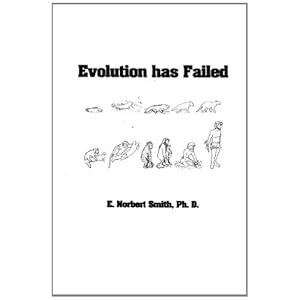
Evolution has Failed (Volume 1)

Biologist and author Norbert Smith has never been a fan of Darwinism, and Evolution has Failed is his latest assessment. One of his areas of considerable experience is alligators, because his job included tagging them:

Having done well in electronics in the Air Force, Smith was interested in using telemetry on submerged alligators. He developed greatly improved telemetry equipment for monitoring rattlesnakes. He then acquired a large alligator at the Welder Refuge, fitted it with a collar, and released it into Big Lake.He was attempting to test the way in which alligators regulate their body heat (thermoregulation) for his MS thesis. To do this he would follow the alligator for days, observing it from a blind or, when necessary, from a boat.

A great deal was riding on the experiment because, contrary to the widely accepted “reptilian brain” theory of intelligence, the alligator is intelligent. Once escaped, it is gone … hard to recapture. Read More ›

Natural Selection Doesn’t Help, Gradualism is Out, and so is Evolution

When Charles Darwin presented his theory of evolution one of the main objections was that he had no credible explanation for how biology, with its many designs and intricacies, could have arisen on its own. Darwin’s main argument, for which he presented many powerful evidences, was that biology did not appear to be designed. From its different patterns to its inefficiencies, the design perspective seemed to be badly failing. But this leaves us with evolution in name only. What were the details? How did the world of biology arise on its own? Inefficient or not, biology nonetheless was not trivial. How could it have evolved?  Read more

Is “living fossils” an apt term?

Recently, Brandon Keim, presenting “11 Animal Wonders of Evolution” (June 28, 2011) at Wired says no,

After all, their lineages haven’t survived ice ages and warm spells and every natural upheaval just to be visualized in amber by some upstart hairless ape. A better term is “evolutionarily distinct.” They’re simply, impressively unique.

One could say that of the Kha-Nyou  Read More ›

We can still legally refuse to drink the Kool-Aid

In “Making Stories Visible The Task for Bioethics Commissions” (Issues in Science and Technology 27/2), Meera Lee Sethi and Adam Briggle explore claims made for science finds – under the banner, “Critical skepticism is always appropriate”: blockquote> Narrative explanations can help us understand difficult scientific issues, but they can also mislead us. Critical skepticism is always appropriate. Read More ›

Who else believed in the myth of junk DNA? Jerry Coyne, for example

Why Evolution Is True

In 2009, University of Chicago geneticist Jerry A. Coyne compared predictions based on intelligent design with those based on Darwinian evolution. “If organisms were built from scratch by a designer,” he argued, they would not have imperfections.

“Perfect design would truly be the sign of a skilled and intelligent designer. Imperfect design is the mark of evolution; inf fact, it’s precisely what we expect from evolution.” According to Coyne, “when a trait is no longer used or becomes reduced, the genes that make it don’t instantly disappear from the genome: Evolution strops their action by inactivating them, not snipping them out of the DNA. From this we can make a prediction. We expect to find, in the genomes of many species, silenced, or ‘dead,’ genes: genes that once were useful but re no longer intact or expressed. In other words, there should be vestigial genes.”  Read More ›

Is Reader’s Digest semantically conceding the field to intelligent design?

File:Morpho menelaus didius Male Dos MHNT.jpg
Morpho produces colours without dyes. Research into methods improved computer screens.

The April 2011 edition of Reader’s Digest features an article by Shaun Pett called “Intelligent Design” (p. 82). We are told, “A new field of research uses nature to solve everyday human problems.”:

The term “biomimicry,” popularized by American natural-sciences writer Janine Benyus in the late 1990s, refers to innovations that take their inspiration from flora and fauna. Biomimicry advocates argue that with 3.8 billion years of research and development, evolution has already solved many of the challenges humans now encounter.

Question: Why do human enterprises in this area need guidance that immediately beggars the resources of natural selection, if nature doesn’t? Read More ›

“Evolutionary arms race” explains THIS Cambrian statistic?

  Lead author Dr Michael Lee, of the South Australian Museum and University of Adelaide, says the “exceptionally preserved fossil eyes” also underscore the speed and magnitude of the evolutionary innovation that occurred during this period. “If the development of complex life is viewed as 24 hours, everything of interest happened in the first hour,” he says. “Our fossils are from that first hour. Within the first blink of evolution, animals had evolved eyes that are very similar to what modern animals have today.” – in conversation with Dani Cooper, “Eyes give insight into evolutionary arms race” (ABC News, 30 June 2011) And this striking compression of time is due to: “The evolution of vision triggered the ability to find Read More ›

Political correctness re Stone Age village almost falsifies evolutionary psychology

File:Catal Hüyük Restauration B.JPG
Inside a model of a neolithic house at Catal Hüyük/Stipich Béla

In “Family ties doubted in Stone Age farmers” (New Scientist, 01 July 2011), Michael Marshall reports that

Blood may not always be thicker than water, if a controversial finding from one of the world’s best-preserved Stone Age settlements is to be believed. At Çatalhöyük in Turkey, it appears that people did not live in families. Instead, the society seems to have been organised completely differently.

How do we know? TheÇatalhöyük people (7500-5500 BCE) “buried their dead beneath the floors of the houses, suggesting that people were buried where they lived.”

The researchers measured the teeth from 266 individuals, assuming that teeth are are more similar among relatives and that people buried together would be more closely related.

But she found no pattern at all. “It does not appear that individuals that were buried together were closely related to each other,” she says. “Çatalhöyük was likely not centred around nuclear families.”

In the best tradition of the assured results of modern science, further speculations follow. In the rush to confirm a trendy idea (families are optional), no one seems to consider that Read More ›