Uncommon Descent Serving The Intelligent Design Community

If peer review were a drug, would it get on the market?

Here, we’ve written a fair bit about peer review, but so have lots of sources. Here’s E. Calvin Beisner of the Cornwall Alliance (climate Armageddon skeptics),

It now arises that the failures occur not just in climate science but across the board, as the article “Classical Peer Review: An Empty Gun” (published in a peer-reviewed journal!), summarized and commented on here, reveals. Writes Richard Smith in his study of peer review published in Breast Cancer Review:… almost no scientists know anything about the evidence on peer review. It is a process that is central to science – deciding which grant proposals will be funded, which papers will be published, who will be promoted, and who will receive a Nobel prize. We might thus expect that scientists, people who are trained to believe nothing until presented with evidence, would want to know all the evidence available on this important process. Yet not only do scientists know little about the evidence on peer review but most continue to believe in peer review, thinking it essential for the progress of science. Ironically, a faith based rather than an evidence based process lies at the heart of science.

Read More ›

Agnostic sociologist on the “Darwinian wars”

Darwin's Pious Idea: Why the Ultra-Darwinists and Creationists Both Get It Wrong Steve Fuller, reviewing Conor Cunningham’s Darwin’s Pious Idea: Why the Ultra-Darwinists and Creationists Both Get It Wrong (Eerdmans, 2011) for Times Higher (24 March 2011), comments,

Let me start by conceding the central, most controversial thesis argued in this book: that neo-creationism and ultra-Darwinism are opposing offshoots of the same modernist root. Both read the Bible literally and take nature itself to possess a crackable code. Neither wishes science and theology to exist in separate spheres. To be sure, William Dembski and Richard Dawkins, say, differ radically on what should happen once the two are brought together: one infers natural theology, the other atheistic naturalism. These are the terms on which the ongoing “Darwin wars” are fought.My disagreement starts with the suggestion in the subtitle that Read More ›

Atheist philosopher Raymond Tallis trashes “Darwinitis,” strikes blow for reality of consciousness

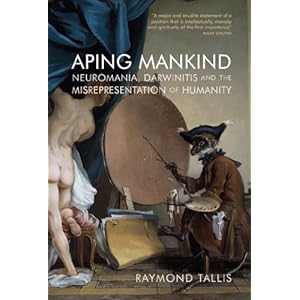
Aping Mankind: Neuromania, Darwinitis and the Misrepresentation of Humanity

In “Human consciousness is much more than mere brain activity,” Mark Vernon writes, “When we meditate or use our powers of perception, we call on more than just a brain” (The Guardian, June17, 2011):

How does the animated meat inside our heads produce the rich life of the mind? Why is it that when we reflect or meditate we have all manner of sensations and thoughts but never feel neurons firing? It’s called the “hard problem”, and it’s a problem the physician, philosopher and author Raymond Tallis believes we have lost sight of – with potentially disastrous results.Vernon, reviewing Raymond Tallis’s new book Aping Mankind: Neuromania, Darwinitis and the Misrepresentation of Humanity, offers,

What is astonishing about this rampant reductionism is that it is based on a conceptual muddle that is readily unpicked. Sure, you need a brain to be alive, but to be human is not to be a brain. Think of it this way: you need legs to walk, but you’d never say that your legs are walking.  Read More ›

Is World Magazine what Christianity Today was supposed to be?

Steno tells us that Jay Richards’ (ed) God and Evolution won World Magazine’s Book of the Year (American), as did Norman Nevin’s (ed) Should Christians Embrace Evolution (British).

Don’t miss Marvin Olasky’s thoughtful discussion of why these two books deserved to lead. First, because

Think about the three main intellectual influencers of the 20th century: Karl Marx, Sigmund Freud, and Charles Darwin. Two of the three—Freud and Marx—have lost most of their influence. The exception is Darwin. Two years ago his millions of fans celebrated the bicentennial of his birth, which was also the 150th anniversary of his famous book On the Origins of Species.He highlights the role of the Templeton Foundation in fronting Christian Darwinism, which most Christians actually do not and cannot accept.

Or, as I like to say, “Your church would make a nice little block of condos, but why are you giving it money in the mean time? Shouldn’t you be buying shares?” Read More ›

“Slacker sociopath” says “science of evil” empathy test flawed

The Science of Evil: On Empathy and the Origins of Cruelty

In his new book, The Science of Evil, developmental psychologist Simon Baron-Cohen thinkshe has the mysteryof evil worked out, or so Katherine Bouton explains, in “Book sees evil as zero empathy: Baron-Cohen’s study could stir controversy” (Halifax Chronicle-Herald, June 18, 2011):

“My main goal is to understand human cruelty, replacing the unscientific term ‘evil’ with the scientific term ‘empathy,’ ” he writes at the beginning of the book, which might be seen as expanding on the views on empathy expressed in his 1997 book, Mindblindness: An Essay on Autism and Theory of Mind (Bradford). Evil, he notes, has heretofore been defined in religious terms (with the concept differing in the major world religions), as a psychiatric condition (psychopathology) or, as he puts it, in “frustratingly circular” terms: “He did x because he is truly evil”).[ … ]

“What leads an individual’s Empathizing Mechanism to be set at different levels?” Baron-Cohen asks. “The most immediate answer is that it depends on the functioning of a special circuit in the brain, the empathy circuit” …

Must be somewhere near the charity neurons but far from the God circuit, right?

Baron-Cohen reckons without my friend Five Feet of Fury, who took his test and found it flawed: Read More ›

Intelligent Design & the Design Question

I don’t have much of a lead-in for this post, so I’ll get right to the point: I think it’s important to draw a distinction between two concepts when it comes to ID. Namely, the distinction between the Design Question, and Intelligent Design itself.

When I say ‘the Design Question’, I mean more or less this: The question of whether X is designed, where X is some particular artifact, some particular part of nature, or nature as a whole.

And by Intelligent Design, I think a good, concise view was given here by Jonathan Wells: Intelligent design maintains that it is possible to infer from empirical evidence that some features of the natural world are best explained by an intelligent cause rather than unguided natural processes.

The purpose of this post is to point out that while ID and the Design Question are related (not to mention very important) they are nevertheless distinct: It’s possible to answer “yes” to the Design Question, and still reject ID as stated. Likewise, it’s possible to affirm an ID inference in many cases, yet still answer in the negative on the Design Question (say, affirming that organism X was designed, while still believing that nature as a whole was not designed.)

More below.

Read More ›

Flying Spaghetti Monster News

Atheist Raises Money for Vandalized Church For those who are not intimately familiar with the ID debate and its substance (I assume that some who visit this website fall into this category) there is an acronym, FSM: Flying Spaghetti Monster. This is an attempt by those who oppose any inference to design (the evidence be damned) within the cosmos or living systems, to portray such proponents as being out of touch with reality and incapable of thinking logically or rationally. Of course, it is the Darwinist who has abandoned reason and logic in pursuit of a materialistic philosophical agenda that is being devastated on a daily basis by the discoveries of legitimate modern science. As anyone who is familiar with Read More ›

US Republican presidential runner Michele Bachmann explicitly supports ID in public schools?

in an “everything on the table….let the students decide” approach, says HuffPost. Could she possibly be channelling her own base? Michele Bachmann expressed skepticism of evolution at the Republican Leadership Conference in New Orleans, Friday. “I support intelligent design,” Bachmann told reporters following her speech at the conference, CNN reports. “What I support is putting all science on the table and then letting students decide. I don’t think it’s a good idea for government to come down on one side of scientific issue or another, when there is reasonable doubt on both sides.” “I would prefer that students have the ability to learn all aspects of an issue,” Bachmann said. And that’s why I believe the federal government should not be Read More ›

Remember “evolve already? Now this …

At Enlightenment Next, we learn from physicist Brian Swimme, This is the greatest discovery of the scientific enterprise: You take hydrogen gas, and you leave it alone, and it turns into rosebushes, giraffes, and humans. Which is happening everywhere in the universe at a pace we can account for. Or maybe not. See also “Evolve already?”

Stomping out independent thought, Campus USA

Caroline Crocker, author of Free to Think, on Darwin trolls harassing students on campus:

At a recent conference in Hawaii I was approached by a group of about eight students lamenting about how only one side of the evolution issue is taught in their classrooms and that anyone who suggests that there may be scientific evidence for the other side is ridiculed. In fact, at universities throughout the country, faculty and administrators harass students who attend Intelligent Design and Evolution Awareness (IDEA) club meetings, where they just want to openly and freely investigate the evidence supporting evolution versus intelligent design.  The IDEA club organizers at some universities complain that Read More ›

Spotted!: “irreducible complexity” used (misused?) in popular literature

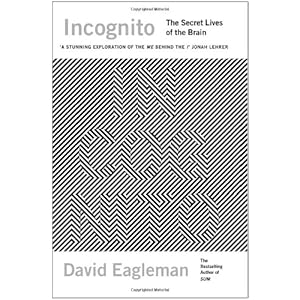
IncognitoIn Incognito, Baylor College of Medicine’s “rock star” neuroscientist David Eagleman argues for  neuroscience to determine prison sentences, using the term:

Not everyone with a brain tumour undertakes a mass shooting, and not all males commit crimes. Why not? As we will see in the next chapter, it is because genes and environment interact in unimaginably complex patterns. This irreducible complexity has consequences: Read More ›

They said it: CNN’s loaded strawman “definition” of ID

According to a report by CNN political correspondent, Peter Hamby, US Presidential Candidate Michele Bachmann recently went on record as saying:

“I support intelligent design”  . . .  “What I support is putting all science on the table and then letting students decide. I don’t think it’s a good idea for government to come down on one side of scientific issue or another, when there is reasonable doubt on both sides” . . .  “I would prefer that students have the ability to learn all aspects of an issue”  . . . “And that’s why I believe the federal government should not be involved in local education to the most minimal possible process.”

This is in itself interesting, as it means that significant numbers of policy makers are increasingly aware of the problem of Lewontinian-Saganian, NAS, NSTA style a priori imposition of evolutionary materialism on science education.

But, this is not the main issue for this post.

That comes up when Mr Hamby provides a “definition” of ID:

Intelligent design suggests that the complexity of the universe cannot be explained by evolution alone, and must also be attributed to a creator or supernatural being.

By now, surely, CNN’s reporters and editors — never mind that artful wriggle-room word, “suggests” — know they could easily find a reasonable, non-loaded, accurate definition of ID, such as is provided by New World Encyclopedia:

Read More ›

Trying to boost intelligence when we don’t even know what it is

In a wide-ranging and thoughtful discussion, The European’s Martin Eierman asks Nick Bostrom, director of Oxford’s Future of Humanity Institute about the potential for genetic engineering enhancements of the mind, and Bostrom replies,essentially, that “we’ll get used to it.”

Bostrom: If you want to develop new drugs, you have to show that they are safe and effectively treat a disease. So when you want to find ways to enhance our brain activity, you perversely have to show that we are currently sick and need treatment. You cannot say, “I simply want to make this better than before”. We need to remove that stigma.

Some would butt in, before we try to enhance “mind,” “conciousness,”or “intelligence,” hadn’t we better decide what they are? There are no scientifically satisfactory definitions for any of these concepts. (There are the push poll definitions of various factions, but that is another matter.) Read More ›

“Just give me Darwin; you can have the facts … “

In the beginning was Darwin, and he created Science. Incluyding, to hear devotee Jerry Coyne tell it, he created biogeogaphy. This naturally irritates science historian Michael Flannery, who knows the facts: It should be stated at the outset that what Coyne really means by “evolution” in his title is Darwinism. That cleared up, Coyne predictably goes to the man himself: “he [Darwin] realized that evolution was necessary to explain not just the origins and forms of plants and animals but also their distribution across the globe. These distributions raise a lot of questions . . . .” (p. 95) Darwin, he goes on to say, pondered these questions and devoted two chapters to the subject in Origin (chapters XI and Read More ›