Uncommon Descent Serving The Intelligent Design Community

A “simple” summing up of the basic case for scientifically inferring design (in light of the logic of scientific induction per best explanation of the unobserved past)

Categories
Design inference
ID Foundations
Irreducible Complexity
Philosophy
science education
Sciences and Theology
specified complexity
Video
worldview
Share
Facebook
Twitter/X
LinkedIn
Flipboard
Print
Email

In answering yet another round of G’s talking points on design theory and those of us who advocate it, I have outlined a summary of design thinking and its links onward to debates on theology,  that I think is worth being  somewhat adapted, expanded and headlined.

With your indulgence:

_______________

>> The epistemological warrant for origins science is no mystery, as Meyer and others have summarised. {Let me clip from an earlier post  in the same thread:

Let me give you an example of a genuine test (reported in Wiki’s article on the Infinite Monkeys theorem), on very easy terms, random document generation, as I have cited many times:

One computer program run by Dan Oliver of Scottsdale, Arizona, according to an article in The New Yorker, came up with a result on August 4, 2004: After the group had worked for 42,162,500,000 billion billion monkey-years, one of the “monkeys” typed, “VALENTINE. Cease toIdor:eFLP0FRjWK78aXzVOwm)-‘;8.t” The first 19 letters of this sequence can be found in “The Two Gentlemen of Verona”. Other teams have reproduced 18 characters from “Timon of Athens”, 17 from “Troilus and Cressida”, and 16 from “Richard II”.[24]

A website entitled The Monkey Shakespeare Simulator, launched on July 1, 2003, contained a Java applet that simulates a large population of monkeys typing randomly, with the stated intention of seeing how long it takes the virtual monkeys to produce a complete Shakespearean play from beginning to end. For example, it produced this partial line from Henry IV, Part 2, reporting that it took “2,737,850 million billion billion billion monkey-years” to reach 24 matching characters:

RUMOUR. Open your ears; 9r”5j5&?OWTY Z0d…

Of course this is chance generating the highly contingent outcome.

What about chance plus necessity, e.g. mutations and differential reproductive success of variants in environments? The answer is, that the non-foresighted — thus chance — variation is the source of high contingency. Differential reproductive success actually SUBTRACTS “inferior” varieties, it does not add. The source of variation is various chance processes, chance being understood in terms of processes creating variations uncorrelated with the functional outcomes of interest: i.e. non-foresighted.

If you have a case, make it . . . .

In making that case I suggest you start with OOL, and bear in mind Meyer’s remark on that subject in reply to hostile reviews:

The central argument of my book is that intelligent design—the activity of a conscious and rational deliberative agent—best explains the origin of the information necessary to produce the first living cell. I argue this because of two things that we know from our uniform and repeated experience, which following Charles Darwin I take to be the basis of all scientific reasoning about the past. First, intelligent agents have demonstrated the capacity to produce large amounts of functionally specified information (especially in a digital form).

Notice the terminology he naturally uses and how close it is to the terms I and others have commonly used, functionally specific complex information. So much for that rhetorical gambit.

He continues:

Second, no undirected chemical process has demonstrated this power.

Got that?

Hence, intelligent design provides the best—most causally adequate—explanation for the origin of the information necessary to produce the first life from simpler non-living chemicals. In other words, intelligent design is the only explanation that cites a cause known to have the capacity to produce the key effect in question . . . . In order to [[scientifically refute this inductive conclusion] Falk would need to show that some undirected material cause has [[empirically] demonstrated the power to produce functional biological information apart from the guidance or activity a designing mind. Neither Falk, nor anyone working in origin-of-life biology, has succeeded in doing this . . .}

In effect, on identifying traces from the remote past, and on examining and observing candidate causes in the present and their effects, one may identify characteristic signs of certain acting causes. These, on observation, can be shown to be reliable indicators or signs of particular causes in some cases.

From this, by inductive reasoning on inference to best explanation, we may apply the Newtonian uniformity principle of like causing like.

It so turns out that FSCO/I is such a sign, reliably produced by design, and design is the only empirically grounded adequate cause known to produce such. Things like codes [as systems of communication], complex organised mechanisms, complex algorithms expressed in codes, linguistic expressions beyond a reasonable threshold of complexity, algorithm implementing arrangements of components in an information processing entity, and the like are cases in point.

It turns out that the world of the living cell is replete with such, and so we are inductively warranted in inferring design as best causal explanation. Not, on a priori imposition of teleology, or on begging metaphysical questions, or the like; but, on induction in light of tested, reliable signs of causal forces at work.

And in that context the Chi_500 expression,

Chi_500 = Ip*S – 500, bits beyond the solar system threshold

. . . is a metric that starts with our ability to measure explicit or information content, directly [an on/off switch such as for the light in a room has two possible states and stores one bit, two store two bits . . . ] or by considering the relevant analysis of observed patterns of configurations. It then uses our ability to observe functional specificity (does any and any configuration suffice, or do we need well-matched, properly arranged parts with limited room for variation and alternative arrangement before function breaks] to move beyond info carrying capacity to functionally specific info.

This is actually commonly observed in a world of info technology.

I have tried the experiment of opening up the background file for an empty basic Word document then noticing the many seemingly meaningless repetitive elements. So, I pick one effectively at random, and clip it out, saving the result. Then, I try opening the file from Word again. It reliably breaks. Seeming “junk digits” are plainly functionally required and specific.

But, as we saw from the infinite monkeys discussion, it is possible to hit on functionally specific patterns if they are short enough, by chance. Though, discovering when one has done so can be quite hard. The sum of the random document exercises is that spaces of about 10^50 are searchable within available resources. At 25 ASCII characters, at 7 bits per character, that is about 175 bits.

Taking in the fact that for each additional bit used in a system, the config space DOUBLES, the difference between 175 or so bits, and the solar system threshold adopted based on exhausting the capacity of the solar system’s 10^57 atoms and 10^17 s or so, is highly significant. At the {500-bit} threshold, we are in effect only able to take a sample in the ratio of one straw’s size to a cubical haystack as thick as our galaxy, 1,000 light years. As CR’s screen image case shows, and as imagining such a haystack superposed on our galactic neighbourhood would show, by sampling theory, we could only reasonably expect such a sample to be typical of the overwhelming bulk of the space, straw.

In short, we have a very reasonable practical threshold for cases where examples of functionally specific information and/or organisation are sufficiently complex that we can be comfortable that such cannot plausibly be accounted for on blind — undirected — chance and mechanical necessity.

{This allows us to apply the following flowchart of logical steps in a case . . . ladder of conditionals . . .  structure, the per aspect design inference, and on a QUANTITATIVE approach grounded in a reasonable threshold metric model:

The per aspect explanatory filter that shows how design may be inferred on empirically tested, reliable sign

On the strength of that, we have every epistemic right to infer that cell based life shows signs pointing to design. {For instance, consider how ribosomes are used to create new proteins in the cell:
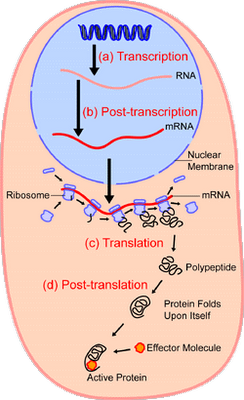
The step-by-step process of protein synthesis, controlled by the digital (= discrete state) information stored in DNA

And, in so doing, let us zoom in on the way that the Ribosome uses a control tape, mRNA, to step by step assemble a new amino acid chain, to make a protein:
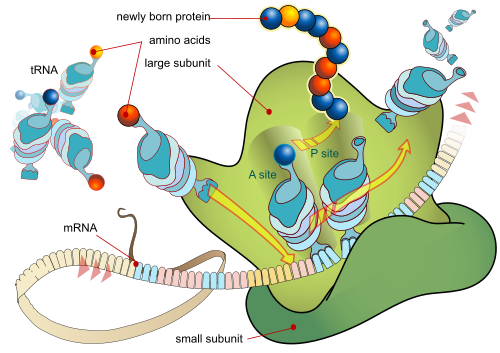
Step by step protein synthesis in action, in the ribosome, based on the sequence of codes in the mRNA control tape (Courtesy, Wikipedia and LadyofHats)

This can be seen as an animation, courtesy Vuk Nikolic:

Let us note the comparable utility of punched paper tape used in computers and numerically controlled industrial machines in a past generation:
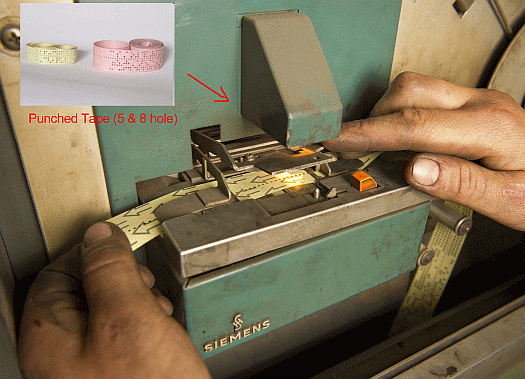
Punched paper Tape, as used in older computers and numerically controlled machine tools (Courtesy Wiki & Siemens)

Given some onward objections, May 4th I add an info graphic on DNA . . .
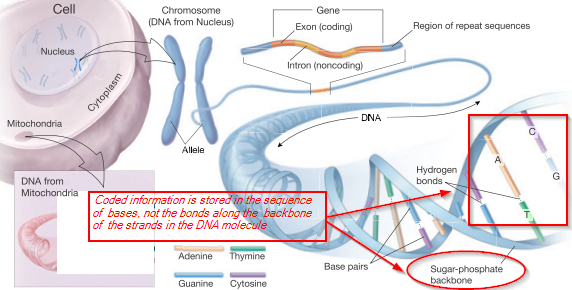
Fig I.0: DNA as a stored code exhibiting functionally specific complex digital information (HT: NIH)

And a similar one on the implied communication system’s general, irreducibly complex architecture:
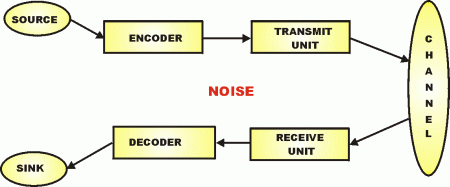
A communication system
A communication system. Notice the required arrangement of a set of well-matched, corresponding components that are each necessary and jointly sufficient to achieve function, e.g. coder and decoder, transmitter and receiver, Transmitter, channel and receiver, etc.

In turn,  that brings up the following clip from the ID Foundation series article on Irreducible Complexity, on Menuge’s criteria C1 – 5 for getting to such a system (which he presented in the context of the Flagellum):

But also, IC is a barrier to the usual suggested counter-argument, co-option or exaptation based on a conveniently available cluster of existing or duplicated parts. For instance, Angus Menuge has noted that:

For a working [bacterial] flagellum to be built by exaptation, the five following conditions would all have to be met:

C1: Availability. Among the parts available for recruitment to form the flagellum, there would need to be ones capable of performing the highly specialized tasks of paddle, rotor, and motor, even though all of these items serve some other function or no function.

C2: Synchronization. The availability of these parts would have to be synchronized so that at some point, either individually or in combination, they are all available at the same time.

C3: Localization. The selected parts must all be made available at the same ‘construction site,’ perhaps not simultaneously but certainly at the time they are needed.

C4: Coordination. The parts must be coordinated in just the right way: even if all of the parts of a flagellum are available at the right time, it is clear that the majority of ways of assembling them will be non-functional or irrelevant.

C5: Interface compatibility. The parts must be mutually compatible, that is, ‘well-matched’ and capable of properly ‘interacting’: even if a paddle, rotor, and motor are put together in the right order, they also need to interface correctly.

( Agents Under Fire: Materialism and the Rationality of Science, pgs. 104-105 (Rowman & Littlefield, 2004). HT: ENV.)

In short, the co-ordinated and functional organisation of a complex system  is itself a factor that needs credible explanation.

However, as Luskin notes for the iconic flagellum, “Those who purport to explain flagellar evolution almost always only address C1 and ignore C2-C5.” [ENV.]

And yet, unless all five factors are properly addressed, the matter has plainly not been adequately explained. Worse, the classic attempted rebuttal, the Type Three Secretory System [T3SS] is not only based on a subset of the genes for the flagellum [as part of the self-assembly the flagellum must push components out of the cell], but functionally, it works to help certain bacteria prey on eukaryote organisms. Thus, if anything the T3SS is not only a component part that has to be integrated under C1 – 5, but it is credibly derivative of the flagellum and an adaptation that is subsequent to the origin of Eukaryotes. Also, it is just one of several components, and is arguably itself an IC system. (Cf Dembski here.)

Going beyond all of this, in the well known Dover 2005 trial, and citing ENV, ID lab researcher Scott Minnich has testified to a direct confirmation of the IC status of the flagellum:

Scott Minnich has properly tested for irreducible complexity through genetic knock-out experiments he performed in his own laboratory at the University of Idaho. He presented this evidence during the Dover trial, which showed that the bacterial flagellum is irreducibly complex with respect to its complement of thirty-five genes. As Minnich testified: “One mutation, one part knock out, it can’t swim. Put that single gene back in we restore motility. Same thing over here. We put, knock out one part, put a good copy of the gene back in, and they can swim. By definition the system is irreducibly complex. We’ve done that with all 35 components of the flagellum, and we get the same effect.” [Dover Trial, Day 20 PM Testimony, pp. 107-108. Unfortunately, Judge Jones simply ignored this fact reported by the researcher who did the work, in the open court room.]

That is, using “knockout” techniques, the 35 relevant flagellar proteins in a target bacterium were knocked out then restored one by one.

The pattern for each DNA-sequence: OUT — no function, BACK IN — function restored.

Thus, the flagellum is credibly empirically confirmed as irreducibly complex. [Cf onward discussion on Knockout Studies, here.]

The kinematic von Neumann self-replicating machine [vNSR] concept is then readily applicable to the living cell:
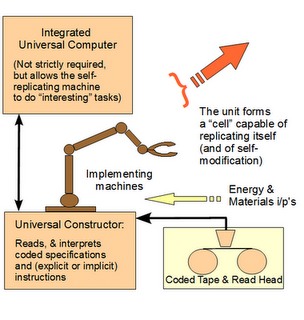
jvn_self_replicator
The kinematic vNSR shows how stored coded information on a tape can be used to control a self-replicating automaton, relevant to both paper tape and the living cell

Mignea’s model of minimal requisites for a self-replicating cell [speech here], are then highly relevant as well:
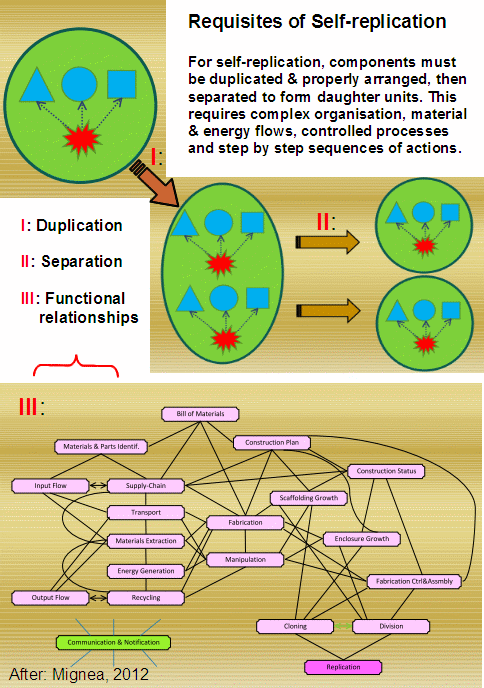
self_replication_mignea
Mignea’s schematic of the requisites of kinematic self-replication, showing duplication and arrangement then separation into daughter automata. This requires stored algorithmic procedures, descriptions sufficient to construct components, means to execute instructions, materials handling, controlled energy flows, wastes disposal and more. (Source: Mignea, 2012, slide show as linked; fair use.)

HT CR, here’s a typical representation of cell replication through Mitosis:

And, we may then ponder Michael Denton’s reflection on the automated world of the cell, in his foundational book, Evolution, a Theory in Crisis (1986):

To grasp the reality of life as it has been revealed by molecular biology, we must magnify a cell a thousand million times until it is twenty kilometers in diameter [[so each atom in it would be “the size of a tennis ball”] and resembles a giant airship large enough to cover a great city like London or New York. What we would then see would be an object of unparalleled complexity and adaptive design. On the surface of the cell we would see millions of openings, like the port holes of a vast space ship, opening and closing to allow a continual stream of materials to flow in and out. If we were to enter one of these openings we would find ourselves in a world of supreme technology and bewildering complexity. We would see endless highly organized corridors and conduits branching in every direction away from the perimeter of the cell, some leading to the central memory bank in the nucleus and others to assembly plants and processing units. The nucleus itself would be a vast spherical chamber more than a kilometer in diameter, resembling a geodesic dome inside of which we would see, all neatly stacked together in ordered arrays, the miles of coiled chains of the DNA molecules. A huge range of products and raw materials would shuttle along all the manifold conduits in a highly ordered fashion to and from all the various assembly plants in the outer regions of the cell.
 
We would wonder at the level of control implicit in the movement of so many objects down so many seemingly endless conduits, all in perfect unison. We would see all around us, in every direction we looked, all sorts of robot-like machines . . . . We would see that nearly every feature of our own advanced machines had its analogue in the cell: artificial languages and their decoding systems, memory banks for information storage and retrieval, elegant control systems regulating the automated assembly of components, error fail-safe and proof-reading devices used for quality control, assembly processes involving the principle of prefabrication and modular construction . . . . However, it would be a factory which would have one capacity not equaled in any of our own most advanced machines, for it would be capable of replicating its entire structure within a matter of a few hours . . . .
 
Unlike our own pseudo-automated assembly plants, where external controls are being continually applied, the cell’s manufacturing capability is entirely self-regulated . . . .[[Denton, Michael, Evolution: A Theory in Crisis, Adler, 1986, pp. 327 – 331. This work is a classic that is still well worth reading. Emphases added. (NB: The 2009 work by Stephen Meyer of Discovery Institute, Signature in the Cell, brings this classic argument up to date. The main thesis of the book is that: “The universe is comprised of matter, energy, and the information that gives order [[better: functional organisation]  to matter and energy, thereby bringing life into being. In the cell, information is carried by DNA, which functions like a software program. The signature in the cell is that of the master programmer of life.” Given the sharp response that has provoked, the onward e-book responses to attempted rebuttals, Signature of Controversy, would also be excellent, but sobering and sometimes saddening, reading.) ]}

An extension of this, gives us reason to infer that body plans similarly show signs of design. And, related arguments give us reason to infer that a cosmos fine tuned in many ways that converge on enabling such C-chemistry, aqueous medium cell based life on habitable terrestrial planets or similarly hospitable environments, also shows signs of design.

Not on a prioi impositions, but on induction from evidence we observe and reliable signs that we establish inductively. That is, scientifically.

Added, May 11: Remember, this focus on the cell is in the end because it is the root of the Darwinist three of life and as such origin of life is pivotal:
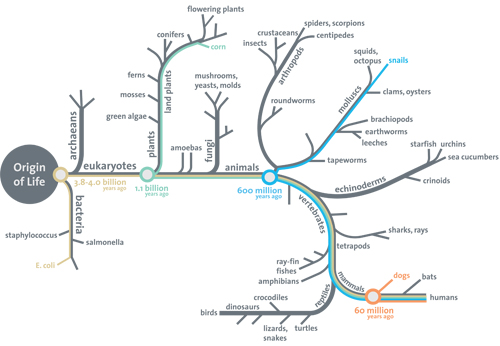
The Smithsonian's tree of life model, note the root in OOL
The Smithsonian’s tree of life model, note the root in OOL

Multiply that by the evidence that there is a definite, finitely remote beginning to the observed cosmos, some 13.7 BYA being a common estimate, and 10 – 20 BYA a widely supported ballpark. That says, it is contingent, has underlying enabling causal factors, and so is a contingent, caused being.

All of this to this point is scientific, with background logic and epistemology.

Not theology, revealed or natural.

It owes nothing to the teachings of any religious movement or institution.

However, it does provide surprising corroboration to the statements of two apostles who went out on a limb philosophically by committing the Christian faith in foundational documents to reason/communication being foundational to observed reality, our world. In short the NT concepts of the Logos [John 1, cf Col 1, Heb 1, Ac 17] and that the evident, discernible reality of God as intelligent creator from signs in the observed cosmos [Rom 1 cf Heb 11:1 – 6, Ac 17 and Eph 4:17 – 24], are supported by key findings of science over the past 100 or so years.

There are debates over timelines and interpretations of Genesis, as well there would be.

They do not matter, in the end, given the grounds advanced on the different sides of the debate. We can live with Gen 1 – 11 being a sweeping, often poetic survey meant only to establish that the world is not a chaos, and it is not a product of struggling with primordial chaos or wars of the gods or the like. The differences between the Masoretic genealogies and those in the ancient translation, the Septuagint, make me think we need to take pause on attempts to precisely date creation on such evidence. Schaeffer probably had something right in his suggestion that one would be better advised to see this as describing the flow and outline of Biblical history rather than a precise, sequential chronology. And that comes up once we can see how consistently reliable the OT is as reflecting its times and places, patterns and events, even down to getting names right.

So, debating Genesis is to follow a red herring and go off to pummel a strawman smeared with stereotypes and set up for rhetorical conflagration. A fallacy of distraction, polarisation and personalisation. As is too often found as a habitual pattern of objectors to design theory.

What is substantial is the evidence on origins of our world and of the world of cell based life in the light of its challenge to us in our comfortable scientism.

And, in that regard, we have again — this is the umpteenth time, G; and you have long since worn out patience and turning the other cheek in the face of personalities, once it became evident that denigration was a main rhetorical device at work — had good reason to see that design theory is a legitimate scientific endeavour, regardless of rhetorical games being played to make it appear otherwise.>>

_______________

In short, it is possible to address the design inference and wider design theory without resort to ideologically loaded debates. And, as a first priority, we should. END

______________

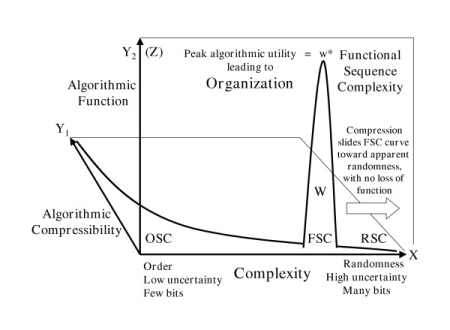
PS: In support of my follow up to EA at 153 below, at 157, it is worth adding (May 8th) the Trevors-Abel diagram from 2005 (SOURCE), contrasting the patterns of OSC, RSC and FSC:
osc_rsc_fsc

Figure 4: Superimposition of Functional Sequence Complexity onto Figure 2. The Y1 axis plane plots the decreasing degree of algorithmic compressibility as complexity increases from order towards randomness. The Y2 (Z) axis plane shows where along the same complexity gradient (X-axis) that highly instructional sequences are generally found. The Functional Sequence Complexity (FSC) curve includes all algorithmic sequences that work at all (W). The peak of this curve (w*) represents “what works best.” The FSC curve is usually quite narrow and is located closer to the random end than to the ordered end of the complexity scale. Compression of an instructive sequence slides the FSC curve towards the right (away from order, towards maximum complexity, maximum Shannon uncertainty, and seeming randomness) with no loss of function.

Comments
F/n:
S: I’m not sure you understand the meaning of the word “objective,” it means independent of the human mind
Indeed, it means, not MERELY subjective. Collins English is especially apt:
objective [?b?d??kt?v] adj 1. (Philosophy) existing independently of perception or an individual's conceptions are there objective moral values? 2. undistorted by emotion or personal bias 3. of or relating to actual and external phenomena as opposed to thoughts, feelings, etc. 4. (Medicine) Med (of disease symptoms) perceptible to persons other than the individual affected 5. (Linguistics / Grammar) Grammar denoting a case of nouns and pronouns, esp in languages having only two cases, that is used to identify the direct object of a finite verb or preposition and for various other purposes. In English the objective case of pronouns is also used in many elliptical constructions (as in Poor me! Who, him?), as the subject of a gerund (as in It was me helping him), informally as a predicate complement (as in It's me), and in nonstandard use as part of a compound subject (as in John, Larry, and me went fishing) See also accusative 6. of, or relating to a goal or aim n 1. the object of one's endeavours; goal; aim 2. (Military) Also called objective point Military a place or position towards which forces are directed 3. an actual phenomenon; reality 4. (Linguistics / Grammar) Grammar a. the objective case b. a word or speech element in the objective case 5. (Physics / General Physics) Also called object glass Optics a. the lens or combination of lenses nearest to the object in an optical instrument b. the lens or combination of lenses forming the image in a camera or projector Abbreviation obj Compare subjective objectival [??bd??k?ta?v?l] adj objectively adv objectivity less commonly, objectiveness n Collins English Dictionary – Complete and Unabridged © HarperCollins Publishers 1991, 1994, 1998, 2000, 2003
Being objective does not mean that we do not or cannot experience something as observed or do/cannot recognise it as existing, or that observation under widely achieved circumstances does not provide adequate warrant for the independent reality of an object or a feature of an object. In the case of FSCO/I, we do recognise say text in English such as the first part of this sentence, and we do distinguish it from gibberish:h8tdg8yfg5tojg75r. We are aware that English text can stand some degree of corruption and still be recognisable (online archived books are a good example) but it does tot take much to convert language to gibberish. Similarly, some snow will not render images on TV unrecognisable, but beyond a point, it will. We see through such actual exemplar cases the independent, recognisable reality of what has been descriptively termed functionally specific, complex organisation and associated information, abbreviated, FSCO/I for convenience. It turns out that the same extends to computer code, whether source or object. Though, such tends to be pretty intolerant of noise. It also extends to structured strings that describe a nodes-arcs view of an entity, such as in a drawing package. That is a context where patently dismissive assertions end up exemplifying what they would dismiss. As in, refuting themselves. Have you copied, pasted into Word and done the spell and grammar checks yet? Then took in the number of characters and multiplied by 7? Is that number, in bits, of a string, which functions in English a case of objectively recognised, measured functional, specific info? If you think not, why not? And, why should anyone take your no seriously? If yes, your argument has already collapsed. I hope this sort of thing is helping you clarify basics. KFkairosfocus
May 5, 2013
May
05
May
5
05
2013
12:29 PM
12
12
29
PM
PDT
LOL. Nice one @98 Chance Ratcliff. Looks like sigbaba won't be coming back for a while.computerist
May 5, 2013
May
05
May
5
05
2013
10:44 AM
10
10
44
AM
PDT
EII: Good point. Do I have your permission to use it? KFkairosfocus
May 5, 2013
May
05
May
5
05
2013
12:30 AM
12
12
30
AM
PDT
CR: Okay, yes, coded info (especially when used algorithmically as in protein synthesis -- this is a no-brainer point) exist in systems that store, transfer, accept and use info. In this case the whole is a self replicating, self assembling entity, in addition with maintenance, error detection and sometimes correction etc. The logical focus for discussion, is where did such arise, how. OOL, then is the pivotal context, just as we saw with Thaxton et al in TMLO from 1984 on, and as Denton implied in the clip that appears in the OP. I find the focus of objectors on anything but, the promised cases where FSCO/I arises by blind chance and mechanical necessity, inadvertently revealing. (The suggestion that such a thing is imaginary ("subjective") or ill defined or unobservable [if function has to be recognised] whatever, in a context where the objector has to read cases of FSCO/I and produce similar cases, is even more inadvertently revealing. I think we need to realise something like, we do not have any one size fits all definition by precise description of any number of key terms, including life. In many cases we proceed by key cases that ground a conceptual understanding, and lay a basis for descriptions, models and inference by evidently close family resemblance. Definition by key exemplars and close family resemblance is actually conceptually prior to precising definitions that try to set the borders of the concept. Where, any number of key concepts have insistently fuzzy borders, not just things like "baldness." In light of all this, a "safe threshold" metric to identify cases where -- on complexity and scope of search based on blind sampling -- it is not reasonable/ plausible to think that blind, non-foresighted, non intentional, non-intelligent chance and mechanical necessity could originate cases of functionally specific information, is reasonable. KFkairosfocus
May 5, 2013
May
05
May
5
05
2013
12:25 AM
12
12
25
AM
PDT
Yes! The arrangement of the parts in a thoughtful and mindful way to produce a desired effect is called intent and intent is clearly from mind not material. Matter alone does not display intentional states because matter does not have the ability to arrange itself.Andre
May 4, 2013
May
05
May
4
04
2013
10:38 PM
10
10
38
PM
PDT
KF @80,
"I interpret digital cods in your sense as primarily speaking of the code system. In the case of code strings, the OP shows that sufficiently short code strings — MUCH shorter than 500 – 1,000 bits — can be produced by chance, but the problem then becomes finding the code in the sea of gibberish..."
Yes, that's correct. However it's my thinking that when we see intimations such as "DNA doesn't really contain a code" or "codes don't necessarily require intelligence" it's relevant to make reference to the whole system. Interpreting the message requires systemic context. With regard to DNA codes, not only do we have a complex string of bits which represents another material entity, but this message exists within an elaborate system of information transfer that translates a series of coded messages into a concrete product. In the context of this system, design is implicated not just by the coded message, but by the whole system in which the code is executed. In fact, the message only makes sense given the context in which it operates. Still, perhaps I was commenting a bit wide of the OP. :)Chance Ratcliff
May 4, 2013
May
05
May
4
04
2013
03:47 PM
3
03
47
PM
PDT
KF, good examples at #95. Incidentally, the function sample I provided at #98 will accommodate a context which performs spelling and grammar checks on text, as well as any other type of string analysis. (I might revise the example to make it more correct and more generic.) The introduction of the context into the analysis shows that it's a necessary part of the logic. In my opinion, messages must be considered in the context of a functional system in order to have any meaning. English text presupposes correct grammar, and program code presupposes correct syntax and semantics, as well as proper execution. Codon strings might presuppose an amino acid sequence which folds properly. These however are threshold conditions. Actual function will exist within the threshold of correct grammar, properly executing code, or folding sequences. Put another way, if the set F contains all valid sequences for a given context, then actual functional sequences F1 will have this relationship with the threshold set: F1 ⊂ F . As an example, the code int returnX(int x) {return x;} void doNothing() {return;} int main() { int x; x = returnX(x); doNothing(); return 0; } Both functions are valid, but do nothing of consequence when called. These might exist in the set of valid sequences F, but not in the set of functional sequences F1. Likewise, the phrase, the circle is triangular, would pass a spelling and grammar check, but be unuseful. A DNA sequence could conceivably code for a protein which folds but has no significant metabolic effect on an organism. So function, while objective, can be hard to nail down without considering specific contexts. The threshold conditions are easier to come by. Accurate FSCI analysis would be less straightforward than the simple case, unless I'm mistaken. For instance, if the set S contains all possible input strings of a given length, then the information content of a valid message in bits, in a given context, would be -log2(cardinality(F)/cardinality(S)) where F is the set of valid strings for the context.Chance Ratcliff
May 4, 2013
May
05
May
4
04
2013
03:17 PM
3
03
17
PM
PDT
sigbaba, I wonder if I could interest you in a little thought experiment, in the form of four simple questions: 1. Is it possible that we could discover an artifact on Mars that would prove the existence of extraterrestrials, without the presence or remains of the extraterrestrials themselves? 2. If yes, exactly what kind of artifact would suffice? Car? House? Writing? Complex device? Take your pick. 3. Explain rationally why the existence of this artifact would convince you of the existence of extraterrestrials. 4. Would that explanation be scientifically sound? I would assert the following: a. If you answer “Yes” to Question 4, then to deny ID is valid scientific methodology is nothing short of doublethink. You are saying that a rule that holds on Mars does not hold on Earth. How can that be right? b. If you can answer Question 3 while answering “No” to Question 4, then you are admitting that methodological naturalism/materialism is not always a reliable source of truth. c. If you support the idea that methodological naturalism/materialism is equivalent to rational thought, then you are obligated to answer “No” to Question 1.englishmaninistanbul
May 4, 2013
May
05
May
4
04
2013
02:14 PM
2
02
14
PM
PDT
S: Please stop putting words into my mouth that don't belong there and thoughts into my mind that don't belong there. We undeniably are humans and as a part of our background experience and common sense knowledge base, we do experience and observe what it means to be designers and the results of such at work, starting with posts in this thread. To say that is to report a public, commonly known fact; to try to rhetorically pretend that this is not so in this context, the better to toss up objections is selective hyperskepticism and an inadvertent testimony to just how weak your case of objections is, which is also pretty much what happened with your attempt to dismiss that DNA is a code carrier in the living cell.. And, reality is what is, truth is what accurately describes it. Knowledge is that which is warranted to be a credibly accurate description. This does not reduce reality to mind or to words etc, but it does imply that such a thing as a warranted, credibly true description is an intellectual exercise. Sufficient has been pointed out at this stage that it should be evident to the onlooker what you know or should know, and should be prepared to acknowledge. That your position is leading you into a ladder of denials of that magnitude is utterly revealing on just how weak your case is. As in reductio ad absurdum. KFkairosfocus
May 4, 2013
May
05
May
4
04
2013
01:16 PM
1
01
16
PM
PDT
S: I think you have a problem with what it means to observe. For a great many things indeed under widely met circumstances, seeing it is sufficient warrant to know it to be so. We see text and read it. We see an out of control car careering towards the crossing and jump out of its way, and more, much more. In ever so many important cases of observation in science, an experienced observer reporting orally or in writing or with text was and is more than enough warrant for establishing an objectively known state of affairs. In short, you are being selectively hyperskeptical again, given that you are relying on your knowledge of reading and writing to take part in this thread. Those learned skills and associated judgements are more than adequate to identify textual function. In the case of DNA and proteins, the path from code in DNA to AA sequences, folding, activation and function -- cf. OP, is not in serious doubt. Your appropriate responsiveness to well established facts that seem not to be comfortable to you, however, for good reason all to evident in this thread, is. Now, on Shannon info, i.e. average info carrying capacity per symbol in a context, it is not sufficient to be a metric of FSCO/I. It is an index of complexity inasmuch as more symbols implies more alternative possibilities. We need to adjust for meaningfulness and function that are observable and sensitive to specific configuration. That is, there is limited tolerance for variation. FSCO/I as to deal with JOINT complexity and functional specificity, noting that while you are tempted to object, such is indeed observable and in many cases can be assigned values on a metric scale. Code that compiles and works is an obvious simple case, as is text that passes grammar and spell check and is meaningful in ways that depend on configuration. In other words a very large proportion of the files, web pages, programs, images etc we deal with from day to day are FSCO/I. And that you belabour this instead of starting from where the vast majority of those familiar with a digital world would, speaks volumes on just how serious Meyer's challenge is. Let me clip from the OP:
In making that case I suggest you start with OOL, and bear in mind Meyer’s remark on that subject in reply to hostile reviews:
The central argument of my book is that intelligent design—the activity of a conscious and rational deliberative agent—best explains the origin of the information necessary to produce the first living cell. I argue this because of two things that we know from our uniform and repeated experience, which following Charles Darwin I take to be the basis of all scientific reasoning about the past. First, intelligent agents have demonstrated the capacity to produce large amounts of functionally specified information (especially in a digital form).
Notice the terminology he naturally uses and how close it is to the terms I and others have commonly used, functionally specific complex information. So much for that rhetorical gambit. He continues:
Second, no undirected chemical process has demonstrated this power.
Got that?
Hence, intelligent design provides the best—most causally adequate—explanation for the origin of the information necessary to produce the first life from simpler non-living chemicals. In other words, intelligent design is the only explanation that cites a cause known to have the capacity to produce the key effect in question . . . . In order to [[scientifically refute this inductive conclusion] Falk would need to show that some undirected material cause has [[empirically] demonstrated the power to produce functional biological information apart from the guidance or activity a designing mind. Neither Falk, nor anyone working in origin-of-life biology, has succeeded in doing this . . .}
In effect, on identifying traces from the remote past, and on examining and observing candidate causes in the present and their effects, one may identify characteristic signs of certain acting causes. These, on observation, can be shown to be reliable indicators or signs of particular causes in some cases. From this, by inductive reasoning on inference to best explanation, we may apply the Newtonian uniformity principle of like causing like. It so turns out that FSCO/I is such a sign, reliably produced by design, and design is the only empirically grounded adequate cause known to produce such. Things like codes [as systems of communication], complex organised mechanisms, complex algorithms expressed in codes, linguistic expressions beyond a reasonable threshold of complexity, algorithm implementing arrangements of components in an information processing entity, and the like are cases in point. It turns out that the world of the living cell is replete with such, and so we are inductively warranted in inferring design as best causal explanation. Not, on a priori imposition of teleology, or on begging metaphysical questions, or the like; but, on induction in light of tested, reliable signs of causal forces at work.
So now can you show us significant cases where per observation, FSCO/I has been reliably produced by blind chance and mechanical necessity? As opposed to the world around us where it is a routine product of design? If indeed the only empirically warranted, observed cause -- on billions of cases -- is design, then that warrants an inference on FSCO/I as sign, that design is the best causal explanation. Which is the essential claim made as the design inference. KF PS: S, kindly observe the flow chart in the OP, which is similar to an activity diagram and expresses a case structure. CR's example is a specific application to code.kairosfocus
May 4, 2013
May
05
May
4
04
2013
12:51 PM
12
12
51
PM
PDT
BOOL isThisInformationFSCI(String* message, Context* context) {    String* code = context->compile(message);    try {context->execute(code)}    catch {return 0;}    return countBits(code) > THRESHOLD; } Above, Context is an abstract class with two abstract methods, compile and execute, which return the compiled code string from whichever concrete context was supplied and executes the code. This arrangement allows for the method to compile code in whatever language is specified in the concrete implementation and run it in a supplied virtual machine. THRESHOLD is a constant which is appropriate to the system that generated the message. It might be set at something like 500 bits. The logic here is straightforward. The message must compile into valid code without error, and execute without throwing an exception. If both of these conditions are satisfied, and the code string length exceeds the threshold, then there is FSCI in the message. This demonstrates what an objective function might look like in its minimum recognizable form: code of sufficient length which compiles and executes without error.Chance Ratcliff
May 4, 2013
May
05
May
4
04
2013
11:24 AM
11
11
24
AM
PDT
FSCO/I is shown by observed function, sensitive to disturbance by moderate noise injection. It is in fact often and easily recognisable as in text in English such as your post. In the case of object code, as in DNA making protein, it is well known.
In other words, you know it when you see it. I'm not sure you understand the meaning of the word "objective," it means independent of the human mind. Your definition requires a human mind to judge, and humans could disagree depending on their level of knowledge or even their aesthetic sense.
Humans are something we are and experience. We observe characteristics and behaviours to which we attach labels like intelligence and design. That is not to mean that such are unwarranted assertions. Just the opposite, the phenomena are antecedent to analysis.
This is little more than solipsism. Saying that there can be no truth without the mind is a denial of external reality.
I suggest that you actually take a moment to look back above, and see what is happening. So far, it looks a lot like this or its fellow travellers:
This is no search for truth. It is a search for enemies. ________ S: Do tell us, have you read the OP (much less any onward linked stuff)? If so, could you give a thumbnail summary, highlighting strengths, weaknesses and ideas on ways forward? If not, what is the basis for the several critiques we have had to correct above, some of them more than once? KFsigaba
May 4, 2013
May
05
May
4
04
2013
09:54 AM
9
09
54
AM
PDT
sigaba:
When you guys say “information” you mean Shannon information, right?
Not necessarily. Shannon (so-called) "information" is useful as a purely statistical tool to calculate complexity. It is not helpful for determining function. Other levels of information beyond Shannon statistics include syntax, semantics, pragmatics. These latter levels can be loosely categorized as levels of "function." Calculating the Shannon measure can be a step in the process of detecting design, but we have to be able to look beyond Shannon calculations.Eric Anderson
May 4, 2013
May
05
May
4
04
2013
09:48 AM
9
09
48
AM
PDT
PS: Pull Word. Put into it a relevant text block. Call the spelling and grammar checks. Let us assume they pass. Call the properties and examine number of characters. Multiply by 7 for ASCII. Similarly, use a compiler, test and compile then run a program. Use a file statistics package to see size. And so forth. Try the exercise of noise bombing a program at bit or character level and see if it still works. Try the same with an AutoCAD drawing file, etc. Do you see why I am not particularly impressed with objections that in a digital age, try to pretend that FSCO/I is meaningless or dubious?kairosfocus
May 4, 2013
May
05
May
4
04
2013
09:31 AM
9
09
31
AM
PDT
S: FSCO/I is shown by observed function, sensitive to disturbance by moderate noise injection. It is in fact often and easily recognisable as in text in English such as your post. In the case of object code, as in DNA making protein, it is well known. Function in relevant senses -- dismissals notwithstanding -- is quite objective, observable and often obvious. Cf DNA and mRNA in protein synthesis. Is THAT hopelessly subjective and useless? I would think not. If function is not apparent or observed (i.e. we are not looking at having to create some mythical universal decryption algorithm), it is not relevant. But the cases where it is relevant, are obviously highly important. Next, you have pulled a selectively hyperskeptical switcheroo. Proof is not in the remit of science. Reliable empirically grounded warrant on inductive logic is. Think about why you did that in a case you are obviously disinclined to accept, when there is no sign that you object to ever so many similar cases that are normal in scientific praxis, and particularly on matters of theories about modelling the past or history of an object. Similarly, inference to design as credible causal process is not inference to designers of any given nature or class. Various candidates may be possible, to be addressed on other evidential issues. E.g. we infer arson on signs without needing to know more than that arsonists are possible. In observational sciences, we cannot impose experimental controls, we must work with the world as a going concern. You are back to implying circularity without warrant. Humans are something we are and experience. We observe characteristics and behaviours to which we attach labels like intelligence and design. That is not to mean that such are unwarranted assertions. Just the opposite, the phenomena are antecedent to analysis. are you willing to make a general denial of the reality of intelligence and design, even as you use a computer designed by intelligent, knowledgeable designers? Absurd. Similarly, the existence of known cases of intelligence and design, all around us immediately entails that such is possible. We observe similar behaviours in say beavers, and that gives good reason to avoid thinking that humans exhaust the possibility. as for FSCO/I, it can be calculated, and shown from the simple example of the data in your post. X-no of ASCII characters, objectively recognisable as functional in English. 7 bits per character, ASCII code. 7*X - 500, yields the in excess of the solar system threshold. This looks like willful obtuseness at this point. You have already seen a rough calc for a typical functional protein and have been pointed to cases for more exact and refined values. We are not dealing with alleged proofs, much less proofs of God. Are you denying that string data structures such as appear in posts here, of form . . . -*-*-*- . . . are contingent, or observable as such? If so, kindly explain away the choice: connexion vs connection as spellings of a certain word. In DNA base sequences are contingent, as is so in Amino Acid strings. Only, it is certain strings that will function. And it is a reasonable analytical step to consider the field of possibilities before highlighting the relative few that will fit a given context and contribute to function. I have taken time, repeatedly, to correct foundational defects in your argument, only to see the same cropping up over and over, this, at a time when I have had other things that needed doing. Do you see any reason for me to go beyond such critical "little [but pivotal] errors at the beginning"? You may wish to convert a discussion on empirical signs of design into a grand metaphysical argument on teleology and the four classical causes as you wish. The problem starts way before that, and if you struggle with things that are as simple as that DNA is an observed case of a code in the living cell, no further grand debates can be fruitful. You may resort to statistical protocols all you want, that is not going to change a basic fact of blind sampling. If you have the equivalent of a truckload of beans with a few gold beads -- say, five or ten -- scattered in them, a blindly sampled handful will only be likely to come up with what is typical: beans. I suggest that you actually take a moment to look back above, and see what is happening. So far, it looks a lot like this or its fellow travellers:
. . . to put a correct view of the universe into people’s heads we must first get an incorrect view out . . . the problem is to get them to reject irrational and supernatural explanations of the world, the demons that exist only in their imaginations, and to accept a social and intellectual apparatus, Science, as the only begetter of truth [[--> NB: this is a knowledge claim about knowledge and its possible sources, i.e. it is a claim in philosophy not science; it is thus self-refuting]. . . . To Sagan, as to all but a few other scientists, it is self-evident [[--> actually, science and its knowledge claims are plainly not immediately and necessarily true on pain of absurdity, to one who understands them; this is another logical error, begging the question , confused for real self-evidence; whereby a claim shows itself not just true but true on pain of patent absurdity if one tries to deny it . . ] that the practices of science provide the surest method of putting us in contact with physical reality, and that, in contrast, the demon-haunted world rests on a set of beliefs and behaviors that fail every reasonable test [[--> i.e. an assertion that tellingly reveals a hostile mindset, not a warranted claim] . . . . It is not that the methods and institutions of science somehow compel us to accept a material explanation of the phenomenal world, but, on the contrary, that we are forced by our a priori adherence to material causes [[--> another major begging of the question . . . ] to create an apparatus of investigation and a set of concepts that produce material explanations, no matter how counter-intuitive, no matter how mystifying to the uninitiated. Moreover, that materialism is absolute [[--> i.e. here we see the fallacious, indoctrinated, ideological, closed mind . . . ], for we cannot allow a Divine Foot in the door. [Cf clip here. If you think these words are quote-mined or unrepresentative, kindly read the fuller clip and comments as well as other remarks cited.]
KFkairosfocus
May 4, 2013
May
05
May
4
04
2013
09:22 AM
9
09
22
AM
PDT
I see. Thanks, but all you've done is reworded the definition of a classical information channel. I think your argument is faulty. In 4, it does not follow that the "arbitrary" arrangement of the components of the system cannot be reduced to physical law, in the case that the representation in 1 is created by a physical, natural phenomenon.sigaba
May 4, 2013
May
05
May
4
04
2013
09:20 AM
9
09
20
AM
PDT
Like I said earlier, I simply do not have time for an extended post. I'll have to trust that you can gather the issues from a previous conversation. Try going hereUpright BiPed
May 4, 2013
May
05
May
4
04
2013
08:54 AM
8
08
54
AM
PDT
When you guys say "information" you mean Shannon information, right?sigaba
May 4, 2013
May
05
May
4
04
2013
08:54 AM
8
08
54
AM
PDT
If your sensor is going to enable a display, or be attached to an actuator perhaps, then it becomes functional.
I admit I'm not clear on how this significantly changes the experiment. I did imply I am recording the information from the sensor. Is there some sort of provision that the information must act on the world or something? I'm not sure how this would change the input into the system. The distinction between "form" and "information" in your use appears to be semantic.sigaba
May 4, 2013
May
05
May
4
04
2013
08:52 AM
8
08
52
AM
PDT
Upright BiPed makes it much clearer. The story is: DNA-RNA-protein synthesis forms a communication channel, and where there is a communications channel, there must be a sender?sigaba
May 4, 2013
May
05
May
4
04
2013
08:46 AM
8
08
46
AM
PDT
by the way... how many temperature sensors hooked up to thermodynamic systems do we find in nature? Second question: What is their output and where does it go?Upright BiPed
May 4, 2013
May
05
May
4
04
2013
08:29 AM
8
08
29
AM
PDT
I can connect a temperature sensor to a simple thermodynamic system and it will start emitting bits, millions of them. However, for any string of 500, it’s impossible to distinguish between complex information and random information.
The transcription of form through a sensor of some sort is not a transfer of information, its just a transcription of form. If your sensor is going to enable a display, or be attached to an actuator perhaps, then it becomes functional. Again, you simply do not know what you are talking about.Upright BiPed
May 4, 2013
May
05
May
4
04
2013
08:25 AM
8
08
25
AM
PDT
Here, I know exactly how we can settle this: BOOL isThisInformationFCOSI(unsigned char *bytes, size_t bytesLength) { BOOL val; /* implementation continues */ return val; } If this procedure is strictly logical reasoning, you should be able to finish that. Add any input parameters you need.sigaba
May 4, 2013
May
05
May
4
04
2013
08:15 AM
8
08
15
AM
PDT
Again, if you have a genuinely substantial objection the easy answer to the Meyer challenge is direct: show that FSCO/I of 500+ bits is on observation, originally produced by blind chance and mechanical necessity without intelligent direction.
There's a few very big problems with this: 1) You don't know FSCO/I when you see it. I can connect a temperature sensor to a simple thermodynamic system and it will start emitting bits, millions of them. However, for any string of 500, it's impossible to distinguish between complex information and random information. All we can do is look at the bit string and see if it "looks like" a pattern of something we've seen before, some human cultural artifact like Shakespeare or some patterned mathematical construct, or maybe the first few base pairs of Heme. This is a hopelessly subjective procedure. 2) Let's say we surmount this and we do see a string that has a pattern, it's impossible to prove that it isn't the work of a Designer. Since we don't know the Designer's methods, it's impossible for us to control for her actions upon the system. We cannot prove that she didn't actually use our experimental setup to create the message. 3) And it is a minor point, but it has not been proven systematically that any particular human creation has FSCO/I, it is argued by assertion that human beings are intelligent and they can create or recognize FSCO/I. Again, this procedure is completely teleological and contingent, because we're imputing finality on the system, as if had a purpose of "searching" for Shakespeare or whatever output it gives us that we decide is FSCO/I. Contingency in nature has a long history in proofs for the existence of God, for example by Aquinas, but it has been illegitimate for a scientific argument for at least 400 years. I would have thought that if there was a significant flaw in my argument it could have been dealt with rather briefly, but instead your responses get longer and longer, and reiterate, page after turgid page, information which I do not dispute and is beside the point. You do not actually clarify your argument to remove its defects -- it's reliance on unscientific concepts such as teleology and final cause, it's failure to use proper statistical models, its emotional appeals and appeals to ignorance. This argument, as you have made it, can convince no one, unless they had prior motivation to believe. It will continue to entertain readers of popular books and you will continue having your doctrinal disputes here in the thread, slinging your "evidence" of quotes from your respective Google Docs pages, but it cannot prevail as science in the form it takes. It's not going to improve at all unless you rectify these things: * Your theory's reliance on contingency in nature. * Your theory's statistical argument, and it's profoundly inadequate statistical protocol.sigaba
May 4, 2013
May
05
May
4
04
2013
07:52 AM
7
07
52
AM
PDT
S: Methodological naturalism, as pushed in recent years, boils down to ideological, materialist question-begging. If something is going to rule out a reasonable possibility before facts can speak, and would turn science into a game in a materialist ideological circle, frustrating the vital goal of science of actually open-mindedly seeking to learn the truth about our world based on empirical evidence, it is a question-begging fallacy. And unfortunately that is exactly what a priori materialism is doing. Years ago, it didn't make sense for marxists to lock up discussion in a marxian materialist circle, and it makes no sense today to do much the same. And that is not by my say-so, but it is about a very real problem that undermines one of the major goals of genuine science. KFkairosfocus
May 4, 2013
May
05
May
4
04
2013
07:30 AM
7
07
30
AM
PDT
Gregory:
‘Design theory’ differs from ‘Intelligent Design Theory.’
Good luck proving that.Joe
May 4, 2013
May
05
May
4
04
2013
06:07 AM
6
06
07
AM
PDT
sigaba:
It used to be Behean irreducible complexity, but because that is spent and discredited,...
No it takes evidence to discredit IC. And to date there isn't any that demonstrates that blind and undirected chemical processes ca produce anything, let alone IC systems/ structures.
Most scientists believe in a God, many would claim to be Christian, and almost all would say they are methodological naturalists.
According to the National Academy of Science most scioentists are atheists. Where are you getting your data from?Joe
May 4, 2013
May
05
May
4
04
2013
06:05 AM
6
06
05
AM
PDT
GREGORY: You have made a false, poisonous accusation at 4 above, in effect calling me a liar, without warrant. You seem to wish to ignore that basic fact, and act as though all is well and that it is all my fault on conflating design theory as you now wish to define it with Intelligent Design Theory as you wish to define it. You need to fix that. As for your basic assertions on design theory (tantamount to a recirculation of your talking points on id vs ID), they were addressed months ago as already linked. Neither of your categories fits, and they are rejected as tendentious. The pivotal focus for this thread happens to be, that an inference to design as causal process that best explains an object etc, on empirically reliable tested sign is a reasonable and indeed scientific endeavour, which can be cross checked against the real authority, the state of nature. So far, despite claims to be able to empirically overthrow, such is conspicuous by absence. In that context, I have less than no interest in side tracks over tendentious talking points, as has already been pointed out. Now, please fix your false accusation problem. At this point, you are verging on threadjacking. KF ______________ 'Design theory' differs from 'Intelligent Design Theory.' If you don't wish to respect that, then call it a lie and hope that people believe you. You do *NOT* speak for 'design theory and thinkers,' KF. You are promoting something different: IDT. Pointing this out is to liberate 'design theory and thinkers' from your IDism. Real design theorists and thinkers reject IDT, openly, in public and globally. I was in a room full of 'design theorists and thinkers' in western Europe in 2012 who laughed at IDT, wanting to disassociate themselves from it! That's not false reporting (or any sort of 'personal attack'), it's just the reality on the ground. Accepting that 'design theory' differs from IDT should be a simple, reasonable, logical admission. But for some reason you are blowing it out of proportion. Why is this? There is nothing 'uncivil' implied or meant, so try not to take it personally.Gregory
May 4, 2013
May
05
May
4
04
2013
03:14 AM
3
03
14
AM
PDT
Chance: I interpret digital cods in your sense as primarily speaking of the code system. In the case of code strings, the OP shows that sufficiently short code strings -- MUCH shorter than 500 - 1,000 bits -- can be produced by chance, but the problem then becomes finding the code in the sea of gibberish [even for 19 and 24 character code cases], as the amount of computing time wasted on the exercise is showing. KFkairosfocus
May 4, 2013
May
05
May
4
04
2013
02:45 AM
2
02
45
AM
PDT
GREGORY: You have been uncivil. Instead of resolving the matter by taking responsibility and making amends, you have tried to pretend that the fault lies elsewhere, now with "threats." Let's be frank. You called me deceitful at 4 above in the opening phrase [where I replied correctively at 5 promptly . . . which you obviously refused to heed], and that is an unwarranted and provably false accusation. I have pointed that out at was it 59, with onward links provided for those needing documentation on WHY I reject your attempt to force-fit design theory and thinkers into categories of your manufacture that amount to strawmannish caricatures that set up all sorts of tendentious insinuations. I am calling you to be responsible, and return to reasonable standards of discussion. Take this as a freebie warning. KF _________ @Eric #62 Since I am being threatened with 'Strikes' here, I will not answer you. I've suggested you contact me directly. That is likely a better solution than more talk here. And it is safe and civilised. "you argued that Dembski makes a clear distinction between ‘intelligent design’ and ‘design.’" I've addressed this already in the other 'Omega' thread and even still you are not speaking accurately. IDT vs. the design argument. That's what Dembski tries to distinguish. Again, 'IDT' is *not* a monster that can swallow 'design theory.' The master category is not for sale.Gregory
May 4, 2013
May
05
May
4
04
2013
02:42 AM
2
02
42
AM
PDT
1 2 3 4 5 6 7