Uncommon Descent Serving The Intelligent Design Community

A “simple” summing up of the basic case for scientifically inferring design (in light of the logic of scientific induction per best explanation of the unobserved past)

Categories
Design inference
ID Foundations
Irreducible Complexity
Philosophy
science education
Sciences and Theology
specified complexity
Video
worldview
Share
Facebook
Twitter/X
LinkedIn
Flipboard
Print
Email

In answering yet another round of G’s talking points on design theory and those of us who advocate it, I have outlined a summary of design thinking and its links onward to debates on theology,  that I think is worth being  somewhat adapted, expanded and headlined.

With your indulgence:

_______________

>> The epistemological warrant for origins science is no mystery, as Meyer and others have summarised. {Let me clip from an earlier post  in the same thread:

Let me give you an example of a genuine test (reported in Wiki’s article on the Infinite Monkeys theorem), on very easy terms, random document generation, as I have cited many times:

One computer program run by Dan Oliver of Scottsdale, Arizona, according to an article in The New Yorker, came up with a result on August 4, 2004: After the group had worked for 42,162,500,000 billion billion monkey-years, one of the “monkeys” typed, “VALENTINE. Cease toIdor:eFLP0FRjWK78aXzVOwm)-‘;8.t” The first 19 letters of this sequence can be found in “The Two Gentlemen of Verona”. Other teams have reproduced 18 characters from “Timon of Athens”, 17 from “Troilus and Cressida”, and 16 from “Richard II”.[24]

A website entitled The Monkey Shakespeare Simulator, launched on July 1, 2003, contained a Java applet that simulates a large population of monkeys typing randomly, with the stated intention of seeing how long it takes the virtual monkeys to produce a complete Shakespearean play from beginning to end. For example, it produced this partial line from Henry IV, Part 2, reporting that it took “2,737,850 million billion billion billion monkey-years” to reach 24 matching characters:

RUMOUR. Open your ears; 9r”5j5&?OWTY Z0d…

Of course this is chance generating the highly contingent outcome.

What about chance plus necessity, e.g. mutations and differential reproductive success of variants in environments? The answer is, that the non-foresighted — thus chance — variation is the source of high contingency. Differential reproductive success actually SUBTRACTS “inferior” varieties, it does not add. The source of variation is various chance processes, chance being understood in terms of processes creating variations uncorrelated with the functional outcomes of interest: i.e. non-foresighted.

If you have a case, make it . . . .

In making that case I suggest you start with OOL, and bear in mind Meyer’s remark on that subject in reply to hostile reviews:

The central argument of my book is that intelligent design—the activity of a conscious and rational deliberative agent—best explains the origin of the information necessary to produce the first living cell. I argue this because of two things that we know from our uniform and repeated experience, which following Charles Darwin I take to be the basis of all scientific reasoning about the past. First, intelligent agents have demonstrated the capacity to produce large amounts of functionally specified information (especially in a digital form).

Notice the terminology he naturally uses and how close it is to the terms I and others have commonly used, functionally specific complex information. So much for that rhetorical gambit.

He continues:

Second, no undirected chemical process has demonstrated this power.

Got that?

Hence, intelligent design provides the best—most causally adequate—explanation for the origin of the information necessary to produce the first life from simpler non-living chemicals. In other words, intelligent design is the only explanation that cites a cause known to have the capacity to produce the key effect in question . . . . In order to [[scientifically refute this inductive conclusion] Falk would need to show that some undirected material cause has [[empirically] demonstrated the power to produce functional biological information apart from the guidance or activity a designing mind. Neither Falk, nor anyone working in origin-of-life biology, has succeeded in doing this . . .}

In effect, on identifying traces from the remote past, and on examining and observing candidate causes in the present and their effects, one may identify characteristic signs of certain acting causes. These, on observation, can be shown to be reliable indicators or signs of particular causes in some cases.

From this, by inductive reasoning on inference to best explanation, we may apply the Newtonian uniformity principle of like causing like.

It so turns out that FSCO/I is such a sign, reliably produced by design, and design is the only empirically grounded adequate cause known to produce such. Things like codes [as systems of communication], complex organised mechanisms, complex algorithms expressed in codes, linguistic expressions beyond a reasonable threshold of complexity, algorithm implementing arrangements of components in an information processing entity, and the like are cases in point.

It turns out that the world of the living cell is replete with such, and so we are inductively warranted in inferring design as best causal explanation. Not, on a priori imposition of teleology, or on begging metaphysical questions, or the like; but, on induction in light of tested, reliable signs of causal forces at work.

And in that context the Chi_500 expression,

Chi_500 = Ip*S – 500, bits beyond the solar system threshold

. . . is a metric that starts with our ability to measure explicit or information content, directly [an on/off switch such as for the light in a room has two possible states and stores one bit, two store two bits . . . ] or by considering the relevant analysis of observed patterns of configurations. It then uses our ability to observe functional specificity (does any and any configuration suffice, or do we need well-matched, properly arranged parts with limited room for variation and alternative arrangement before function breaks] to move beyond info carrying capacity to functionally specific info.

This is actually commonly observed in a world of info technology.

I have tried the experiment of opening up the background file for an empty basic Word document then noticing the many seemingly meaningless repetitive elements. So, I pick one effectively at random, and clip it out, saving the result. Then, I try opening the file from Word again. It reliably breaks. Seeming “junk digits” are plainly functionally required and specific.

But, as we saw from the infinite monkeys discussion, it is possible to hit on functionally specific patterns if they are short enough, by chance. Though, discovering when one has done so can be quite hard. The sum of the random document exercises is that spaces of about 10^50 are searchable within available resources. At 25 ASCII characters, at 7 bits per character, that is about 175 bits.

Taking in the fact that for each additional bit used in a system, the config space DOUBLES, the difference between 175 or so bits, and the solar system threshold adopted based on exhausting the capacity of the solar system’s 10^57 atoms and 10^17 s or so, is highly significant. At the {500-bit} threshold, we are in effect only able to take a sample in the ratio of one straw’s size to a cubical haystack as thick as our galaxy, 1,000 light years. As CR’s screen image case shows, and as imagining such a haystack superposed on our galactic neighbourhood would show, by sampling theory, we could only reasonably expect such a sample to be typical of the overwhelming bulk of the space, straw.

In short, we have a very reasonable practical threshold for cases where examples of functionally specific information and/or organisation are sufficiently complex that we can be comfortable that such cannot plausibly be accounted for on blind — undirected — chance and mechanical necessity.

{This allows us to apply the following flowchart of logical steps in a case . . . ladder of conditionals . . .  structure, the per aspect design inference, and on a QUANTITATIVE approach grounded in a reasonable threshold metric model:

The per aspect explanatory filter that shows how design may be inferred on empirically tested, reliable sign

On the strength of that, we have every epistemic right to infer that cell based life shows signs pointing to design. {For instance, consider how ribosomes are used to create new proteins in the cell:
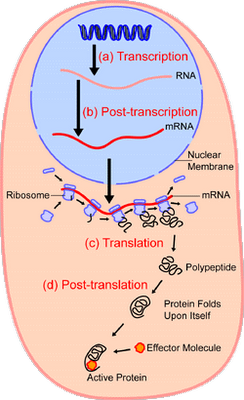
The step-by-step process of protein synthesis, controlled by the digital (= discrete state) information stored in DNA

And, in so doing, let us zoom in on the way that the Ribosome uses a control tape, mRNA, to step by step assemble a new amino acid chain, to make a protein:
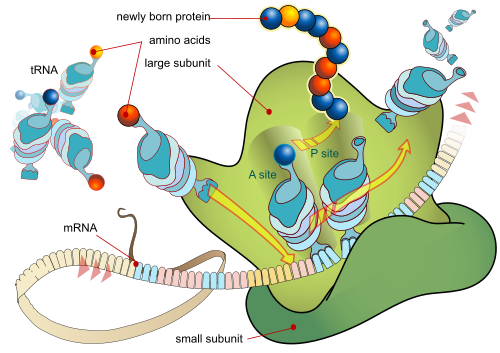
Step by step protein synthesis in action, in the ribosome, based on the sequence of codes in the mRNA control tape (Courtesy, Wikipedia and LadyofHats)

This can be seen as an animation, courtesy Vuk Nikolic:

Let us note the comparable utility of punched paper tape used in computers and numerically controlled industrial machines in a past generation:
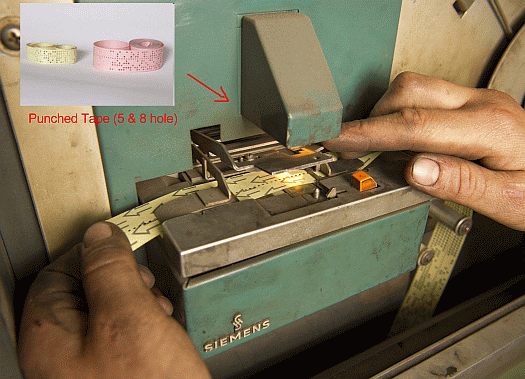
Punched paper Tape, as used in older computers and numerically controlled machine tools (Courtesy Wiki & Siemens)

Given some onward objections, May 4th I add an info graphic on DNA . . .
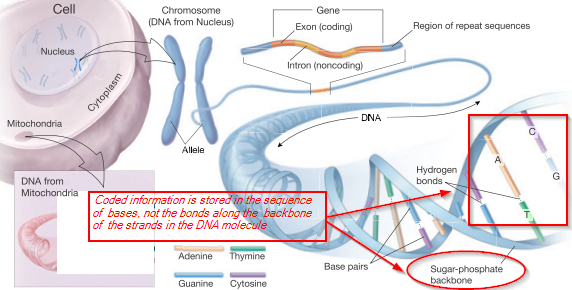
Fig I.0: DNA as a stored code exhibiting functionally specific complex digital information (HT: NIH)

And a similar one on the implied communication system’s general, irreducibly complex architecture:
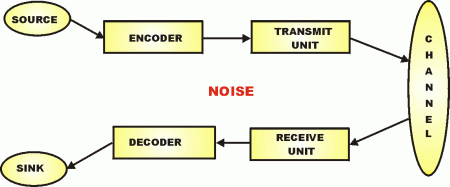
A communication system
A communication system. Notice the required arrangement of a set of well-matched, corresponding components that are each necessary and jointly sufficient to achieve function, e.g. coder and decoder, transmitter and receiver, Transmitter, channel and receiver, etc.

In turn,  that brings up the following clip from the ID Foundation series article on Irreducible Complexity, on Menuge’s criteria C1 – 5 for getting to such a system (which he presented in the context of the Flagellum):

But also, IC is a barrier to the usual suggested counter-argument, co-option or exaptation based on a conveniently available cluster of existing or duplicated parts. For instance, Angus Menuge has noted that:

For a working [bacterial] flagellum to be built by exaptation, the five following conditions would all have to be met:

C1: Availability. Among the parts available for recruitment to form the flagellum, there would need to be ones capable of performing the highly specialized tasks of paddle, rotor, and motor, even though all of these items serve some other function or no function.

C2: Synchronization. The availability of these parts would have to be synchronized so that at some point, either individually or in combination, they are all available at the same time.

C3: Localization. The selected parts must all be made available at the same ‘construction site,’ perhaps not simultaneously but certainly at the time they are needed.

C4: Coordination. The parts must be coordinated in just the right way: even if all of the parts of a flagellum are available at the right time, it is clear that the majority of ways of assembling them will be non-functional or irrelevant.

C5: Interface compatibility. The parts must be mutually compatible, that is, ‘well-matched’ and capable of properly ‘interacting’: even if a paddle, rotor, and motor are put together in the right order, they also need to interface correctly.

( Agents Under Fire: Materialism and the Rationality of Science, pgs. 104-105 (Rowman & Littlefield, 2004). HT: ENV.)

In short, the co-ordinated and functional organisation of a complex system  is itself a factor that needs credible explanation.

However, as Luskin notes for the iconic flagellum, “Those who purport to explain flagellar evolution almost always only address C1 and ignore C2-C5.” [ENV.]

And yet, unless all five factors are properly addressed, the matter has plainly not been adequately explained. Worse, the classic attempted rebuttal, the Type Three Secretory System [T3SS] is not only based on a subset of the genes for the flagellum [as part of the self-assembly the flagellum must push components out of the cell], but functionally, it works to help certain bacteria prey on eukaryote organisms. Thus, if anything the T3SS is not only a component part that has to be integrated under C1 – 5, but it is credibly derivative of the flagellum and an adaptation that is subsequent to the origin of Eukaryotes. Also, it is just one of several components, and is arguably itself an IC system. (Cf Dembski here.)

Going beyond all of this, in the well known Dover 2005 trial, and citing ENV, ID lab researcher Scott Minnich has testified to a direct confirmation of the IC status of the flagellum:

Scott Minnich has properly tested for irreducible complexity through genetic knock-out experiments he performed in his own laboratory at the University of Idaho. He presented this evidence during the Dover trial, which showed that the bacterial flagellum is irreducibly complex with respect to its complement of thirty-five genes. As Minnich testified: “One mutation, one part knock out, it can’t swim. Put that single gene back in we restore motility. Same thing over here. We put, knock out one part, put a good copy of the gene back in, and they can swim. By definition the system is irreducibly complex. We’ve done that with all 35 components of the flagellum, and we get the same effect. [Dover Trial, Day 20 PM Testimony, pp. 107-108. Unfortunately, Judge Jones simply ignored this fact reported by the researcher who did the work, in the open court room.]

That is, using “knockout” techniques, the 35 relevant flagellar proteins in a target bacterium were knocked out then restored one by one.

The pattern for each DNA-sequence: OUT — no function, BACK IN — function restored.

Thus, the flagellum is credibly empirically confirmed as irreducibly complex. [Cf onward discussion on Knockout Studies, here.]

The kinematic von Neumann self-replicating machine [vNSR] concept is then readily applicable to the living cell:
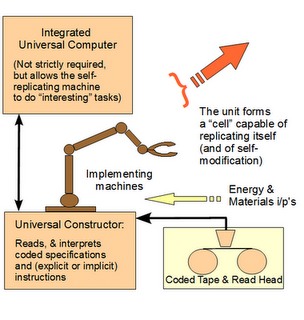
jvn_self_replicator
The kinematic vNSR shows how stored coded information on a tape can be used to control a self-replicating automaton, relevant to both paper tape and the living cell

Mignea’s model of minimal requisites for a self-replicating cell [speech here], are then highly relevant as well:
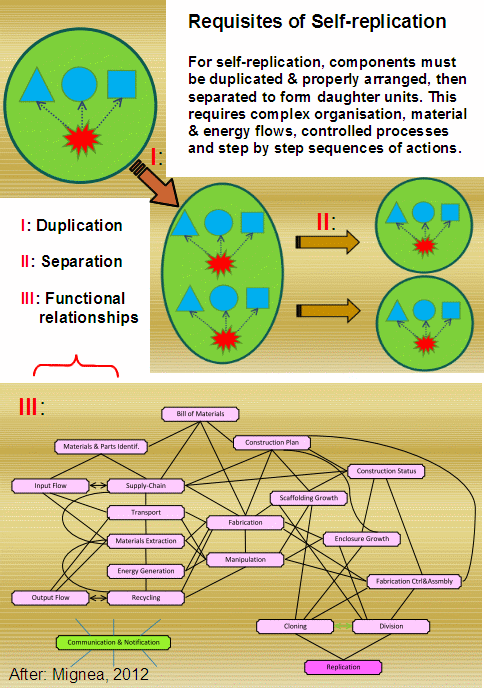
self_replication_mignea
Mignea’s schematic of the requisites of kinematic self-replication, showing duplication and arrangement then separation into daughter automata. This requires stored algorithmic procedures, descriptions sufficient to construct components, means to execute instructions, materials handling, controlled energy flows, wastes disposal and more. (Source: Mignea, 2012, slide show as linked; fair use.)

HT CR, here’s a typical representation of cell replication through Mitosis:

And, we may then ponder Michael Denton’s reflection on the automated world of the cell, in his foundational book, Evolution, a Theory in Crisis (1986):

To grasp the reality of life as it has been revealed by molecular biology, we must magnify a cell a thousand million times until it is twenty kilometers in diameter [[so each atom in it would be “the size of a tennis ball”] and resembles a giant airship large enough to cover a great city like London or New York. What we would then see would be an object of unparalleled complexity and adaptive design. On the surface of the cell we would see millions of openings, like the port holes of a vast space ship, opening and closing to allow a continual stream of materials to flow in and out. If we were to enter one of these openings we would find ourselves in a world of supreme technology and bewildering complexity. We would see endless highly organized corridors and conduits branching in every direction away from the perimeter of the cell, some leading to the central memory bank in the nucleus and others to assembly plants and processing units. The nucleus itself would be a vast spherical chamber more than a kilometer in diameter, resembling a geodesic dome inside of which we would see, all neatly stacked together in ordered arrays, the miles of coiled chains of the DNA molecules. A huge range of products and raw materials would shuttle along all the manifold conduits in a highly ordered fashion to and from all the various assembly plants in the outer regions of the cell.
 
We would wonder at the level of control implicit in the movement of so many objects down so many seemingly endless conduits, all in perfect unison. We would see all around us, in every direction we looked, all sorts of robot-like machines . . . . We would see that nearly every feature of our own advanced machines had its analogue in the cell: artificial languages and their decoding systems, memory banks for information storage and retrieval, elegant control systems regulating the automated assembly of components, error fail-safe and proof-reading devices used for quality control, assembly processes involving the principle of prefabrication and modular construction . . . . However, it would be a factory which would have one capacity not equaled in any of our own most advanced machines, for it would be capable of replicating its entire structure within a matter of a few hours . . . .
 
Unlike our own pseudo-automated assembly plants, where external controls are being continually applied, the cell’s manufacturing capability is entirely self-regulated . . . .[[Denton, Michael, Evolution: A Theory in Crisis, Adler, 1986, pp. 327 – 331. This work is a classic that is still well worth reading. Emphases added. (NB: The 2009 work by Stephen Meyer of Discovery Institute, Signature in the Cell, brings this classic argument up to date. The main thesis of the book is that: “The universe is comprised of matter, energy, and the information that gives order [[better: functional organisation]  to matter and energy, thereby bringing life into being. In the cell, information is carried by DNA, which functions like a software program. The signature in the cell is that of the master programmer of life.” Given the sharp response that has provoked, the onward e-book responses to attempted rebuttals, Signature of Controversy, would also be excellent, but sobering and sometimes saddening, reading.) ]}

An extension of this, gives us reason to infer that body plans similarly show signs of design. And, related arguments give us reason to infer that a cosmos fine tuned in many ways that converge on enabling such C-chemistry, aqueous medium cell based life on habitable terrestrial planets or similarly hospitable environments, also shows signs of design.

Not on a prioi impositions, but on induction from evidence we observe and reliable signs that we establish inductively. That is, scientifically.

Added, May 11: Remember, this focus on the cell is in the end because it is the root of the Darwinist three of life and as such origin of life is pivotal:
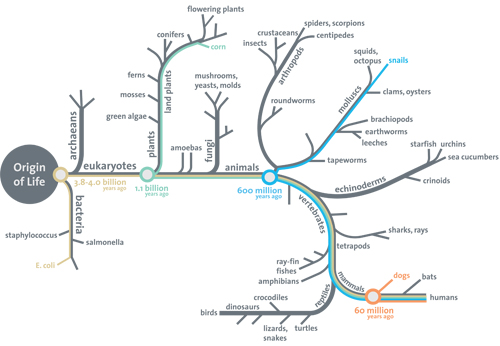
The Smithsonian's tree of life model, note the root in OOL
The Smithsonian’s tree of life model, note the root in OOL

Multiply that by the evidence that there is a definite, finitely remote beginning to the observed cosmos, some 13.7 BYA being a common estimate, and 10 – 20 BYA a widely supported ballpark. That says, it is contingent, has underlying enabling causal factors, and so is a contingent, caused being.

All of this to this point is scientific, with background logic and epistemology.

Not theology, revealed or natural.

It owes nothing to the teachings of any religious movement or institution.

However, it does provide surprising corroboration to the statements of two apostles who went out on a limb philosophically by committing the Christian faith in foundational documents to reason/communication being foundational to observed reality, our world. In short the NT concepts of the Logos [John 1, cf Col 1, Heb 1, Ac 17] and that the evident, discernible reality of God as intelligent creator from signs in the observed cosmos [Rom 1 cf Heb 11:1 – 6, Ac 17 and Eph 4:17 – 24], are supported by key findings of science over the past 100 or so years.

There are debates over timelines and interpretations of Genesis, as well there would be.

They do not matter, in the end, given the grounds advanced on the different sides of the debate. We can live with Gen 1 – 11 being a sweeping, often poetic survey meant only to establish that the world is not a chaos, and it is not a product of struggling with primordial chaos or wars of the gods or the like. The differences between the Masoretic genealogies and those in the ancient translation, the Septuagint, make me think we need to take pause on attempts to precisely date creation on such evidence. Schaeffer probably had something right in his suggestion that one would be better advised to see this as describing the flow and outline of Biblical history rather than a precise, sequential chronology. And that comes up once we can see how consistently reliable the OT is as reflecting its times and places, patterns and events, even down to getting names right.

So, debating Genesis is to follow a red herring and go off to pummel a strawman smeared with stereotypes and set up for rhetorical conflagration. A fallacy of distraction, polarisation and personalisation. As is too often found as a habitual pattern of objectors to design theory.

What is substantial is the evidence on origins of our world and of the world of cell based life in the light of its challenge to us in our comfortable scientism.

And, in that regard, we have again — this is the umpteenth time, G; and you have long since worn out patience and turning the other cheek in the face of personalities, once it became evident that denigration was a main rhetorical device at work — had good reason to see that design theory is a legitimate scientific endeavour, regardless of rhetorical games being played to make it appear otherwise.>>

_______________

In short, it is possible to address the design inference and wider design theory without resort to ideologically loaded debates. And, as a first priority, we should. END

______________

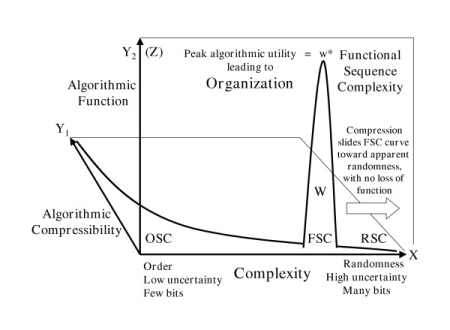
PS: In support of my follow up to EA at 153 below, at 157, it is worth adding (May 8th) the Trevors-Abel diagram from 2005 (SOURCE), contrasting the patterns of OSC, RSC and FSC:
osc_rsc_fsc

Figure 4: Superimposition of Functional Sequence Complexity onto Figure 2. The Y1 axis plane plots the decreasing degree of algorithmic compressibility as complexity increases from order towards randomness. The Y2 (Z) axis plane shows where along the same complexity gradient (X-axis) that highly instructional sequences are generally found. The Functional Sequence Complexity (FSC) curve includes all algorithmic sequences that work at all (W). The peak of this curve (w*) represents “what works best.” The FSC curve is usually quite narrow and is located closer to the random end than to the ordered end of the complexity scale. Compression of an instructive sequence slides the FSC curve towards the right (away from order, towards maximum complexity, maximum Shannon uncertainty, and seeming randomness) with no loss of function.

Comments
F/N: I have updated the OP, on irreducible complexity as well as on DNA and communication systems. KFkairosfocus
May 4, 2013
May
05
May
4
04
2013
02:42 AM
2
02
42
AM
PDT
S: Are you really serious? You tried twice to dismiss my use of the existence of codes in living cells as in effect a question-begging assumption. You used the terms "axiom" and then "premise," in contexts where that intended inference to question-begging on my part was obvious. In reply I pointed out that the reality of such was a matter of well established empirical fact, giving references on the topic. Instead of simply acknowledging the fact, you have played the ignore the correction, then move goal posts to a new tangential objection rhetorical stunt. And yes, at this point, "rhetorical stunt" is an appropriate and accurate description of what you have been doing. Please, do better. If you think I would rely on Wiki of the slanderous and strawmannish hatchet job on ID [which I have taken time to expose here at UD some time ago], to give an actual outright admission that the existence of coding and communication systems and associated organised functional machinery implies design, think again: cf. here and here. As I noted, I cited Wiki to document that there is a commonly understood factual basis for my earlier use of the existence of digital data in DNA as a generally accepted, well warranted reality. What you have done here is to play a red herring, rhetorical strawman objection by serial distractions game. I have documented the real point at stake, that the reality of digital codes and related communication systems in the cell is a fact, not a mere questionable assumption, assertion or dubious premise. By now, you know or should know that, but evidently cannot bring yourself to acknowledge it or what it entails. A reasonable interlocutor, by contrast, would at that point acknowledge the point: yes, it is established as a reasonable fact that there are codes in use as object code in the cell, with associated communication systems. And, in particular, as the OP as set up has said, those codes are used to manufacture proteins. (Again, well established fact.) It turns out that there are hundreds or thousands of proteins in a typical cell, with 300 AA in the chain being a typical number. At 4.32 bits of info carrying capacity per AA -- 1 of 20 states for the overwhelming majority of cases -- it is not hard to add up the amount of information implied by a typical protein: 4 * 300 ~ 1,200 bits [well beyond a 500 bit threshold], and there are hundreds of proteins to be made and put to work in the cell based on the coding system. That information is obviously -- again, well established fact not speculation -- functionally specific, and comes from isolated islands in the space of possible AA sequences of similar length. This can in the first instance be seen from the isolation of protein fold domains in sequence space, on Hamming distance measures. (Look up Durston's 2007 published results of info in 15 protein families, which allows for the redundancies and variabilities of sequences in the islands of function, here and onwards.) The context here is that folding (and in the OOL context this also implies chirality/handedness and the challenge of interfering cross reactions and/or that of encapsulation and gating . . . this gets worse and worse, not better as one digs in . . . ), which must be implied by the specific sequence, is already a major functional constraint that eliminates the vast majority of AA sequence space, and leads to islands of discrete function. But there is more. DNA holds protein-assembly codes. Codes, that function in an organised system that maintains the strings, unzips, transcribes and edits the resulting mRNAs. The mRNAs are then sent to the rough endoplasmic reticulum or the like location, where a waiting ribosome locks in and pulls together its two main parts, as the animation and images show in the OP. With the action of various support molecules, and a stream of tRNA's loaded with the right AA's, proteins are initiated and elongated then ended and released. Folding -- especially for the more complex -- is often chaperoned, and we should note that non-functional, more stable folds are possible and spontaneously propagating -- prions, implicated in mad cow disease, scrapies and possibly Alzheimer's. Where also, the tRNA's hold the AA in a standard coupler, the CCA tail. These work as position-arm devices with standard joint tool-tips. They are loaded with the correct AA based on a cluster of special enzymes that pick up the correct tRNA from its overall configuration. That is, the tRNA's are loaded INFORMATIONALLY. Such -- and more -- implies that we are dealing with a complex, integrated communication and information processing system, based on using a symbolic code. Such a system is, first in key part -- architecture -- irreducibly complex, i.e a cluster of well-matched components must be present and set up with correct correspondence, as the diagram to be added in the OP in a moment will show. Coding and decoding must correspond, protocols must be set up to cover language, and this must be physically instantiated. The core cluster of architectural pieces is irreducibly complex --
and BTW, your attempted dismissal of Behe on a judicial hatchet job is inadvertently revealing -- cf. on IC here, including the discussion on page 2 on how IC is routinely used in knockout based research into the function of genes . . . the objector sites don't usually talk about that part of the story --
. . . as a cluster of key parts are all necessary, in the correct arrangement and co-ordination, or the function irretrievably breaks down. This is in fact a commonplace of engineering, and it is not unexpected. Worse, codes that function ins step by step finite sequences of actions that implement a definite task and achieve a definite end point product or state are direct indications of intent and purpose: algorithms. They also imply language, as symbolic systems are inherently linguistic and again purposeful. At this stage I simply expect more tangential objections, but the point is that your objections are systematically ill informed and based on the rhetoric of distractions and distortions. That is revealing, especially as there is an alternative that G was boasting of having in hand: dozens of couner-examples to the known source of FSCO/I: design. I am sure given the intensity of debates, that if such were so, there would be entire sites set up to highlight such cases. Over the years, I have seen attempted cases, by now over a dozen, but in every case brought to my attention, they prove the opposite of what was claimed. Weasel is a case of purposeful goal directed intelligent search. GAs and evolutionary computing generally depends on the same basic inputs, indeed in a world of search for search (S4S) one can use active information as a metric of the intelligently added info that allows performance in excess of what would be expected from straight random search. The perceived canals on Mars, had they been real, would have been strong indications of planetary scale design. Instead, the drawings were evidences of what the observers thought they were seeing. The Youtube simulation exercise where clocks allegedly spontaneously self assemble and evolve, is an example of failing to understand just what is needed to make something as "simple" as meshing gears, and what is requires to get such into proper alignment. (A gear is a highly complex and functionally specific 3-d object. The alignments and meshing to get to function, not to mention pinning to properly -- exactlingly --aligned axes, all have to be explained on a 3-d basis, and that highlights the rapidity with which FSCO/I and irreducible complexity come to bear.) And so forth. Again, if you have a genuinely substantial objection the easy answer to the Meyer challenge is direct: show that FSCO/I of 500+ bits is on observation, originally produced by blind chance and mechanical necessity without intelligent direction. Persistent resort to tangential objections (themselves too often riddled with fallacies), in absence of this simply inadvertently unde4rscoes the degree of empirical warrant attaching to the inference to design on FSCO/I as sign. KFkairosfocus
May 4, 2013
May
05
May
4
04
2013
02:23 AM
2
02
23
AM
PDT
"No it’s not. These arguments aren’t generated to convince knowledgable people, they’re created to catch the attention of the press and the lay public. Behe’s been dead since Dover. I mean you can believe it, but it’s a philosophical thing at best at this point, that’s why the popular metaphors has moved on. The concept is still as terrible as ever, but still."
The above is an example of a substance-free comment. It's an insipid rant, and contains no argument against the concept or definition of irreducible complexity.Chance Ratcliff
May 3, 2013
May
05
May
3
03
2013
11:19 PM
11
11
19
PM
PDT
"Yeah that’s handwaving, Chance."
Nope, that's the fact of direct experience with digital codes. Digital codes implies design is the premise, and it can be invalidated by demonstrating a non-intelligent, chance-and-necessity source of digital codes. DNA is a base 4 chemical code that corresponds to a 20 character string of amino acid residues, withing the context of a system that maps elements from from one set of strings into another. This is coded information transfer, and systems which transfer information from one form to another are readily established by intelligent agents. Either you're claiming that DNA does not contain a code, or that such codes are not the exclusive products of intelligent activity. If you're claiming something else entirely, please be specific.Chance Ratcliff
May 3, 2013
May
05
May
3
03
2013
10:59 PM
10
10
59
PM
PDT
sigaba, I am traveling, so I cannot participate in this conversation as much as I might otherwise, but I have to say that your comments demonstrate a woefully inadequate (undisciplined, really) conception of what information is, and how it operates within the systems that use it to produce physical effects. Perhaps if you'd approach this without the absolute certainty that you have nothing to learn, you'd come to actually understand issues that you (demonstrably, without a doubt) are uneducated about.Upright BiPed
May 3, 2013
May
05
May
3
03
2013
10:43 PM
10
10
43
PM
PDT
Digital codes imply design. This is hardly disputable.
Yeah that's handwaving, Chance.
Nonsense. Behe’s notion is very much alive and well
No it's not. These arguments aren't generated to convince knowledgable people, they're created to catch the attention of the press and the lay public. Behe's been dead since Dover. I mean you can believe it, but it's a philosophical thing at best at this point, that's why the popular metaphors has moved on. The concept is still as terrible as ever, but still.sigaba
May 3, 2013
May
05
May
3
03
2013
10:31 PM
10
10
31
PM
PDT
sigaba:
It used to be Behean irreducible complexity, but because that is spent and discredited . . .
Nonsense. Behe's notion is very much alive and well. What we have been treated to, rather than rational refutations, is handwaving hypotheticals, like Miller's attempt to push co-option, Matzke's imaginary "assume system A changing into system B" and so on. Irreducible complexity is very much a live issue. Is it everything? No. Does it cover all cases? Perhaps not. But it is, as Darwin recognized, a fundamental problem for the traditional slight, successive mutations storyline.Eric Anderson
May 3, 2013
May
05
May
3
03
2013
10:22 PM
10
10
22
PM
PDT
Digital codes imply design. This is hardly disputable. The information encoded into DNA is a base 4 digital string specifying, among other things, a base 20 amino acid alphabet within the context of the system in which it functions. A design inference is warranted here, and can be falsified by citing an empirically verifiable material process capable of establishing such a relationship. There are plenty of examples of digital codes, and systems in which they function, being the verifiable products of design, and none which can be attributed to a verifiable material process. Irreducible complexity implies design also. When we find a system composed of multiple, interdependent parts working together to perform a function, where the function of the system cannot be performed by any of the individual parts themselves, and removal of any of the parts causes the system to effectively cease functioning, we have irreducible complexity and a design inference is warranted. The system for transferring information from DNA into an amino acid sequence is such a system. This can be falsified by citing an empirically verifiable material process capable of establishing such a mechanism. There are also plenty of examples of irreducibly complex systems being the verifiable products of design, and none which can be credited to a verifiable material process.Chance Ratcliff
May 3, 2013
May
05
May
3
03
2013
09:24 PM
9
09
24
PM
PDT
Joe-
It takes more than just being sufficiently rare to warrant a design inference wrt Intelligent Design and intelligent design.
You're right, it also has to "look like" whatever process we have decided, by assertion, is design. It used to be Behean irreducible complexity, but because that is spent and discredited, we now have Meyer popularizing digital codes, because apparently we've run out of mousetraps.
I would say it is a given that all materialists are atheists who adhere to methodological naturalism.
Most scientists believe in a God, many would claim to be Christian, and almost all would say they are methodological naturalists. The assertion that they are not is rooted in sectarian disagreements over the proper exegesis of holy scripture, nothing more.sigaba
May 3, 2013
May
05
May
3
03
2013
06:05 PM
6
06
05
PM
PDT
KF- Your links have no information in support of your arguments. The Wikipedia article on genetic code does not claim that it is too complex to have arisen from nature, and if it did, Wikipedia is no useable authority anyways. I have read your post. You argue that a code implies a design, but you have no basis to claim this. You refer to the concept of "functionally specified complex information" but this receives a definition that is teleological --it is this thing because it shows purpose and "foresight." You appeal to a ridiculous fallacy that "like causes like" (somehow attributed to Newton, as if that made a difference), and your principle evidence seems to be that DNA can be compared to a paper tape machine. You appeal to statistical improbabilities of the process itself or the code it contains, but your account of the statistical trials necessary to create the code is incomplete at best, and as an "experiment" you attempt an infinite monkey procedure in Microsoft Word(!) without making any effort to show that this process is an accurate model of how DNA is actually created and mutated. If it is rare to see Shakespeare in a monkey trial, thus you argue it must be astronomically more rare to encode collagen in DNA, but these two procedures are not remotely analogous. At length, most of your post, you recapitulate established facts about how DNA is transcribed, but this information is irrelevant, because you have not proven that code implies design. You then finish off arguments from ignorance, intuitions that any such thing as complex as a cell could not possibly be natural, because, well, we cannot imagine how. It is wondrous, and it might be designed, but none of your arguments here are to that effect. You then, naturally, indulge in some Bible quotes, just to reassure everyone that this theory is in fact a form of worship and is ideologically safe. So I repeat, your criteria for design are arbitrary and would apply to any arbitrarily selected phenomena in nature, living or not, and constitutes a teleological argument for a designer. You have no evidentiary basis for this belief, and it is impossible to prove it true or false. No trial or protocol could possibly be devised that could tell the difference between "functionally specified complex information" and "information."sigaba
May 3, 2013
May
05
May
3
03
2013
05:58 PM
5
05
58
PM
PDT
sigaba:
Everybody here goes to elaborate pains to distinguish between creationism and intelligent design, but atheism, materialism, and methodological naturalism are not properly distinguished, and all are treated as if they were the same thing.
I would say it is a given that all materialists are atheists who adhere to methodological naturalism. Are all atheists also materialists? Do all atheists adhere to methodological naturalsim? Can one be an atheist and still worship Mother Nature and Father Time? Perhaps if you deny that you do so. So, what's your point?Joe
May 3, 2013
May
05
May
3
03
2013
05:25 PM
5
05
25
PM
PDT
sigaba:
It shouldn’t make any difference what the nature of a physical system is — if it is sufficiently rare, then it is designed.
1- It is the nature of the system we are trying to determine 2- It takes more than just being sufficiently rare to warrant a design inference wrt Intelligent Design and intelligent design. 3- And it ain't just protein synthesis. There is a requirement for several different proteins of varying quantities to work together 4- DNA does nothing by itself. It is just one component in a semiotic system 5- The Design Inference extends beyond biology- read "The Privileged Planet"- for example:
“The one place that has observers is the one place that also has perfect solar eclipses.”... “There is a final, even more bizarre twist. Because of Moon-induced tides, the Moon is gradually receding from Earth at 3.82 centimeters per year. In ten million years will seem noticeably smaller. At the same time, the Sun’s apparent girth has been swelling by six centimeters per year for ages, as is normal in stellar evolution. These two processes, working together, should end total solar eclipses in about 250 million years, a mere 5 percent of the age of the Earth. This relatively small window of opportunity also happens to coincide with the existence of intelligent life. Put another way, the most habitable place in the Solar System yields the best view of solar eclipses just when observers can best appreciate them.”
BTW no one thought pulsars were alien signals- well maybe the press, but not the researchers. The signal was too messy.Joe
May 3, 2013
May
05
May
3
03
2013
05:12 PM
5
05
12
PM
PDT
S: Twice, you have pretty obviously tried to imply that I have begged questions by starting from DNA etc as coded information-bearing molecules. Now that I have linked summary sources in case that you somehow did not get the message -- which is a commonplace of educated people -- you accuse me of being petty. That speaks sad volumes. You can do better. Please, stop going down that road, it does exactly nothing but create a distraction. KF PS: In the material part, DNA encodes algorithmic info used to assemble proteins in a step by step process, using high contingency string data structures. The sequence of bases is not specified by the sort of mechanical necessity implied by a rotating neutron star. These things should be quite plain. Equally, you know or should know that high contingency entities are rooted in chance and/or design, eg: >>hydygcftxyfcyd>> vs >>this is a designed string>>. I should not have to be wasting time to go over such again and again.kairosfocus
May 3, 2013
May
05
May
3
03
2013
05:08 PM
5
05
08
PM
PDT
I think you're more upset with my terminology than my argument, and have chosen only to engage with that. This is petty. Your criteria for design is arbitrary, and cherry-picked from the unknown edges of life science in order to minimize critique.
Pulsars do not exhibit complex symbolic codes used to assemble proteins step by step, i.e. algorithmically.
It shouldn't make any difference what the nature of a physical system is -- if it is sufficiently rare, then it is designed. This is my understanding of the theory. How is protein synthesis "complex" but a magnetic rotating star not? your assignment of this term is arbitrary. To restrict the definition to "algorithmic" is needless and without basis in your argument, and I would add it's not clear that DNA is processed "algorithmically." It is encoded and decoded, but by a very simple mapping, DNA has no high-level semantics besides the mapping, and no one claims that DNA transcription is a Turning-complete process or even a process that obeys any formal mathematical logic. It would also be needlessly restrictive to claim that DNA is the definitional basis of all life, or the only evidence we have that a designer works in nature.sigaba
May 3, 2013
May
05
May
3
03
2013
05:00 PM
5
05
00
PM
PDT
S: Pulsars -- accounted for on mechanical necessity giving rise to natural regularity [periodic pulses due to rotation] -- do not exhibit complex symbolic codes used to assemble proteins step by step, i.e. algorithmically. There is no proper comparison. KF PS: If you have not read the OP, please do so.kairosfocus
May 3, 2013
May
05
May
3
03
2013
04:45 PM
4
04
45
PM
PDT
S: I have never said, anywhere, that life is a message. I have pointed out that certain key molecules of cell based life, are information-bearing, and in particular DNA and mRNA carry coded digital -- discrete state -- symbolic info. This is not an "unargued premise" (again, an unproved starting point for an argument, and potentially subject to dispute, here with obvious hints between the lines of question-begging) it is an established major factual finding of science that accounted for more than one Nobel Prize. Why are you reduced to wasting time and effort by objecting to or by implication denigrating established facts generally known to educated people and accessible to anyone capable of a basic Google search? Try here -- added above also -- as a simple 101. KFkairosfocus
May 3, 2013
May
05
May
3
03
2013
04:43 PM
4
04
43
PM
PDT
Gregory: I'm genuinely confused about whatever broader point you are making. Can you perhaps respond to my #13 above? Thanks,Eric Anderson
May 3, 2013
May
05
May
3
03
2013
04:40 PM
4
04
40
PM
PDT
I would note that people made similar claims when we discovered pulsars -- it was believed to be impossible for natural objects to create radio signals that were so perfect, and it was assumed that a natural intelligence was the only possible answer. Of course it wasn't, the argument was made from ignorance.sigaba
May 3, 2013
May
05
May
3
03
2013
04:39 PM
4
04
39
PM
PDT
I don't think you understand what I'm saying. Your position, that life is a message, is an unargued premise. It's the sharpshooter's fallacy -- nature sprayed bullets at the wall, you've painted a target around the bullets that constitute life and claimed that nature was aiming there in the first place. The fact that there are significant gaps in our knowledge of life allows you to claim this, but you would never be able to do so for other highly specific and ordered processes in nature, because we understand them better. I can produce any number of physical systems that embody more than 500 bits of information; the selection of a life-producing one on your part is completely arbitrary. This morning I found myself behind a California license place, 4BPD895. The chances of this were one in millions, can you imagine the incredible coincidence?
That is, if the pushers of the false dichotomy natural vs supernatural cared to be sound they could easily have been sound.
What do you mean false dichotomy? Can something be both natural and supernatural?sigaba
May 3, 2013
May
05
May
3
03
2013
04:30 PM
4
04
30
PM
PDT
F/N: Onlookers, notice, no clear counter example to Meyer's challenge? Including from the one who boasted of dozens of such? Notice the way objectors are arguing? What is this telling us on the balance on the merits? KF PS: G's tendentious agendas in his big vs little ID terminology was exposed here and here (and in several other places by several people, some time back. For those who came in late.kairosfocus
May 3, 2013
May
05
May
3
03
2013
04:21 PM
4
04
21
PM
PDT
Jerry: Cf here on on selective hyperskepticism. As to the stunt of equating design theory and creationism, that is sad and sadly revealing, cf. correction here on in the WACs. Why people imagine "skepticism" to be an intellectual virtue escapes me. Critical awareness and a requirement of reasonableness, yes; skeptical games and tactics of the sort we see so drearily often, no. KFkairosfocus
May 3, 2013
May
05
May
3
03
2013
04:14 PM
4
04
14
PM
PDT
S, re:
I do think you rely on the axiom that life constitute a message, and that any other configuration of matter, regardless of how rare, does not.
It seems to me that coded information in DNA and derived molecules in the living cell is a matter of generally accepted scientifically observed fact. As is seen in things like protein synthesis. Why on earth do you now wish to rhetorical convert such a fact of empirical observation and analysis into an "axiom"? As in:
ax·i·om (ks-m) n. 1. A self-evident or universally recognized truth; a maxim: "It is an economic axiom as old as the hills that goods and services can be paid for only with goods and services" (Albert Jay Nock). 2. An established rule, principle, or law. 3. A self-evident principle or one that is accepted as true without proof as the basis for argument; a postulate. [Middle English, from Old French axiome, from Latin axima, aximat-, from Greek, from axios, worthy; see ag- in Indo-European roots.] The American Heritage® Dictionary of the English Language, Fourth Edition copyright ©2000 by Houghton Mifflin Company. Updated in 2009. Published by Houghton Mifflin Company. All rights reserved.
In short, complex, functionally specific, coded information in the cell is so evidently a matter of fact, and it is so evidently a strong sign of design as best causal explanation, that we are seeing here an evident case of selective hyperspepticism to try to blunt the point. Revealing. And the onward attempt to build on that first error, to project the imagined view that the design inference is essentially a theological exercise, speaks even more volumes; given the implied well poisoning. What part of, designers and their work are facts of observation, is so hard to grasp? Or, that in producing designs, designers often create features that on investigation per inductive logic anchored to observations, can be seen to be reliable signs of design as credible cause. That, FSCO/I is a typical example of such, e.g. in coded information beyond he 500 bit threshold? That life based on cells is full of such? Going further, that a given designer is a secondary designer who may have come from a previous one has NOTHING to do with whether the objects showing reliable signs were designed. Indeed, through Venter et l we already have known cases of design in DNA. So, that as a candidate cause, a molecular nanotech lab some generations on could do what we see is reasonable. Inference to design as based on signs of ARTificial cause is not to be equated to inference to a specifically supernatural cause. That's basic logic, and the point is rooted in 2350 year old remarks by Plato that are fairly accessible. That is, if the pushers of the false dichotomy natural vs supernatural cared to be sound they could easily have been sound. Where there are signs of design that do point beyond our observed cosmos, to a cause sufficiently powerful and having intent to build a cosmos is the fine tuning of our cosmos that enables C-chemistry, aqueous medium, protein etc using cell based life. Linked in OP. A cosmos-building intelligence that sets up basic physics balanced on a knife's edge to facilitate cell based life is an interesting conclusion, but it is not the issue on the table in this thread -- the sum total in the OP is a LINK. I would suggest some rethinking on why you sought to twist an inconvenient observed and commonly known fact -- coded info in DNA -- into an "axiom" in order to try to score rhetorical points. The, please think again. KFkairosfocus
May 3, 2013
May
05
May
3
03
2013
04:07 PM
4
04
07
PM
PDT
Kairos it would be interesting to see what anti ID people have to say about main article on top. Do they agree or disagree with it and why?Eugen
May 3, 2013
May
05
May
3
03
2013
02:58 PM
2
02
58
PM
PDT
Axel:
The promissory note didn’t bin and gorn and dunnit, but it sure will one day.
Science doesn't promise to answer all questions. Materialists do -- intelligent design proponents may or may not, I cannot completely tell. Everybody here goes to elaborate pains to distinguish between creationism and intelligent design, but atheism, materialism, and methodological naturalism are not properly distinguished, and all are treated as if they were the same thing. The edge of scientific knowledge is constantly in a crisis with paradoxes, unresolved contradictions and false assumptions, that's just how it works. Science cannot provide metaphysical certainty, it is merely the best system we have for making statements about the natural world. Science cannot prove or disprove the existence of supernatural forces, though I gather that some here would like to change the foundations of science in order to admit supernatural causes phenomena. This is how I read KF's reference to "worldview", and he seems in basic agreement with the Dover trial testimonies of Behe, Minnich and Stephen Fuller, who all conceded that science as a discipline itself must be redefined, in terms of epistemology and philosophy of knowledge, if ID were to be accepted as valid science. I would add that this defect is completely self-imposed; if we had the identity of a designer or could determine its method of action, there would be no need to refer to the supernatural and science could remain naturalistic. But if a designer is to remain an opaque and undeterminable entity, appeals to the supernatural are required -- I suppose this is why many IDers split on this issue, but all agree that they are under no obligation to provide one.sigaba
May 3, 2013
May
05
May
3
03
2013
02:39 PM
2
02
39
PM
PDT
This is somewhat off topic but since this is the most popular thread today, some may be interested to see what a famous materialist is doing by distorting the debate. The Teaching Company/Great Courses announced a new course today: Skepticism 101 by Michael Shermer: http://www.thegreatcourses.com/tgc/courses/course_detail.aspx?cid=9388 Here is the contents of this course which is only available in audio. I have no idea what it says since I do not plan to buy it but included the short description of the evolution vs. creationism lecture. He is obviously knowingly distorting the argument to tie ID to creationism which thread obviously dispels. 1 The Virtues of Skepticism 2 Skepticism and Science 3 Mistakes in Thinking We All Make 4 Cognitive Biases and Their Effects 5 Wrong Thinking in Everyday Life 6 The Neuroscience of Belief 7 The Paranormal and the Supernatural 8 Science versus Pseudoscience 9 Comparing SETI and UFOlogy 10 Comparing Evolution and Creationism
(description of this lecture from the website: From the 1925 Scopes “Monkey” trial to the 2006 Dover trial over the theory of Intelligent Design, look at the history of the evolution and creationism debate, which has important political and cultural ramifications for science and education. Break down the “God of the Gaps” argument and consider why people shouldn’t fear evolution.?)
11 Science, History, and Pseudohistory 12 The Lure of Conspiracy Theories 13 Inside the Modern Cult 14 The Psychology of Religious Belief 15 The God Question 16 Without God, Does Anything Go? 17 Life, Death, and the Afterlife 18 Your Skeptical Toolkitjerry
May 3, 2013
May
05
May
3
03
2013
12:49 PM
12
12
49
PM
PDT
KF-
the inference to design as process is not a theological inference but a scientific one, as has been explicitly pointed out and explained, starting with OP.
That is your assertion, however I do think you rely on the axiom that life constitute a message, and that any other configuration of matter, regardless of how rare, does not. The organization of diamonds can be specified in an extremely compact way, but we don't claim that diamonds are evidence for design, because we understand natural principles under which diamonds form. Life can be specified in a very compact way, but because we do not have natural principles to explain how it forms, we can say it is evidence of design. We are left with a Designer that occupies the gaps in knowledge. The aspects we choose to put into the explanatory filter are completely subjective and subject to present scientific knowledge. I'm not sure the proposition of a designer is wrong, but I don't think it's objective, or that it provides a falsifiable proposition such that you could identify any material object and say it was designed or not.sigaba
May 3, 2013
May
05
May
3
03
2013
12:48 PM
12
12
48
PM
PDT
'You can either completely change your understanding of epistemology and philosophy to include supernatural non-causality, simultaneous life-death, and a physical world that depends on the conscious observer, or you can figure out why the Copenhagen Interpretation isn’t complete, the second solution is more parsimonious and we have Many Worlds as a result.' That says it all sigaba! It's like the man who, when asked how to get to some town or other replied that, well, if he wanted to go there, he wouldn't start of from where they were! That's the atheist scientist for you. Come up against paradoxes? Just replace 'counter-rationality' with 'counter-intuitiveness'. Invocation of the 'promissory note of the gaps'. The promissory note didn't bin and gorn and dunnit, but it sure will one day. You just wait. Those scientists in the TV ads in their white coats, standing and looking at a test tube, aren't doing that for the benefit of their health. No, Sirree. A Brave New World beckons! Many Worlds! Love it. I believe in many worlds, corresponding to each person, and coordinated seamlessly by God, at all but the sub-atomic level. (Another QM proof of the falsity of objectivity, in favour of 'inter-subjectivity': personal observation of a particle affects it physically). But not Many Worlds to render any and every crackpot, atheist fantasy, possible, rendering everything meaningless, simply because they've come up against a wall of ever-proliferating paradoxes, necessarily impenetrable by the analytical intelligence. Then there's the proof of the centrality of the Observer in the universe, wherever he may be located, to which conundrum Bornagain77 has referred on several occasions. I'm sure it goes on and on. Why wouldn't it?Axel
May 3, 2013
May
05
May
3
03
2013
12:43 PM
12
12
43
PM
PDT
S: the inference to design as process is not a theological inference but a scientific one, as has been explicitly pointed out and explained, starting with OP. Above in this thread, I have taken time -- explicitly to resolve a matter regarded as tangential but which would distract -- on worldviews and theological issues; which are to be addressed on comparative difficulties not on scientific methods and evidence. A worldview level discussion on grounding our basic frames of thought for the world is a different matter form the implications of FSCO/I on its most credible source in terms of causal process, design. KFkairosfocus
May 3, 2013
May
05
May
3
03
2013
11:37 AM
11
11
37
AM
PDT
Onlookers, G continues tangents. His attempted and loaded distinctions are of no weight. And his claims to be easily able to overturn the premise Meyer has given as is cited above, are shown hollow by his failure to substantiate while resorting to accusations. KFkairosfocus
May 3, 2013
May
05
May
3
03
2013
11:32 AM
11
11
32
AM
PDT
Thank you for your clarifying words, KF. If you believe that the inference of design in nature is a matter of accepting a particular Christian doctrine, I will not disagree with you.sigaba
May 3, 2013
May
05
May
3
03
2013
10:57 AM
10
10
57
AM
PDT
1 3 4 5 6 7

Leave a Reply