August 2011
Summer evening fun: The design inference and crop circles
New book: John Lennox asks, If I believe that the earth is 4.5 billion years old, am I denying the authority of Scripture?

ID-friendly Oxford math prof JohnLennox has a new book out, Seven Days That Divide the World: The Beginning According to Genesis and Science . Can’t imagine which seven days. Blurb:
What did the writer of Genesis mean by ‘the first day’? Is it a literal week or a series of time periods? If I believe that the earth is 4.5 billion years old, am I denying the authority of Scripture? Read More ›
You lose, Reverend: a minister blunders while attacking the inerrancy of his own holy book

Pity the poor readers of The Huffington Post. Not only do they have to put up with biased coverage of controversial scientific issues, such as the Intelligent Design controversy (see here, here, here and here for recent examples), but they also have to endure poorly researched articles on religion that are riddled with errors, despite the fact that these articles are often written by ministers of religion, who really should know better. This post is about one badly misinformed minister, Rev. Dr. David J. Lose, who has just written a terrible article for The Huffington Post.
Intelligent Design, as readers of Uncommon Descent are well aware, is a scientific quest for patterns in Nature which exhibit signs of being the product of some intelligence – a quest which is rapidly yielding new results in fields as diverse as cosmology, biochemistry and neurology. Read More ›
“No Dinosaurs in Heaven” film purports to tell the Trooth about the intelligent design community
Giant fossil bird found in Central Asia
Flores man really was microcephalic, say researchers
Geologist-artist’s 1998 work presages later changes in view of dinosaurs
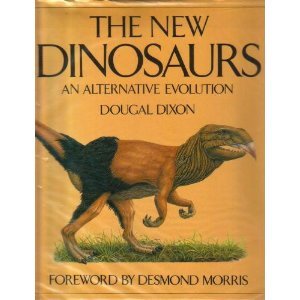
In “Alternative Evolution” of Dinosaurs Foresaw Contemporary Paleo Finds” (Scientific American August 10, 2011), Brian Switek surveys the great changes that have taken place in how dinosaurs are viewed, many of which may have been foreseen by Dougal Dixon, who thought he was writing a fantasy about how dinosaurs would have evolved, had they survived. Except that they happened way back then. Read More ›
Biologos & NPR on Adam and Eve – but is it Science?
Biologos have responded to the NPR program, by suggesting that it is OK to believe in a literal Adam and Eve as theology, even if science is silent on the question. http://biologos.org/blog/nprs-adam-and-eve-story
Darrel Falk and Kathryn Applegate write that “There is no scientific reason to upset that theological apple cart. Indeed as scientists, we must respect the theological diversity of Evangelicalism.” although adding “Science is an amazing tool that gives insight into our world, one which is so effective that it is allows us to become virtually certain about some things.” I would prefer though to maintain a degree of greater scientific scepticism concerning historical questions that are not directly testable, lest we turn our scientific narratives into self delusion. Read More ›
Intelligent design theory points to “God of the physicists,” not “God of the Bible”
Hit piece on ID-friendly prez hopeful Bachmann analyzed
Prager University and the Four Big Bangs
For those with open minds (genuine skeptics, not selective skeptics) check out Prager University, especially this. Like Frank Pastore I was once a devout atheist, but eventually realized that I could no longer muster up enough blind faith to believe in a completely materialistic explanation for everything. It was to a great extent that my interest in science, engineering, mathematics, and reason forced me to abandon my materialistic and therefore inherently nihilistic worldview (but there was much more, including the birth of my first daughter after a long infertility ordeal). My conversion from materialistic atheism to Christian theism — to a great extent through reason, logic, and evidence — is what really scares people like Dawkins and his ilk. The Read More ›
He said it: The human mind manages both to slip itself into and stay aloof from the great causal stream that makes the real world boom
Although I may be struck by a thought, or moved by a memory, or distracted by a craving, these familiar descriptions suggest an effect with no obvious physical cause. Thoughts, memories, cravings—they are what? Crossing space and time effortlessly, the human mind deliberates, reckons, assesses, and totes things up; it reacts, registers, reflects, and responds. In some cases, like inattention or carelessness, it invites censure by doing nothing at all or doing something in the wrong way; in other cases, like vision, it acts unhesitatingly and without reflection; and in still other cases, the human mind manages both to slip itself into and stay aloof from the great causal stream that makes the real world boom, so that when it Read More ›
Losing One’s Mind, but Pretending to Defend “Science”
Listen to this rant, and then tell me that this guy is sane. His rants are perfectly analogous to those of people like Dawkins concerning challenges to Darwinian orthodoxy.
Lighter moment: Gary “Far Side” Larson’s cartoons on God and science
God’s kitchen God at His computer God appears on Trivia Tonight UD News favourite: God makes the snake