Uncommon Descent Serving The Intelligent Design Community
Author

Denyse O'Leary

Ah, priorities … and oh, consequences …

In “Did Erasmus Darwin foreshadow the tweaking of his grandson’s paradigm?” (The Scientist , 2011-03-01) , Andrew D. Ellington, a University of Texas biologist tells us,

The Lamarckian idea that giraffes’ reaching for leaves resulted in longer-necked progeny seems silly to us today, primarily because we know so very much about the underlying mechanisms of genetics. And yet Lamarck may have a last laugh—think inheritance patterns in ciliates, or the effect of diet on the coat color of agouti mouse offspring. We are in the midst of a paradigm shift in our understanding of how evolution can act…on evolution, yielding mechanisms that allow both adaptation and heritability within the course of a lifetime. And such paradigm shifts almost always have societal consequences. Manel Esteller shows that epigenetics also impacts the “dark genome” in a way that may improve cancer diagnostics. An even more far-reaching consequence is that it may prove possible to engineer epigenetics, as Bob Kingston’s Thought Experiment tacitly suggests. If so, will epigenetic engineering be subject to the same restrictions as genetic engineering? Or will this be a way that we can not merely treat disease, but possibly engineer human health into future generations?

And in the face of so momentous a revolution in our thinking, his worry is

We can expect that epigenetics will be held up as the forerunner of that bastard child of Creationism, Intelligent Design.

Such limited aims in the face of so vast an ocean of possibilities.

Not only is he right in his concerns, such as they are, but it helps to see why he is right. In the  first place, the modern Darwinism enforced in schools is a narrow cult compared to what Darwin actually proposed about how evolution occurs. For example, as David Tyler notes, Read More ›
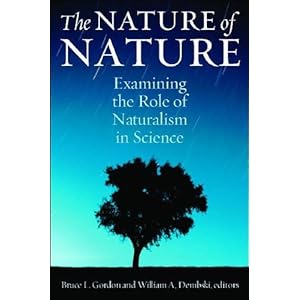
Nature of Nature: For $18 plus shipping, rid your life of bores and trolls – and, more important, learn the big story

The Nature of Nature: Examining the Role of Naturalism in ScienceA friend writes to say that Nature of Nature can be had at Amazon for just shy of $18, commenting “Given the tiny price for the huge interesting proceedings of the Baylor conference, I hope that tons of us will buy the book.”

Yes, indeed, It is indispensable for whistling bores and broomsticks out of one’s life. In Nature of Nature, both sides on the ID controversy give it their best shot. Including Nobel Prize winners.

No bores, no broomsticks, no trolls, no truthing.

Just think! For a mere $18 plus shipping, and a few hours time, you can Read More ›

But “Lucy” herself is mostly an artifact

Gil Dodgen offers below a comparison between Mozart and “Lucy”, noting “I can’t think of anything in my wildest imagination that could be more absurd or preposterous.”

Good point. My question is, how much is “Lucy”* an artifact of the imagination?

With Mozart (1756-1791), we are looking at a portrait of a young man about whom we know a good deal, in historical time – the word of contemporaries and the documentary records, as well as his corpus of work and the well-documented circumstances of his time (18th century Vienna).

The worst we can say of the portrait painter of old is that he tended to flatter. If that painting didn’t look like Mozart at all, he wouldn’t get paid.

With Lucy, we are looking at an artist’s rendering of a reconstruction of a few bones, with details about Lucy’s life that are, beyond the most obvious (eat, sleep, etc.), almost entirely a work of someone’s imagination. The more letters that person can put after their name and the greater the number of years “in the field” and shazzam!! Imagination converts to fact, via the assured results of modern science: “Shed’ve … done this.”

For now. Until someone else comes along, with the same or more attributes, makes bigger shazzam!! and behold: “Shed’ve … done that!”

And as for the rest of us: Shut up, you morons, and believe.

Then, faced with this stuff, Read More ›

Martin Gaskell, the Darwin lobby’s astronomer target, supports Texas anti-discrimination bill

Here, Aman Batheja reports that an “Arlington lawmaker’s bill would protect questioners of evolution” (Star-Telegram, Mar. 17, 2011):

The measure from Republican state Rep. Bill Zedler would block higher education institutions from discriminating against or penalizing teachers or students based on their research into intelligent design or other theories that disagree with evolution.

The really surprising thing about this story is that it is fair and Batheja did his homework. (I am ashamed to admit what a rarity that is on these sorts of subjects these days, so he deserves a great deal of credit.)

Yes, we hear (as expected) that Read More ›

Examining claims for Neanderthal ancestry in humans

In “Q&A: Who is H. sapiens really, and how do we know?” (BMC Biology 2011, 9:20doi:10.1186/1741-7007-9-20), Mason Liang and Rasmus Neilsen explain reasons for thinking that humans and Neanderthals interbred: Is it true that modern humans have Neanderthals and other archaic species in their direct ancestry?  According to two recently published papers by Green et al. and Reich et al., the answer to this question is yes. Human genomes are in part composed of DNA from other archaic hominin species that traditionally have not been counted among our ancestors, although the proportion of archaic DNA in the genome depends on your ethnicity. On the basis of analyses of ancient DNA, Green et al. report that, on average, 1 to 5% Read More ›

Coffee!! : The Yeesh files – dark matter as key to habitable planets in outer space

“Dark matter could make planets habitable” (New Scientist, 30 March 2011), Maggie McKee tells us:

No one knows what dark matter is – astronomers merely detect its gravitational pull on normal matter, which it seems to outweigh by a factor of five to one. But many researchers believe it is made of particles called WIMPs, which interact only weakly with normal matter but annihilate on contact with each other, creating a spray of energetic particles.[ … ]

But Read More ›

Neuroscience: Morality for neurons

(My latest MercatorNet column reviews an  attempt to refound morality on a  materialist basis: Commonsense notions of the mind must be abandoned in favor of a purely brain-based approach because we are our neurons: Churchland is partial to a theory that morality originates in the oxytocin-vasopressin network in mammals. One outcome is stunners like this: “The social life of humans, whether in hunter-gatherer villages, farming towns, or cities, seems to be even more complex than that of baboons or chimpanzees.” Now, why in the world would that be? We never get a clear idea how Churchland think morality works, though we do get more than a glimpse of her politics. Go here for more.

Brain chemistry: Human vs. chimp

“Evolution of cognition might be down to brain chemistry”, Andy Coghlan reports, (New Scientist, 28 March 2011): Philipp Khaitovich of the Partner Institute for Computational Biology in Shanghai, China, and colleagues analysed brain tissue from deceased humans, chimpanzees and rhesus macaques to study the concentrations of 100 chemicals linked with metabolism. In the human prefrontal cortex, the levels of 24 of these were drastically different from levels in the corresponding brain regions of the other primates. In the cerebellum, however, there were far fewer differences between humans and the other animals, with just six chemicals showing different concentrations. This suggests that, since our lineage split off from other primates, the evolution of metabolism in the thinking and learning parts of Read More ›

Darwinian brand marketing: it helps to be stunned

Here’s my latest Deprogram from Salvo, a magazine you should support. The stuff you are about to split a gut laughing while reading is all true: FIT FOR A ZOMBIE Evolutionary Brand Marketing for Your Survival[ … ] Hogshead is a brand marketing specialist; she helps executives persuade us to pay more for their brands. She has even formulated a theory, developed from the study of apes and neuroscience: to sell is to cast a spell, and the best strategy for casting a spell is to “fascinate” people. She has identified seven Darwinian triggers for successful sales spells. These triggers are not the fundamental reasons why we buy things, of course. We buy shoes to protect our feet, but brand Read More ›

An Open Letter to Dr. Jerry Coyne, from the Maverick Rabbi

From: Rabbi Moshe Averick

To: Dr. Jerry Coyne is a distinguished biologist at the University of Chicago and a self labeled “cultural Jew.”

Dear Dr. Coyne,

I’ve been contemplating the three attacks you launched against Rabbi Adam Jacobs and myself within a period of several weeks (3/7, 3/9, 3/27/11). They appeared on your website “Why Evolution is True”, and were, to a large extent, in response to a column that Rabbi Jacobs had written for the HuffPost religion section (3/6/11) called “A reasonable argument for God’s existence.” Rabbi Jacobs had mentioned that some of the material was drawn from my book, Nonsense of a High Order: The Confused and Illusory World of the Atheist. [# 7 in Jewish theology. – ed.] What I found most fascinating is that all these attacks were couched in terms of our Jewishness. Among the flowery gems that flowed from your highly enlightened, educated, and sophisticated pen:

“Evangelical Christians can be as moronic as they want, but when a rabbi says something dumb, well that sets my DNA on edge.”

“Frankly I’m weary of arguments like this one and deeply saddened that they come from Jews.”

And finally, “Jews can be just as willfully misguided about evolution as Christians like William Dembske and Michael Behe.”

Your first comment about setting “my DNA on edge” appears overtly racist. Do you actually believe there is such a thing as “Jewish DNA?” You say that you are “deeply saddened that they come from Jews.” Are Jews actually different than other human beings? Do you expect more from Jews? I guess you feel that we are superior to the gentiles. Has natural selection made us smarter than “moronic” Christians? What about non-Christian gentiles? Is there also such a thing as “Christian and non-Christian gentile DNA?” Gee, the next thing that might pop out of your Darwinian inspired view of reality is that there is also superior “Aryan DNA.” Hmmm, where have I heard that before? I’ll leave the analysis of your arguably racist views to some of the expert social scientists who inhabit your Hyde Park neighborhood. Let’s move on to the gist of the matter.

You stated that “Jews can be…willfully misguided about evolution.” What is so strange about this remark is that neither Rabbi Jacobs nor I ever discussed the theory of Darwinian evolution. The topic under discussion was the origin of life. When asked how life came from non-life, Rabbi Jacobs stated, “How? I have no idea. On the basis of all chemistry I know, it seems to me astonishingly improbable.” Oh, excuse me. That wasn’t Rabbi Jacobs, that was Read More ›

Epigenetics: But, Dr. Jablonka, the world just feels so lonely without the fat gene, the gay gene, and the God gene …

In “Traumatizing your DNA: Researcher warns that it isn’t ‘all in the genes’” (Physorg, March 23, 2011), we learn, Epigenetic research suggests that the effects of stress and environmental pollution can be passed on to future generations without any obvious change or mutation in our DNA. The problem, Prof. Jablonka points out, is that we have no idea of the extent these effects will have on the human genome of the future. “I am a story teller. I read a lot of information and develop theories about evolution. For the last 25 years, before it became a fad, I was interested in the transmission of information not dependent on DNA variations,” Dr. Jablonka says. “Epigenetic inheritance is information about us Read More ›

Because we know the facts now, Rod, that’s why

Someone reminded me of this: “Darwin Pushed to Margins: Why is resistance to evolution so strong among science teachers?” Rod Dreher wonders (Big Questions On Line, Templeton Foundation, February 22, 2011) Then he lobs this: More broadly, many people of faith are drawn to the study of evolution to explore God’s work, and find a spiritual connection in their study of nature. This perspective was common in the 19th and early 20th centuries, but is not often enough articulated in current debates about evolution. Sorry, Rod, but that’s just too rotten a chestnut. Fact is, 78% of evolutionary biologists are pure naturalists (no God and no free will). Only two of 149 eminent ones were clearly theists. Let’s start with Read More ›

Scenes from the battle of the books …

Someone has noticed “a slew of anti-Darwin books published last fall”. Now, there are two ways of looking at that: 1. Sociologically, it is a quite predictable reaction to the two-year orgy of worshipping the beard. 2. Or, it’s a …conspiracy. Ring up Barbara Forrest, the world-renowned expert on ID and get the … trooth.

God yes or no?: Live Webcast of debate tonight between William Lane Craig and Lawrence Krauss

Here: Wednesday, March 30, 20117:00 PM EST William Lane Craig versus Lawrence Krauss Topic: Is There Evidence for God? http://www.thegreatdebatencsu.com/ https://www.facebook.com/event.php?eid=192530664101598 The organizers say, due to limited seating, watch, don’t go. Write here and tell us what you think Also: Thursday, April 7, 2011 7:00 PM EST William Lane Craig versus Sam Harris Topic: Is the Foundation of Morality Natural or Supernatural? https://www.facebook.com/event.php?eid=133604053378987 (the website for the event is forthcoming and the link to it will be placed on this Facebook page)