Uncommon Descent Serving The Intelligent Design Community

Evolution driven by laws? Not random mutations?

Categories
Evolutionary biology
Intelligent Design
News
Share
Facebook
Twitter/X
LinkedIn
Flipboard
Print
Email

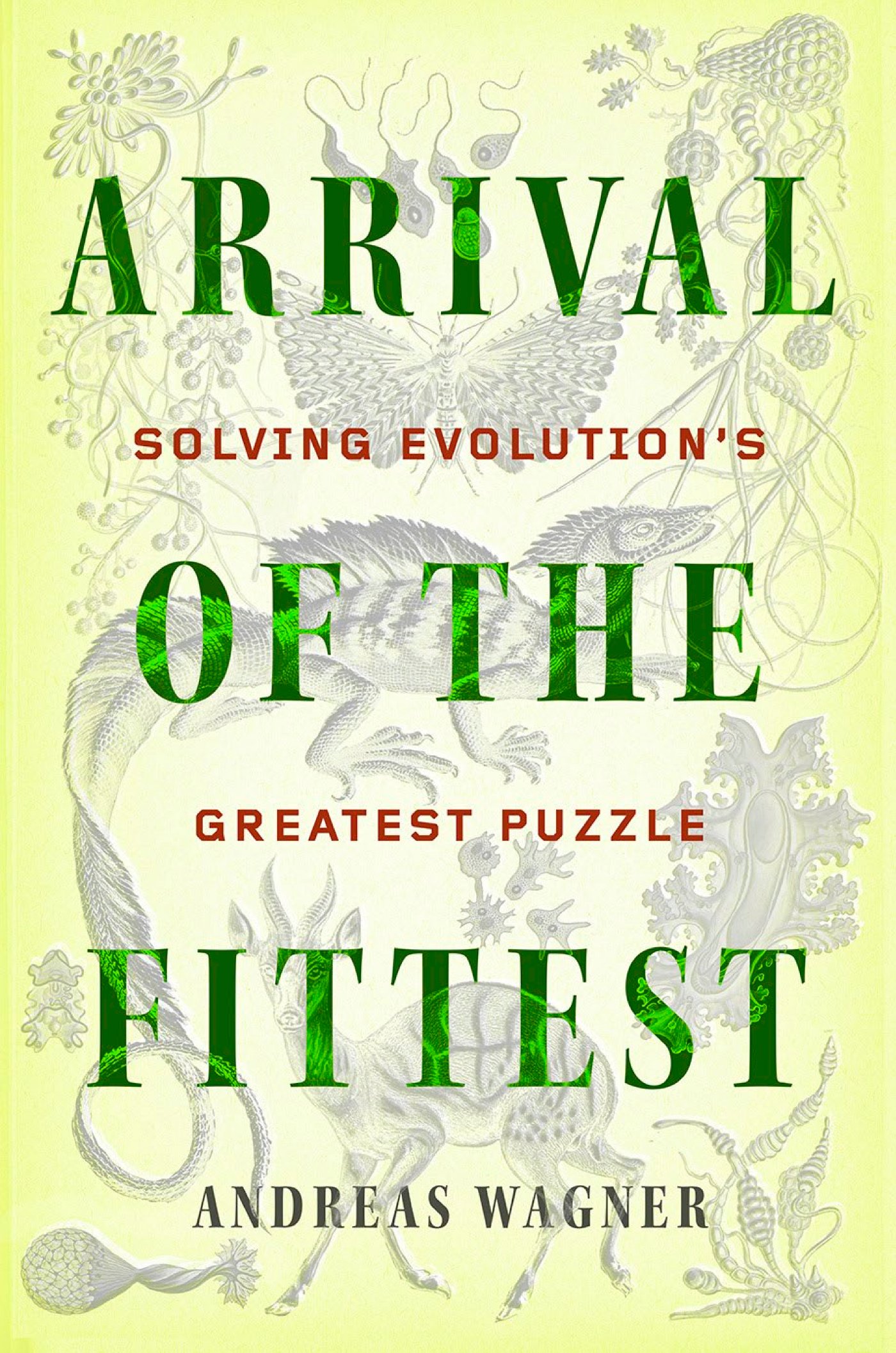
So claims a recent book, Arrival of the Fittest, by Andreas Wagner, professor of evolutionary biology at U Zurich in Switzerland (also associated with the Santa Fe Institute). He lectures worldwide and is a fellow of the American Association for the Advancement of Sciences.

From the book announcement:

Can random mutations over a mere 3.8 billion years solely be responsible for wings, eyeballs, knees, camouflage, lactose digestion, photosynthesis, and the rest of nature’s creative marvels? And if the answer is no, what is the mechanism that explains evolution’s speed and efficiency?

In Arrival of the Fittest, renowned evolutionary biologist Andreas Wagner draws on over fifteen years of research to present the missing piece in Darwin’s theory. Using experimental and computational technologies that were heretofore unimagined, he has found that adaptations are not just driven by chance, but by a set of laws that allow nature to discover new molecules and mechanisms in a fraction of the time that random variation would take.

From a review (which is careful to note that it is not a religious argument):

The question “how does nature innovate?” often elicits a succinct but unsatisfying response – random mutations. Andreas Wagner first illustrates why random mutations alone cannot be the cause of innovations – the search space for innovations, be it at the level of genes, protein, or metabolic reactions is too large that makes the probability of stumbling upon all the innovations needed to make a little fly (let alone humans) too low to have occurred within the time span the universe has been around.

He then shows some of the fundamental hidden principles that can actually make innovations possible for natural selection to then select and preserve those innovations.

Like interacting parallel worlds, this would be momentous news if it is true. But someone is going to have to read the book and assess the strength of the laws advanced.

One thing for sure, if an establishment figure can safely write this kind of thing, Darwin’s theory is coming under more serious fire than ever. But we knew, of course, when Nature published an article on the growing dissent within the ranks about Darwinism.

In origin of life research, there has long been a law vs. chance controversy. For example, Does nature just “naturally” produce life? vs. Maybe if we throw enough models at the origin of life… some of them will stick?

Note: You may have to apprise your old schoolmarm that Darwin’s theory* is “natural selection acting on random mutations,” not “evolution” in general. It is the only theory that claims sheer randomness can lead to creativity, in conflict with information theory. See also: Being as Communion.

*(or neo-Darwinism, or whatever you call what the Darwin-in-the-schools lobby is promoting or Evolution Sunday is celebrating).*

Follow UD News at Twitter!

Comments
DavidD, Do you know who Dembski is? Do you think he's a "Darwinist"?keith s
November 1, 2014
November
11
Nov
1
01
2014
02:42 AM
2
02
42
AM
PDT
keith s "It isn’t a conscious search. It’s a search in the mathematical sense, in which points are selected (via mutation) from a search space and their fitness is evaluated." I love reading religious "Faith Affirmation" quotesDavidD
November 1, 2014
November
11
Nov
1
01
2014
02:24 AM
2
02
24
AM
PDT
DavidD, It isn't a conscious search. It's a search in the mathematical sense, in which points are selected (via mutation) from a search space and their fitness is evaluated. Dembski understands this, even if you don't. His recent talk at the University of Chicago was titled "Conservation of Information in Evolutionary Search".keith s
November 1, 2014
November
11
Nov
1
01
2014
02:20 AM
2
02
20
AM
PDT
As you can see, the 'islands of function' argument is dead in the water, so to speak.keith s
November 1, 2014
November
11
Nov
1
01
2014
02:11 AM
2
02
11
AM
PDT
Thorton "Evolution doesn’t have to search the ginormous whole universe search space looking for innovations. All it does in each new generation is search the space immediately surrounding the existing working copy. If it finds a small improvement, it keeps it." Evolution is incapable of searching for anything, it's blind, undirected, unguided, unintelligent, etc, etc, etc reeeeemember ? Why is it that these religious Darwinist types keep sneaking in the concept of intelligence when their central religious dogma says it's unnecessary and actually forbids it's mention? Why the mention of intelligent creative concepts and then denying there is any such thing ? Why the lying for Darwin ? It's because evolution isn't about science. It never from the start has been, It's about promotion of yet another religious faith in a long line of faiths this planet has ever seen. The mismanagement of Earth's present and remaining natural resources prove they have no handle on the Science. They are truly Anti-Science.DavidD
November 1, 2014
November
11
Nov
1
01
2014
02:11 AM
2
02
11
AM
PDT
Also, you're relying on Axe's enzyme experiment, which is deeply flawed. Here's how I explained it to vjtorley:
As for Axe, there is a huge problem with his experiment. He takes two related but highly dissimilar enzymes and tries to determine how many nucleotides would have to change to get from the first enzyme’s function to the second’s. This is bogus, because no one claims that the second enzyme evolved from the first, or vice-versa. They are related, but that doesn’t mean that one evolved from the other. All it means is that they have a common ancestor. For Axe’s experiment to be successful, he would have needed to demonstrate that the two enzymes couldn’t have evolved from a common ancestor.
And:
today I thought of a good analogy for people who don’t understand the technical details: It’s as if Axe is arguing that you can’t drive from Milwaukee to Detroit, because if you draw a straight line between the two and follow it, you’ll run straight into Lake Michigan. (Axe’s argument is actually worse than that, but why flog a dead horse?)
keith s
November 1, 2014
November
11
Nov
1
01
2014
02:11 AM
2
02
11
AM
PDT
You also dodged my response to Allan Miller:
Allan Miller:
I’d add that the landscape is never static. The contours are perennially shifting as the environment changes (the environment, of course, being everything that impacts on gene persistence, not just the organism’s physical surroundings).
Let me expand on that for the benefit of our UD interlocutors. The fitness landscape faced by an organism can change a) as the physical surroundings change (e.g. climate change); b) as organisms move about their geographic ranges (e.g. a mountainside species experiencing different selective pressures at higher vs. lower elevations); c) as the species evolves (e.g. a subpopulation moving into a particular niche, pressuring others in the same species to exploit different niches); d) as other species evolve (e.g. predator-prey arms races); e) as the genome itself evolves (e.g. changes to one part of the genome altering the prospective fitness of changes to another part); f) as population sizes cycle (e.g. predator boom-bust cycles leading to the marvelous prime-number adaptation in cicada life cycles). So in addition to the other questionable or invalid assumptions made by the ‘islands of function’ folks, we need to add one more: the assumption that fitness landscapes are either static or that they change too little to allow populations to get unstranded. It’s a silly assumption, given all the ways in which fitness landscapes can change over time.
keith s
November 1, 2014
November
11
Nov
1
01
2014
02:05 AM
2
02
05
AM
PDT
KF asks:
Notice the dodge?
I did. You dodged my point about the many dimensions of the fitness landscape:
Let me start the ball rolling by noting that real-life fitness landscapes have many dimensions, not just the three implied by the ‘islands of function’ metaphor. To see why this is important, let’s start with a two-dimensional landscape and build from there. In a two-dimensional landscape, height still represents fitness, but horizontal motion is limited to one dimension — a line, rather than a plane. Motion is limited to two directions, right and left. In such a landscape, a peak is any point that has lower points on both sides. There may be higher peaks (or equivalently, ‘islands’) further along the line, but you would have to move through the adjacent lower points to get to them. It’s easy to see how evolution could get stuck on a local peak/island. Now consider a three-dimensional landscape. Height represents fitness, as always, but horizontal motion can now range over two dimensions instead of one. You no longer have to go through the low points. You can potentially go around them, and you have many, many choices of paths, not just two. A peak is no longer defined as having lower points to the right and the left. It has to have lower points in all directions. Thus peaks are more exceptional in three dimensional space than they are in two. The trend continues. Each time you add a dimension, you exponentially increase the number of potential paths through the landscape. It becomes harder and harder to find a true peak, because a peak has to be surrounded by lower points not only in each dimension, but in every possible combination of each of the dimensions. By limiting their thinking to three dimensions, IDers drastically overestimate the likelihood of getting stuck on a local peak. Their intuition fails them. Real fitness landscapes have hundreds or thousands of dimensions, and the likelihood of getting stuck on a peak diminishes exponentially as the number of dimensions increases.
keith s
November 1, 2014
November
11
Nov
1
01
2014
01:55 AM
1
01
55
AM
PDT
KF:
KS, all you have shown is that you are refusing to accept that the example of trying to deny that error exists automatically, necessarily creates an error, thus error MUST exist.
KF, The above is a logical argument in support of the claim that "error MUST exist". Logic is a function of our fallible human minds. If our minds are fallible, then our logic might be incorrect. If we can’t be absolutely certain that our logic is correct, then we can’t be absolutely certain of the conclusion of the argument. We can be quite certain that error exists, but we can't be absolutely certain of it. You claim to value logic. Logic demonstrates that absolutely certainty is unattainable (and yes, of course we cannot be absolutely certain of that.)You have persisted in this error for years, in the teeth of repeated correction. Please do better.keith s
November 1, 2014
November
11
Nov
1
01
2014
01:30 AM
1
01
30
AM
PDT
Excerpt from the book: Darwin’s theory was a bit like that first movie of a galloping horse, revolutionary when compared to still photography, but only a modest step on the path to full-length feature films... The single most important question about evolution, the question that Darwin and generations of scientists after him did not, could not touch: How does nature bring forth the new, the better, the superior? You might be puzzled. Wasn’t that exactly Darwin’s great achievement, to understand that life evolved and to explain how? The biggest mystery about evolution eluded his theory. And he couldn’t even get close to solving it.the bystander
November 1, 2014
November
11
Nov
1
01
2014
01:30 AM
1
01
30
AM
PDT
KF,
KS, As you know as I have stated in so many words, I have been exceptionally busy on policy matters for months [maybe it has not registered that there has been a change of govt here], with a current peak . . . as in there’s a new govt that has big challenges on its plate.
Then why not let the new government do its job? Why must you always try to insert yourself into its affairs? If they actually want your help, I'm sure they'll let you know. Let the government do its job, and then you'll have plenty of time to tackle The Bomb.keith s
November 1, 2014
November
11
Nov
1
01
2014
01:26 AM
1
01
26
AM
PDT
Keith S So we can't certain about our certainty of being uncertain?Andre
November 1, 2014
November
11
Nov
1
01
2014
01:21 AM
1
01
21
AM
PDT
KS, As you know as I have stated in so many words, I have been exceptionally busy on policy matters for months [maybe it has not registered that there has been a change of govt here], with a current peak . . . as in there's a new govt that has big challenges on its plate. Solow production functions, signatures of Kondratiev wave troughs in GDP data for the OECS region, sustainable structural transformation of economies through programme and project cycle management based strategic programmes, and the like. With a dose of capacity building and education system transformation as a side order. Not to mention Geothermal energy development and related renewables and alternatives, plus ports and town developments in the teeth of volcano ravages and long term consequences of policy errors. I have been brought to the point where I am now speaking about the project of tickling a dragon's tail, with particular reference to the challenges of investment to trigger and sustain growth with reasonable stability. It is only because I was noticing a problem here that I spoke for record and as you replied I engaged you step by step for a little while instead of what I should have done, go back to sleep. As far as I was able to glance at, your proposed bomb has failed and fizzled spectacularly, not like what would have happened if a brave scientist had not sacrificed his life to stop a chain reaction, taking the infamous blue flash and dying horribly of radiation nine days later. I am off to bed for some quick winks, and when I find reasonable time, I will look at what is reasonable to address. KFkairosfocus
November 1, 2014
November
11
Nov
1
01
2014
01:11 AM
1
01
11
AM
PDT
KS, all you have shown is that you are refusing to accept that the example of trying to deny that error exists automatically, necessarily creates an error, thus error MUST exist. To be uncertain in the teeth of that sort of case, shows only that there is intransigent resistance to reason and evidence at work here. KFkairosfocus
November 1, 2014
November
11
Nov
1
01
2014
01:00 AM
1
01
00
AM
PDT
KS: The post you link starts with a strawman:
Because the ID argument is a negative one
First, corrective arguments have their place, and second, the design inference is on what we know about the source of FSCO/I and is not a negative argument. Next, here is a key clip, strawman no 2:
What mysterious barrier do IDers think prevents microevolutionary change from accumulating until it becomes macroevolution? It’s the deep blue sea, metaphorically speaking. IDers contend that life occupies ‘islands of function’ separated by seas too broad to be bridged by evolution.
You don't get TO evolution until you first get to life as I pointed out in the darwinism challenge long since that has never been properly answered. So you are both making a strawman caricature here and already are begging the foundational question, origin of life in Darwin's pond or the like. Next:
For those who are familiar with fitness landscapes, a brief review. Imagine a three-dimensional landscape, similar to a terrestrial landscape. There are mountains and depressions, ridges and valleys, plains and plateaus. An organism occupies a particular spot on the landscape. Nearby spots represent organisms that are similar, but with slight changes. As you move further away from the spot, in any direction, the organisms represented become less and less like the original organism. Evolution can be visualized as a journey across such a landscape. Individual organisms don’t move, but their offspring may occupy different nearby spots on the landscape. So too for their offspring’s offspring, and so on. Thus successive generations trace out a path (or paths) on the fitness landscape as changes accumulate.
Notice the smuggled in continent of incremental development assumption? What is the independent basis for knowing that such exists apart from imposed a priori materialism that then presents the tree of life that embeds this as proof of it? Going on:
The idea, according to ID proponents, is that populations remain stranded on these islands of function. Some amount of microevolutionary change is possible, but only if it leaves you high and dry on the same island. Macroevolution is not possible, because that would require leaping from island to island, and evolution is incapable of such grand leaps. You’ll end up in the water. There is some truth to the ‘islands of function’ metaphor, but it also has some glaring shortcomings that ID proponents almost always overlook. I will mention some of the strengths and shortcomings in the comments, and I know that my fellow commenters will point out others.
Notice the dodge? We can fairly easily show that novel body plans will require genomes of incremental scope 10 - 100+ million bases, to account for new cell types, tissues, organs and associated regulatory networks etc, with the scope of exemplary multicellular animals etc pointing tot he upper end as more realistic. Even with a continent of beings, you would have to account for that much increment in organised functionally specific info, on realistic pops and timescales available. Mission impossible as is well known, 200 MY to fix a couple of muts on a line from chimp-like to human like comes to mind, and the pop vs changes for whales, hundreds to tens of thousands, is further notorious. So even if there were a continent of being, that would not answer the problem. But more tot he point, we re looking at the nature of FSCO/I, a LOT of complexly organised, specifically coupled parts to achieve function. Thus, acceptable configs are very tightly constrained, and will come in islands of function not continents. There is for example no smooth incremental path from See Spot Run or Hello World to a complex operating system or to War and Peace, or the like. Notoriously, major protein fold and function domains are deeply isolated and structurally unrelated in AA sequence space. The Hamming distance to be traversed to find the first island and onward to find others swamps the accessible atomic resources in our solar system or even the observed cosmos as a whole. Down in the comments you go on:
1. Axe claims that “Darwin’s engine moves in steps that can only reach points a tiny distance away from the prior point.” I suppose this depends on what he means by “tiny”, but the distances bridged by mechanisms such as frameshift mutations or recombination are arguably not tiny at all. 2. Axe claims that “further progress would require a still higher point to fall within reach once that move is made.” This is false. Evolution can also make moves that are neutral or even slightly deleterious. 3. Axe also fails to recognize a fact that we’ve been highlighting throughout this thread: The number of directions in which motion is possible increases exponentially with the number of dimensions in the fitness landscape. With so many directions to choose from, it is not surprising at all that evolution, operating across entire populations and long timespans, is able to find directions that lead to higher fitness.
Frame shifts are not going to get us to 10 - 100+ mn bases of further functional organisation involving novel proteins and families of fold-function. And the multidimensional scope is implicit in the WLOG use of strings to map co-ordinates in the relevant spaces. Hamming distance and extensions of that, are inherently multidimensional and underscore the point that depth of isolation hits home hard. It also highlights that large scope incremental changes within zones of function are also going to face huge challenges on pop size, generation spans and mut rates, which is the context of Axe's remarks. AM here adds little tot he point, but multiplies th cluds of misunderstanding that are likely indeed to obfuscate what should be plain:
He describes a kind of landscape that can exist – a static, rugged landscape, where populations can climb a smooth slope but cannot cross the many ‘downhill’ stretches due to the steepness of the slope leading into them. On empirical grounds, it bears little resemblance to the landscape that real DNA-organisms traverse. This landscape is ever-shifting. The environment – which includes every other gene in the genome, and every other evolving and migrating species in the ecosphere – changes continually. And ‘real’ fitness differentials tend to be rather small, rendering random drift a powerful force. Drift is much more ‘exploratory’ than NS, precisely because it is not anchored to peaks/islands. And most importantly, he completely forgets about recombination. This, if you could be bothered to write a GA and investigate the various parameters, provides a massive rate-change to ‘Darwin’s engine’, and brings points notionally ‘distant’ on a point-mutation scenario into very close contact.
Landscapes can play at being sand islands all they want, ever shifting and of variable geometry, that makes zero difference to isolation and the need to get to shores of function amidst seas of non-function. As for recombinations and sexual reproduction etc leaping seas form island to island, that is a flight of fantasy. We are talking 10 - 100+ million bases worth of innovation. A space of possibilities for 4^10 mn is like 8.19*10^6,020,599 possibilites, which so utterly swamps the possible search resources of the observable cosmos, 10^150 steps on an utterly generous scope of search of a search per atom for 10^80 atoms every 10^-45 s, that this is not reasonable. We could go on and on but the point is already adequately made. The search challenge is real, but has been strawmannised and dodged, not fairly faced. And the hoped for magic bullet links at TSZ fail. They only show how willful error mutually reinforces in the teeth of opportunity to correct. KFkairosfocus
November 1, 2014
November
11
Nov
1
01
2014
12:57 AM
12
12
57
AM
PDT
KF, We've been through this before. I think "error exists" is true, but I can't be absolutely certain of it, and neither can you. This is easy to see. The conclusion rests on a logical argument. Logic is a function of our fallible human minds. If we can't be absolutely certain that our logic is correct, then we can't be absolutely certain of the conclusion. P.S. I notice that you still haven't attempted to defuse my bomb. Why are you leaving the dangerous work to the other pro-ID commenters?keith s
November 1, 2014
November
11
Nov
1
01
2014
12:56 AM
12
12
56
AM
PDT
Excerpt from the book: LOL Here is an amazing experiment you can try at home. Put wheat in a container and seal the opening with dirty underwear. Wait twenty-one days, and mice will emerge. Not just newborn mice, but grown adult mice. At least that’s what the seventeenth-century physician and chemist Jan Baptista van Helmont reported.1 (He also revealed that scorpions would emerge from basil placed between two bricks and warmed by sunlight.) Van Helmont wasn’t the first to postulate the doctrine of spontaneous generation, which dates back at least to Aristotle, though he was among the last.the bystander
November 1, 2014
November
11
Nov
1
01
2014
12:33 AM
12
12
33
AM
PDT
KS, you have a choice, when you make an assertion that implies the world IS like X, that is an assertion of truth, claiming to know, or implying or assuming that objective or even absolute knowledge -- warranted true belief -- is impossible or unattainable is an absolute knowledge claim, so it is running into self referential incoherence. Where as a counter example I put it to you, that Error exists is undeniably, certainly and absolutely true, as just one instance. Like unto it, it is certainly and undeniably known to you that you are a conscious entity; leading to a world of implications that overturn all sorts of popular modernist and/or post-/ultra- modernist notions and worldview claims. And I think this is an example of basic logic troubles for many objectors tot he design inference that have gone all the way back to exchanges over first principles of right reason.kairosfocus
November 1, 2014
November
11
Nov
1
01
2014
12:29 AM
12
12
29
AM
PDT
KF, Your "islands of function" argument won't float: Things That IDers Don’t Understand, Part 2a – Evolution is not stranded on ‘islands of function’keith s
November 1, 2014
November
11
Nov
1
01
2014
12:27 AM
12
12
27
AM
PDT
PS: If you need a specific biological case in point of deeply isolated islands of function, try major clusters of proteins in AA space, where as GP has pointed out patiently here and at TSZ over and over for a very long time, the deep isolation of functional folds is notorious, with thousands of islands, about half of which have had to be in place from essentially OOL. PPS: Notice, the key concession a reviewer is making, as noted in the OP:
The question “how does nature innovate?” often elicits a succinct but unsatisfying response – random mutations. Andreas Wagner first illustrates why random mutations alone cannot be the cause of innovations – the search space for innovations, be it at the level of genes, protein, or metabolic reactions is too large that makes the probability of stumbling upon all the innovations needed to make a little fly (let alone humans) too low to have occurred within the time span the universe has been around.
That is the problem that Wagner is acknowledging and is not seeing that if there are laws of nature at work that inject huge quantities of info like that, then that points to fine tuning of the cosmos on steroids, implying design from the foundation of the cosmos, above and beyond the whole gamut of existing evidence of that. PPPS: Notice, K-S' inadvertent admission in comment no 2:
All it does in each new generation is search the space immediately surrounding the existing working copy. If it finds a small improvement, it keeps it.
So, either this is all about minor increments within islands of function (such as Finch beak oscillatory variations with drought/rainy weather cycles) or else there is a huge unwarranted assumption on a vast continent of functions from OOL up to us, traversible by an incremental tree of life. Exactly what there is no good reason to accept, starting from major protein fold and function domains.kairosfocus
November 1, 2014
November
11
Nov
1
01
2014
12:22 AM
12
12
22
AM
PDT
logically_speaking,
Are you absolutely certain about that??
Of course not. Slow down and think.keith s
November 1, 2014
November
11
Nov
1
01
2014
12:10 AM
12
12
10
AM
PDT
K-S, 49: While I have reason to doubt that you and your ilk will attend to a corrective point to the strawman tactic involved in the clip following, I will note for record on:
Evolution doesn’t have to search the ginormous whole universe search space looking for innovations. All it does in each new generation is search the space immediately surrounding the existing working copy. If it finds a small improvement, it keeps it.
1 --> First this pivots on refusing to address the root of the Darwinist tree of life, origin of life in Darwin's pond or the like where self replication is not available to you to start with and needs to be empirically justified. You cannot get to assuming a gated, encapsulated metabolic, code using, ribosome using,von Neumann self replicating life form you have to show how to get there. 2 : This puts design at the table from the outset. 3 : Next, as you full well know or should know [AYFWKoSK], the nature of FSCO/I is that it naturally comes in deeply isolated islands of function (this term has been used as a metaphor for probably over a decade). This is because you need many, correct, correctly coupled and organised parts to achieve specific relevant function. And soon, a bit of noise perturbation leads to disorganisation and/or gibberish, thus off into the vast sea of non-function with no handy hill gradient from differential function – aka fitness function – to help point you neatly uphill. (I won't bother to address the evidence that real fitness functions seem to be extraordinarily rough and ill-behaved for hill climbing.) 4: Now, a look at the clip shows the focus on incrementalism, which requires that the topology of functional life forms is a vast continent of incrementally sloping improvements from FUCA or LUCA to us and the dozens of major body plan forms on the branches. 5: Where is the actually observed evidence for that? Nowhere, this is an assumption imposed by the back door, and implicitly demanded by a priori imposed evolutionary materialism. 6: Yes, we are perfectly happy to grant incremental improvements within islands of function, but that was never the issue, that was to FIND islands of function on a drastically limited search resource relative to search space, given even a toy case like using the 10^57 atoms of our solar system as observers of new tries every 10^-14 s for 10^17 s. The result is, that we have a needle sized blind search of a config space comparable to a cubical yardstick as thick as our galaxy's central bulge. 7: So, following the TSZ et al partyline dismissal argument regarding FSCO/I involves willfully substituting a strawman caricature for the real issue, finding islands of function in vast config spaces. 8: Which pivotal issue has been patiently, exhaustively, pointed out and explained in one way or another over and over and over for as far back as WmAD in NFL. AYFWKoSK. 9: The interested onlooker is invited to read here, as just a fairly recent explanation of this. If he reads here on in context he can see a 101 that has been on the table for years, but of course has been studiously ignored. 10: Let me clip just the first of these, DDD no 8, on the all too predictable incrementalism talking point:
But, it will be typically objected, we only need to make incremental changes to cumulatively climb the hill of fitness! In fact the challenge as shown [there is an infographic] dominates, one needs to first find the islands of function in the relevant config space, without oracles telling you warmer/colder, as there is no functional feedback until one is actually within such an island as T. Where also, the requirement of multiple, well-matched, properly arranged and coupled component parts to achieve function . . . will confine one to relatively tiny fractions of the space of possible configurations [--> that is, to islands of function deeply isolated in the space of possibilities, to achieve relevant function] . . . . In the case of a solar system scale search, we have some 10^57 atoms, interacting across 10^17 s, with an upper reasonable rate of 10^14 interactions per second. If we were to give each such atom a tray of 500 ordinary H/T coins and if they were flipped and “read” every 10^-14 s, we would be able to sample only a small, almost infinitesimal fraction of the space of possibilities of 500 coins. A picture of the challenge would be that if the samples were comparable in scope to a straw, the config space would be a cubical haystack 1,000 Light years across . . .
. . . likewise, to show how there is no excuse, here is Dembski in NFL, at the turn of the 2,000s:
p. 148: “The great myth of contemporary evolutionary biology is that the information needed to explain complex biological structures can be purchased without intelligence. My aim throughout this book is to dispel that myth . . . . Eigen and his colleagues must have something else in mind besides information simpliciter when they describe the origin of information as the central problem of biology. I submit that what they have in mind is specified complexity [ --> cf. here], or what equivalently we have been calling in this Chapter Complex Specified information or CSI . . . . Biological specification always refers to function . . . In virtue of their function [[a living organism's subsystems] embody patterns that are objectively given and can be identified independently of the systems that embody them. Hence these systems are specified in the sense required by the complexity-specificity criterion . . . the specification can be cashed out in any number of ways [[through observing the requisites of functional organisation within the cell, or in organs and tissues or at the level of the organism as a whole] . . .” p. 144: [[Specified complexity can be defined:] “. . . since a universal probability bound of 1 [[chance] in 10^150 corresponds to a universal complexity bound of 500 bits of information, [[the cluster] (T, E) constitutes CSI because T [[ effectively the target hot zone in the field of possibilities] subsumes E [[ effectively the observed event from that field], T is detachable from E, and and T measures at least 500 bits of information . . . ” [--> in short, the whole context is deeply isolated zones T which in biology are specified on function, which then confront the scope of resources available with a supertask to search, leading to the needle in haystack challenge to find islands of function]
. . . I then went on to note:
In short, to be meaningful or functional, a correct set of core components have to match and must be properly arranged, and while there may be some room to vary, it is not true that just any part popped in in any number of ways can fit in. The flow-through unidirectional flow lungs we commonly see in birds provide a biological example of this effect (and of the implied challenges to incremental evolution based on small random changes that must provide functional advantages in ecological niches in order to be fixed in a viable population). In these animals, two sets of inflatable sacs are used to pump and pull air through the lungs, which is different from the more familiar bellows type lung such as we have. As Michael Denton observed in his epochal 1985 Evolution, a Theory in Crisis:
[[T]he structure of the lung in birds and the overall functioning of the respiratory system is quite unique. No lung in any other vertebrate species is known which in any way approaches the avian system. Moreover, it is identical in all essential details in birds as diverse as humming birds, ostriches and hawks . . . . Just how such an utterly different respiratory system could have evolved gradually from the standard vertebrate design is fantastically difficult to envisage, especially bearing in mind that the maintenance of respiratory function is absolutely vital to the life of an organism to the extent that the slightest malfunction leads to death within minutes. Just as the feather cannot function as an organ of flight until the hooks and barbules are coadapted to fit together perfectly, so the avian lung cannot function as an organ of respiration until the parabronchi system which permeates it and the air sac system which guarantees the parabronchi their air supply are both highly developed and able to function together in a perfectly integrated manner . . . [[Evolution, a Theory in Crisis, 1985, pp. 210 - 12.]
In short, we see here a case of an island of irreducibly complex function, on an organ that is literally vital, and that irreducible complexity would arguably block incremental evolution: intermediates between a bellows lung and a bird's flow-through lung, would be most likely lethally defective -- and would at the very least be arguably dis-advantageous -- and so would be selected against by the very same natural selection that is so often appealed to. For, without the right components -- properly arranged and integrated and with the nervous control system and integrated blood circulatory system and muscular systems -- the bird would most likely die within minutes. In short, the way functionally specific complex organisation leads to islands of function in wider configuration spaces is highly relevant to major biological systems, not just technological ones. [--> BTW, while this is a case of IC as well, the FSCO/I argument does NOT rely on IC in general. They happen to frequently come together.] As a direct result, in our general experience, and observation, if the functional result is complex and specific enough, the most likely cause is intelligent choice, or design. This has a consequence. For, this need for choosing and correctly arranging then hooking up correct, matching parts in a specific pattern implicitly rules out the vast majority of possibilities and leads to the concept of islands of function in a vast sea of possible but meaningless and/or non-functional configurations. And, arguably to design -- the commonly observed cause of FSCO/I -- as the best explanation for such cases. So also, if you would dispute the point that such islands of function dependent on specific clusters of combinations of particular parts exist in seas of non-function, as a typical and even reliably observable pattern, it is necessary to support that claim by observed example. That is, show a case where by blind chance and equally blind mechanical necessity, complex functional organisation emerges from non-functional arrangements, and grows in complexity and degree of successful operation from one step to the next; with particular reference to the rise of new major body plans in life forms. Variations and adaptations within existing body plans do not answer to this. That is, the challenge is to get to shorelines of islands of function in seas of non-function, or else to show that here is a vast continent of function that can be incrementally accessed through a branching tree of life. On fair comment, despite the various lines of evidence and the many headlined icons of evolution that are put forth to make Darwinian evolutionary mechanisms seem plausible, this challenge has not been met after over 150 years of trying. Consequently, it is equally fair comment to observe that such functionally specific, complex organisation and associated information have only one empirically observed, adequate cause: purposeful, intelligently directed configuration, i.e. design. Therefore, design theorists argue that the world of life points on such empirically reliable signs to design as a key causal factor in the origins of life as we see and experience it. But, in turn, that has to be shown, not simply asserted . . .
. . . all there a few known clicks away for years. 11: There are many, many examples of the same basic correction going back across years, just they have all been willfully ignored. So, it is plain that considering the penumbra of objectors and their sites as a whole, we are dealing with deliberately and insistently maintained strawman tactic DDD stuff, not a serious and cogent argument. 12: Which inadvertently implies that he design inference on FSCO/I is quite strongly warranted, if to reject it, objectors are forced to first strawmannise it. KFkairosfocus
November 1, 2014
November
11
Nov
1
01
2014
12:06 AM
12
12
06
AM
PDT
Keith S, "The fact that we can’t be absolutely certain does not mean that our thoughts can’t be trusted. It only means that they can’t be trusted absolutely". Are you absolutely certain about that??logically_speaking
October 31, 2014
October
10
Oct
31
31
2014
11:30 PM
11
11
30
PM
PDT
wd400, Ok, so we have established that you side with Keiths, and disagree with Thorton that Wagner is a crackpot who introduced a new law of nature. Ok, we got that. Thorton is the crackpot. Now, since you don't think that Wagner is introducing anything new, and that we have know for a while that random mutations can not account for all the diversity we see in life, What is the definition of the Theory of Evolution?phoodoo
October 31, 2014
October
10
Oct
31
31
2014
11:16 PM
11
11
16
PM
PDT
And if you are still struggling to understand I'll give it to you in plain English Don't shit where you eat.Andre
October 31, 2014
October
10
Oct
31
31
2014
11:16 PM
11
11
16
PM
PDT
Thornton, You broke the truce by insulting Denyse. Don't call me a liar your comment is there its not gone and available for all to see, it is clear that your materialist tendencies have rend red you incapable of displaying any good manners.Andre
October 31, 2014
October
10
Oct
31
31
2014
11:13 PM
11
11
13
PM
PDT
Thornton Should you not be wholly immersed with your own blessid moral development so that you can lead a good life? Why worry about ours?Andre
October 31, 2014
October
10
Oct
31
31
2014
11:11 PM
11
11
11
PM
PDT
Andre
Thornton You insulted Denyse, for that good riddance……
So much for the truce. Less than one day and Andre goes right back to his lies and insults. I guess it's true a leopard can't change his spots or a skunk his stink. Enjoy your incestual group-grope with your buddies while the scientific world laughs and passes you by. Don't forget that inbreeding produces idiots.Thorton
October 31, 2014
October
10
Oct
31
31
2014
11:08 PM
11
11
08
PM
PDT
But Thornton why do you comment here at all? If we are deluded why are you trying to convert us? In the greater scheme of things what does it matter? Universe come and go, galaxies come and go solar systems come and go plainest come and go and life come and go. What are you trying to save us from I it really does not matter?Andre
October 31, 2014
October
10
Oct
31
31
2014
11:06 PM
11
11
06
PM
PDT
Why is Thorton so stupid? That's what I want to know.Mapou
October 31, 2014
October
10
Oct
31
31
2014
11:04 PM
11
11
04
PM
PDT
1 18 19 20 21 22 24

Leave a Reply