Uncommon Descent Serving The Intelligent Design Community

Coffee!! Flying reptile egg soon to be major movie

Adult pteranodon fossils from Royal Ontario Museum. Courtesy  Kenn Chaplin from Toronto Jonathan Amos reports at BBC News (20 January 2011) on a “Fossil female pterosaur found with preserved egg“. Wonderful news, and note this: The egg indicates this ancient flying reptile was a female, and that realisation has allowed researchers to sex these creatures for the first time. Writing in Science magazine, the palaeontologists make some broad statements about differences in pterosaurs, including the observation that only males sported a head-crest. “Broad” statements indeed, about the head-crest. They couldn’t really be sure unless they could sex a flock, and there’s a risk of being led off course. The state of the egg’s shell suggests it was well developed and Read More ›

The 4% solution: The ultimate Copernican revolution is “We’re different”?

In “The challenge of the great cosmic unknowns” ( New Scientist 24 January 2011), Dan Falk reviews Richard Panek’s The 4% Universe: Dark matter, dark energy, and the race to discover the rest of reality: As he nears the present day, Panek weaves together two separate yet closely related storylines. In the first, he takes us to sophisticated laboratories around the world where researchers are trying to isolate particles of dark matter. Their best guess is that dark matter is made of WIMPs (weakly interacting massive particles), which were created at the time of the big bang and are now fiendishly difficult to detect. In the second storyline, we join the hunt for dark energy, which began in the late Read More ›

300px-AmineTreating

ID Foundations, 3: Irreducible Complexity as concept, as fact, as [macro-]evolution obstacle, and as a sign of design

[ID Found’ns Series, cf. also Bartlett here]

Irreducible complexity is probably the most violently objected to foundation stone of Intelligent Design theory. So, let us first of all define it by slightly modifying Dr Michael Behe’s original statement in his 1996 Darwin’s Black Box [DBB]:

What type of biological system could not be formed by “numerous successive, slight modifications?” Well, for starters, a system that is irreducibly complex. By irreducibly complex I mean a single system composed of several well-matched interacting parts that contribute to the basic function, wherein the removal of any one of the [core] parts causes the system to effectively cease functioning. [DBB, p. 39, emphases and parenthesis added. Cf. expository remarks in comment 15 below.]

Behe proposed this definition in response to the following challenge by Darwin in Origin of Species:

If it could be demonstrated that any complex organ existed, which could not possibly have been formed by numerous, successive, slight modifications, my theory would absolutely break down. But I can find out no such case . . . . We should be extremely cautious in concluding that an organ could not have been formed by transitional gradations of some kind. [Origin, 6th edn, 1872, Ch VI: “Difficulties of the Theory.”]

In fact, there is a bit of question-begging by deck-stacking in Darwin’s statement: we are dealing with empirical matters, and one does not have a right to impose in effect outright logical/physical impossibility — “could not possibly have been formed” — as a criterion of test.

If, one is making a positive scientific assertion that complex organs exist and were credibly formed by gradualistic, undirected change through chance mutations and differential reproductive success through natural selection and similar mechanisms, one has a duty to provide decisive positive evidence of that capacity. Behe’s onward claim is then quite relevant: for dozens of key cases, no credible macro-evolutionary pathway (especially no detailed biochemical and genetic pathway) has been empirically demonstrated and published in the relevant professional literature. That was true in 1996, and despite several attempts to dismiss key cases such as the bacterial flagellum [which is illustrated at the top of this blog page] or the relevant part of the blood clotting cascade [hint: picking the part of the cascade — that before the “fork” that Behe did not address as the IC core is a strawman fallacy], it arguably still remains to today.

Now, we can immediately lay the issue of the fact of irreducible complexity as a real-world phenomenon to rest.

For, a situation where core, well-matched, and co-ordinated parts of a system are each necessary for and jointly sufficient to effect the relevant function is a commonplace fact of life. One that is familiar from all manner of engineered systems; such as, the classic double-acting steam engine:
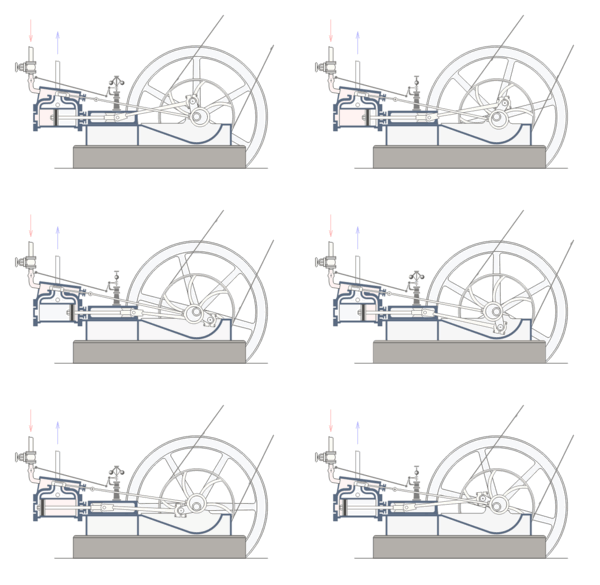
Fig. A: A double-acting steam engine (Courtesy Wikipedia)

Such a steam engine is made up of rather commonly available components: cylinders, tubes, rods, pipes, crankshafts, disks, fasteners, pins, wheels, drive-belts, valves etc. But, because a core set of well-matched parts has to be carefully organised according to a complex “wiring diagram,” the specific function of the double-acting  steam engine is not explained by the mere existence of the parts.

Nor, can simply choosing and re-arranging similar parts from say a bicycle or an old-fashioned car or the like create a viable steam engine.  Specific mutually matching parts [matched to thousandths of an inch usually], in a very specific pattern of organisation, made of specific materials, have to be in place, and they have to be integrated into the right context [e.g. a boiler or other source providing steam at the right temperature and pressure], for it to work.

If one core part breaks down or is removed — e.g. piston, cylinder, valve, crank shaft, etc., core function obviously ceases.

Irreducible complexity is not only a concept but a fact.

But, why is it said that irreducible complexity is a barrier to Darwinian-style [macro-]evolution and a credible sign of design in biological systems?

Read More ›

Finally starting to drag the carcass of Darwinism off the scene?

I’ve long suspected that the carcass of Darwinism is finally getting dragged off the scene, and with any luck, the career atheists and the Christian Darwinists will be fighting over it full time, with few onlookers, and Templeton funding the whack. Have a look at this roundup of abstracts a friend sent me:

Forthcoming articles about Darwinism in Studies in History and Philosophy of Science Part C: Studies in History and Philosophy of Biological and Biomedical Sciences:

1. The Mastodon in the room: how Darwinian is neo-Darwinism?

Daniel R. Brooks

Abstract Failing to acknowledge substantial differences between Darwinism and neo-Darwinism impedes evolutionary biology. Darwin described evolution as the outcome of interactions between the nature of the organism and the nature of the conditions, each relatively autonomous but both historically and spatially intertwined. Furthermore, he postulated that the nature of the organism was more important than the nature of the conditions, leading to natural selection as an inevitable emergent product of biological systems. The neo-Darwinian tradition assumed a creative rather than selective view of natural selection, with the nature of the organism determined by the nature of the conditions, rendering the nature of the organism and temporal contingency unnecessary. Contemporary advances in biology, specifically the phylogenetics revolution and evo-devo, underscore the significance of history and the nature of the organism in biology. Darwinism explains more bio logy better, and better resolves apparent anomalies between living systems and more general natural laws, than does neo-Darwinism. The “extended” or “expanded” synthesis currently called for by neo-Darwinians is Darwinism.

Hmmm. No idea what he is talking about except that the “neo-Darwinians” (now the bad guys) made the mistake of assuming “a creative rather than selective view of natural selection”. In other words, they thought natural selection could create information and it can’t.

So, when the debts are called … Darwinism couldn’t create a small part of the hind end of a flea?

2. What was really synthesized during the evolutionary synthesis? a historiographic proposal

Richard G. Delisle

Abstract The 1920-1960 period saw the creation of the conditions for a unification of disciplines in the area of evolutionary biology under a limited number of theoretical prescriptions: the evolutionary synthesis. Whereas the sociological dimension of this synthesis was fairly successful, it was surprisingly loose when it came to the interpretation of the evolutionary mechanisms per se, and completely lacking at the level of the foundational epistemological and metaphysical commitments. Key figures such as Huxley, Simpson, Dobzhansky, and Rensch only paid lip service to the conceptual dimension of the evolutionary synthesis, as they eventually realized that a number of evolutionary phenomena could not be explained by its narrow theoretical corpus. Apparently, the evolutionary synthesis constituted a premature event in the development of evolutionary biology. Not only are the real achievements of the evolutionary synthesis in need of reevaluation, but this reassessment also has important implications for the historiography of Darwinism and the current debates about the darwinian movement.

So there isn’t really a grand synthesis that was supposed to shut up all critics already. Figures. The only synthesis I ever heard of was, “We all agree to keep our jobs fronting this nonsense. After all, the pop science press are all on our side, and everyone else is scared shiftless.”
Read More ›

Information and Energy

Today’s PhysOrg.com site contains this article. To my view, their investigation has important implications for ID. Many critics of ID ask us: “Well, how does your Designer design?” This is their way of saying to us that a Designer who lies outside the physical realm cannot possibly act within it. Of course, this amounts to a theological claim, and not a scientific one; nevertheless, it’s made. What’s new here, though, is that, whereas formerly it was thought that energy was needed to “erase” information (which leaves its own physical residue–that is, it’s measurable), now this is no longer the case. However, if it is true that energy is not needed to “erase” information, contrariwise, wouldn’t it also be true that Read More ›

A (Perhaps) Scientific Revolution, Brewing Among Young Scientists

This short essay was inspired by Denyse here. She appears to have an inspirational effect on me. Older scientists are still stuck in the past. Richard Dawkins is a prime example, although I don’t consider him to be a “scientist” who has demonstrated any devotion to legitimate scientific rigor throughout his career. He is essentially nothing more than a relatively eloquent storyteller with a very creative imagination, who has no experience in the real world with designing or engineering anything that can be demonstrated to actually work. With the discovery of the fine-tuning of the laws of physics for life, and the discovery that living systems are fundamentally based on the most sophisticated nano-technological, information-processing system ever devised, the Darwinian Read More ›

“It’s in your genes” theory fading in the wake of epigenetics?

In “Getting Over the Code Delusion” (The New Atlantis, Summer 2010), Steve Talbott muses on the mystique around the genetic code in past decades, especially in the light of modern findings: Meanwhile, the epigenetic revolution is slowly but surely making its way into the popular media — witness the recent Time magazine cover story, “Why DNA Isn’t Your Destiny.” The shame of it is that most of the significance of the current research is still being missed. Judging from much that is being written, one might think the main thing is simply that we’re gaining new, more complex insights into how to treat the living organism as a manipulable machine.The one decisive lesson I think we can draw from the work Read More ›

Younger scientists more religious than older ones?

At  Christian thinkmag CARDUS, we learn, via Point of view author Milton Friesen (January 21, 2011), “What scientists believe.” Some interesting observations emerge from his review of Elaine Ecklund,’s, Science vs. Religion: What Scientists Really Think: Younger scientists are more religious than older scientists—the inverse of the general population, where older people tend to be more religious than younger people. [ … ] There is indeed a very real clash of cultures born of different ideas, different ideologies, and different practices. While these variances are deep and persistent, Ecklund argues that the tone and nature of the exchange must change. Scientists need to understand far more about how people experience and practice religion and spirituality. They need to be much more Read More ›

The Enduring Warfare Theses

Though historians tell us that the warfare thesis—the idea that the relationship between science and religion has been mostly one of conflict—is discredited, there seems to be a great many who have not yet learned of its demise. Not only is the warfare thesis alive and well in popular culture, it is also promoted by those who probably should know better. In fact in the origins debate each side has its own version. Why is the warfare thesis so enduring? One reason is that, like any good lie, there is some truth to it. Probably a better reason is its rhetorical power. But perhaps the main reason is that we need it—our religion demands it.  Read more

We hold these truths to be self-evident…

Can you spot the common theme in these historic statements?

“We hold these truths to be self-evident, that all men are created equal, that they are endowed by their Creator with certain unalienable Rights, that among these are Life, Liberty and the pursuit of Happiness.” – Excerpt from the American Declaration of Independence, which was ratified on July 4, 1776.

Men are born and remain free and equal in rights. Social distinctions may be founded only upon the general good.” – Declaration of the Rights of Man and of the Citizen (1789), article 1. The Declaration was approved by the National Constituent Assembly of France, on August 26, 1789.

“Four score and seven years ago our fathers brought forth on this continent a new nation, conceived in liberty and dedicated to the proposition that all men are created equal.” – Excerpt from President Lincoln’s Gettysburg Address, delivered on November 19, 1863.

All human beings are born free and equal in dignity and rights. They are endowed with reason and conscience and should act towards one another in a spirit of brotherhood.” – Universal Declaration of Human Rights (1948), article 1. The Declaration was adopted by the United Nations General Assembly on 10 December 1948 at the Palais de Chaillot, Paris.

“I have a dream that one day this nation will rise up and live out the true meaning of its creed: ‘We hold these truths to be self-evident: that all men are created equal.‘”- Excerpt from the famous ‘I Have a Dream’ speech by Martin Luther King, Jr., delivered on 28 August 1963, at the Lincoln Memorial, Washington D.C.

(Emphases mine – VJT.)

Belief in human equality is a vital part of our democratic heritage. Take this belief away, and the moral foundations of Western civilization immediately collapse, like a house of cards.

Atheists divided

Sad to say, many (perhaps most) of the world’s 25 most influential living atheists don’t seem to share this belief. Specifically, many of these atheists don’t believe that newborn babies have the same moral worth as human adults.
Read More ›

ds_cyb_mind_model
The Eng Derek Smith Cybernetic Model

ID Foundations, 2: Counterflow, open systems, FSCO/I and self-moved agents in action

In two recent UD threads, frequent commenter AI Guy, an Artificial Intelligence researcher, has thrown down the gauntlet:

Winds of Change, 76:

By “counterflow” I assume you mean contra-causal effects, and so by “agency” it appears you mean libertarian free will. That’s fine and dandy, but it is not an assertion that can be empirically tested, at least at the present time.

If you meant something else by these terms please tell me, along with some suggestion as to how we might decide if such a thing exists or not. [Emphases added]

ID Does Not Posit Supernatural Causes, 35:

Finally there is an ID proponent willing to admit that ID cannot assume libertarian free will and still claim status as an empirically-based endeavor. [Emphasis added] This is real progress!

Now for the rest of the problem: ID still claims that “intelligent agents” leave tell-tale signs (viz FSCI), even if these signs are produced by fundamentally (ontologically) the same sorts of causes at work in all phenomena . . . . since ID no longer defines “intelligent agency” as that which is fundamentally distinct from chance + necessity, how does it define it? It can’t simply use the functional definition of that which produces FSCI, because that would obviously render ID’s hypothesis (that the FSCI in living things was created by an intelligent agent) completely tautological. [Emphases original. NB: ID blogger Barry Arrington, had simply said: “I am going to make a bold assumption for the sake of argument. Let us assume for the sake of argument that intelligent agents do NOT have free will . . . ” (Emphases added.)]

This challenge brings to a sharp focus the foundational  issue of counter-flow, constructive work by designing, self-moved initiating, purposing agents as a key concept and explanatory term in the theory of intelligent design. For instance, we may see from leading ID researcher, William Dembski’s No Free Lunch:

. . .[From commonplace experience and observation, we may see that:]  (1) A designer conceives a purpose. (2) To accomplish that purpose, the designer forms a plan. (3) To execute the plan, the designer specifies building materials and assembly instructions. (4) Finally, the designer or some surrogate applies the assembly instructions to the building materials. (No Free Lunch, p. xi. HT: ENV.) [Emphases and explanatory parenthesis added.]

This is of course, directly based on and aptly summarises our routine experience and observation of designers in action.

For, designers routinely purpose, plan and carry out constructive work directly or though surrogates (which may be other agents, or automated, programmed machines). Such work often produces functionally specific, complex  organisation and associated information [FSCO/I;  a new descriptive abbreviation that brings the organised components and the link to FSCI (as was highlighted by Wicken in 1979)  into central focus].

ID thinkers argue, in turn, that that FSCO/I in turn is an empirically reliable sign pointing to intentionally and intelligently directed configuration — i.e. design — as signified cause.

And, many such thinkers further argue that:

if, P: one is not sufficiently free in thought and action to sometimes actually and truly decide by reason and responsibility (as opposed to: simply playing out the subtle programming of blind chance and necessity mediated through nature, nurture and manipulative indoctrination)

then, Q: the whole project of rational investigation of our world based on observed evidence and reason — i.e. science (including AI) — collapses in self-referential absurdity.

But, we now need to show that . . .

Read More ›

Robert Marks interviewed by Tom Woodward

Tom Woodward, author of DOUBTS ABOUT DARWIN and DARWIN STRIKES BACK, interviewed Robert J. Marks about his work at the Evolutionary Informatics Lab. For the podcast, go here: “Darwin or Design?” (program starts at 5:08 | actual interview starts at 7:52)

Women science bloggers: Some thoughts

Robin Lloyd explains in “Woman science bloggers discuss pros and cons of online exposure” (Jan 18, 2011),

Blogging and other Web activities have allowed members of many marginalized communities to open previously locked media doors. But women still rely more on back channels and ask for less help than men do in the digital realm. This tendency and other issues of concern for women bloggers were discussed Sunday at the ScienceOnline2011 conference in Durham, N.C., primarily in a session called “Perils of blogging as a woman under a real name.”

Huh?

Experiences varied among attendees on whether blogging under a real name did indeed present perils. Miriam Goldstein (@oystersgarter), a doctoral student at the Scripps Institution of Oceanography and blogger at Deep-Sea News says she has never had a negative experience. But stories surfaced regarding inappropriate comments by male readers. And one attendee voiced concerns about being emailed by a reader who said he was near her campus and about to stop by her office. Christie Wilcox (@NerdyChristie), a doctoral student at the University of Hawaii-Manoa who blogs at Observations of Nerd, said she only received nasty comments when she blogged on the science of make-up—and the anger came from women. Tribalism takes many forms.

Well, if you have dealt with minor Darwinists, as I have, and are not one of their companions, you get to hear how some of them talk about women. But God or nature or the guardian angel of marriages – or somebody or other anyway – invented a back browser button and a delete key.

I guess the big time Darwinists approve of all that stuff. I’ve never heard of them telling those dudes to smarten up, or slide their keesters to the low class boozehole down the road. I once had a problem with a guy who professed support for ID who behaved like that, but I heard vaguely that he had his can kicked six ways to Sunday over it. Nothing to do with me.

Actually, we had a problem with Darwinmouth here in Canada, but Read More ›

Epigenome: Better find a new use for that pocket CD of your genome

Remember when, as sociologist Dorothy Nelkin tells it,

The language used by geneticists to describe the genes is permeated with biblical imagery. Geneticists call the genome the “Bible,” the “Book of Man”and the “Holy Grail.” They convey an image of this molecular structure as more than a powerful biological entity: it is also a mystical force that defines the natural and moral order. And they project an idea of genetic essentialism, suggesting that by deciphering and decoding the molecular text they will be able to reconstruct the essence of human beings, unlock the key to human nature. As geneticist Walter Gilbert put it, understanding our genetic composition is the ultimate answer to the commandment “know thyself.” Gilbert introduces his lectures on gene sequencing by pulling a compact disk from his pocket and announcing to his audience, “This is you.”*

At ScienceDaily (Jan. 14, 2011), we learn that after the complete draft of the human genome was released in 2003, of the growing focus on is on the epigenome:

Whereas the genome is the same in every cell of an organism, the epigenome of every cell type is different. It is because of the epigenome that a liver cell is not a brain cell is not a bone cell.

From the genome, we learned? …

“We learned many things from the Human Genome Project,” Elgin says, “but of course it didn’t answer every question we had!

“Including one of the oldest: We all start life as a single cell. That cell divides into many cells, each of which carries the same DNA. So why are we poor, bare, forked creatures, as Shakespeare put it, instead of ever-expanding balls of identical cells?

“This [epigenome] work,” says Elgin, “will help us learn the answer to this question and to many others. It will help us to put meat on the bones of the DNA sequences.”

You, know, it almost makes one go all religious and say: Re the “Bible,” the “Book of Man”and the “Holy Grail,” worship the creator not the creation. And recycle your CDs. Read More ›